[ENG] Audience reactions such as “Oh, doom is coming” reveal the emotional weight of eco-anxiety and highlight the need for approaches that go beyond fear. During the first year of understanding eco-anxiety, I explored how eco-anxiety manifests in daily life and how it shapes collective processes within a developing neighbourhood. I also explored how integrating qualitative audience research with artistic research can deepen our understanding of eco-anxiety and contribute to the development of artistic coding as a method. The artistic interventions: 1. The Birds, 2. Bring Back the Birds, 3. Omgaan met Water, 4. Stay Safe in the Media Atmospheres, 5. Artist Residency Oba Next Sluisbuurt, 6. Kunstenaarskennis and 7. Participatiewensen, combined with conceptual reflections of them, demonstrated that understanding eco-anxiety involves questioning, prompting and exploring the affect and emotions that emerge in relation to eco-anxiety. [NL] Publieksreacties over doem en verderf laten het emotionele gewicht van klimaatangst zien en benadrukken de noodzaak van benaderingen die verder gaan dan angst alleen. Tijdens het eerste jaar van het onderzoek naar klimaatangst verkende ik hoe klimaatangst zich manifesteert in het dagelijks leven en hoe het collectieve processen vormgeeft binnen een zich ontwikkelende buurt. Ook onderzocht ik hoe het integreren van kwalitatief publieksonderzoek met artistiek onderzoek ons begrip van klimaatangst kan verdiepen en kan bijdragen aan de ontwikkeling van artistieke codering als methode. De artistieke interventies: 1. The Birds, 2. Bring Back the Birds, 3. Omgaan met Water, 4. Stay Safe in the Media Atmospheres, 5. Artist Residency Oba Next Sluisbuurt, 6. Kunstenaarskennis en 7. Participatiewensen, gecombineerd met conceptuele reflecties daarop, toonden aan dat het begrijpen van klimaatangst inhoudt dat we het affect en de emoties die in relatie tot klimaatangst ontstaan, bevragen, activeren en verkennen.
MULTIFILE
Titel: The Exodus from the Netherlands or Brain Circulation: Push and Pull Factors of Remigration among Highly Educated Turkish Dutch Auteurs: Gürkan Çelik and Ton Notten In: European Review, 22 (3), 2014, pp. 403-413 The exodus from the Netherlands or brain circulation: Push and pull factors of remigration among highly educated Turkish-Dutch An increasing number of Turks, the Netherlands’ largest ethnic minority, are beginning to return to their country of origin, taking with them the education and skills they have acquired abroad, as the Netherlands faces challenges from economic difficulties, social tension and increasingly powerful right wing parties. At the same time Turkey’s political, social and economic conditions have been improving, making returning home even more appealing for Turkish migrants at large. This article gives explanations about the push and pull factors of return migration. The factors influencing return to one’s country of origin are “pulls”. It is assumed that remigration is more affected by positive developments in the country of origin than by negative developments in the country of residence. Civil society, business world and the Dutch government can develop policies to bind these capable people to the Netherlands, at least in the form of “brain circulation” so that they can serve as “bridge builders” between the two countries. Keywords Return migration, integration, Turkish-Dutch, Turkish migrants, brain circulation =============================================================================== SAMENVATTING De uittocht uit Nederland of breincirculatie: Push- en pull-factoren van remigratie onder hoogopgeleide Turkse Nederlanders. In Nederland zien we een lichte toename van het aantal Turken, de grootste etnische minderheidsgroep in Nederland, die terugkeren naar hun land van herkomst. Ze exporteren daarmee goede opleidingen en vaardigheden die ze in Nederland verwierven. De oorzaken: de economische neergang, sociale spanningen en de groeiende invloed van extreemrechtse partijen. Tegelijkertijd verbeteren in Turkije de politieke, sociale en economische omstandigheden die steeds meer aantrekkingskracht uitoefenen op immigranten in dat land. Dit artikel gaat in op de push- and pull-factoren voor remigranten. Pull-factoren beinvloeden iemands terugkeer naar zijn land van herkomst. Aangenomen wordt dat zo’n remigratie sterker wordt bevorderd door positieve ontwikkelingen in het land van herkomst dan door negatieve (push-factoren) in het land waar men op dat moment woont. De civil society, het bedrijfsleven en de Nederlandse overhead kunnen een beleid ontwikkelen dat verdienstelijke inwoners weet te behouden, hen op z’n minst kan inschakelen als bruggenbouwers en aldus kenniscirculatie mogelijk maakt tussen beide landen. Trefwoorden Retourmigratie, integratie, Turkse Nederlanders, Turkse migranten, kenniscirculatie, breincirculatie
DOCUMENT

This paper addresses the following question: What is the current opinion and conception of ordinary Dutch people regarding the influx of refugees from the Middle East, and how can local government formulate a policy on this issue?
DOCUMENT

Based on the theory of embodied cognition we developed NOOT, at tangible tool that allows marking audio-moments during creative sessions. A detailed analysis of using NOOT in practice lead to a reconceptualization of NOOT within processes of external scaffolding. It also spurred a new design project focused on reflection during group sessions
DOCUMENT

The European Manifesto for Inclusive Learning is an initiative of the University of Florence to promote adult education for migrants and refugees. The program seeks to provide “a concrete tool for adult educators to promote adult learning in their local context”. In order to achieve this goal, eight European Union partners in different EU countries collaborated intensively for 1 ½ year to exchange experiences, expand opportunities and to seek to promote a more coordinated and integrated approach. Each partner collected case studies of good practices using a common tool for collecting data. The results of the Dutch partner, The Hague University of Applied Sciences are presented here. Seven cases have been studied with very different, mainly informal ways of mutual learning in the Netherlands. First the Manifesto is described in more detail. This is followed by a sketch of refugee flows to the Netherlands and the Dutch asylum system. After these chapters, the different cases are presented, followed by a conclusion and recommendations based on the Dutch good practices.
DOCUMENT

Abstract Background: To address the lack of social interaction and meaningful activities for persons with dementia (PWD) in nursing homes an artistic Photo-Activity was designed. The present study aims to develop a digital version of the Photo-Activity and to investigate its implementation and impact on nursing home residents with advanced dementia, and their (in)formal carers. Methods: First, within a user-participatory design, a digital-app version of the Photo-Activity will be developed and pilot-tested, in co-creation with (in)formal carers and PWD. Next, the feasibility and effectiveness of the Photo-Activity versus a control activity will be explored in a randomized controlled trial with nursing home residents (N=90), and their (in)formal carers. Residents will be offered the Photo- Activity or the control activity by (in)formal carers during one month. Measurements will be conducted by independent assessors at baseline (T0), after one month (T1) and at follow up, two weeks after T1 (T2). Qualitative and quantitative methods will be used to investigate the effects of the intervention on mood, social interaction and quality of life of the PWD, sense of competence of informal carers, empathy and personal attitude of the formal carers, and quality of the relationship between the PWD, and their (in)formal carers. In addition, a process evaluation will be carried out by means of semi-structured interviews with the participating residents and (in)formal carers. Finally, an implementation package based on the process evaluation will be developed, allowing the scaling up of the intervention to other care institutions. Discussion: Results of the trial will be available for dissemination by Spring 2023. The digital Photo-Activity is expected to promote meaningful connections between the resident with dementia, and their (in)formal carers through the facilitation of person-centered conversations. Trial registration: Netherlands Trial Register: NL9219; registered (21 January 2021); NTR (trialregister.nl)
DOCUMENT

Abstract Background: To address the lack of social interaction and meaningful activities for persons with dementia (PWD) in nursing homes an artistic Photo-Activity was designed. The present study aims to develop a digital version of the Photo-Activity and to investigate its implementation and impact on nursing home residents with advanced dementia, and their (in)formal carers. Methods: First, within a user-participatory design, a digital-app version of the Photo-Activity will be developed and pilot-tested, in co-creation with (in)formal carers and PWD. Next, the feasibility and effectiveness of the Photo-Activity versus a control activity will be explored in a randomized controlled trial with nursing home residents (N=90), and their (in)formal carers. Residents will be offered the Photo- Activity or the control activity by (in)formal carers during one month. Measurements will be conducted by independent assessors at baseline (T0), after one month (T1) and at follow up, two weeks after T1 (T2). Qualitative and quantitative methods will be used to investigate the effects of the intervention on mood, social interaction and quality of life of the PWD, sense of competence of informal carers, empathy and personal attitude of the formal carers, and quality of the relationship between the PWD, and their (in)formal carers. In addition, a process evaluation will be carried out by means of semi-structured interviews with the participating residents and (in)formal carers. Finally, an implementation package based on the process evaluation will be developed, allowing the scaling up of the intervention to other care institutions. Discussion: Results of the trial will be available for dissemination by Spring 2023. The digital Photo-Activity is expected to promote meaningful connections between the resident with dementia, and their (in)formal carers through the facilitation of person-centered conversations. Trial registration: Netherlands Trial Register: NL9219; registered (21 January 2021); NTR (trialregister.nl)
DOCUMENT

Abstract: This study sought to provide insight into how art activities influence the well-being of long-term care residents, and how artists and caregivers collaborate in offering these activities. In two long-term care facilities for people with dementia and one for older people with chronic psychiatric disorders, an uncontrolled pre- and post-test study was conducted using a mixed-method design. Forty-six residents participated in the study. Three art activities—(a) dance, (b) music and movement, and (c) visual arts—were studied and co-created with the residents and executed by artists and caregivers together in eight to ten weeks. The Face expression scale (FACE) was used to examine the extent to which participating in the art activity influenced resident mood. Qualitative data were collected via group discussions with artists, caregivers, residents, and an informal caregiver. The results indicated that participating in an art activity positively influenced resident mood (p < 0.000). p-values for the three art activities were: p < 0.000 for dance, p = 0.048 for music and movement, and p = 0.023 for visual arts. The qualitative data revealed that joining an art activity provided a positive effect, increased social relationships, and improved self-esteem for residents. The collaboration between artists and caregivers stimulated creativity, beauty, and learning from each other, as well as evoking emotions.
DOCUMENT

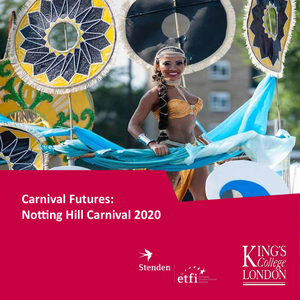
Carnival Futures: Notting Hill Carnival 2020 is a King’s Cultural Institute project led by Nicole Ferdinand (Culture, Media and Creative Industries at King’s College London) which sought to engage cultural organisations and other stakeholders in planning for the future of the Notting Hill Carnival. The content of this report is intended as a contribution to current research and to identifying future directions for the development of the Notting Hill Carnival. The material and views expressed are produced by various stakeholders in a series of workshops.
DOCUMENT
Attending to the emergent debates on tourism and (in)justice, this study critically examines the role of the Walled Off Hotel, Banksy's tourism-artistic intervention in Palestine, in constructing justice. Utilising the evidence from 15 in-depth empathetic interviews, it explores the ways in which local residents make sense of the Hotel and how they frame and experience (in)justices. While demonstrating how these interpretations are entangled with the broader geographic, social and political context, the paper discusses how different forms of justice circulate in this particular context. The new knowledge generated contributes to our further understanding of achieving justice-through-tourism as an affirmative praxis, while addressing the broader humanitarian, earthly, or otherwise existential crisis.
MULTIFILE



