Since the beginning of the new millennium, the use of mental practice and movement imagery within several medical professions in rehabilitation and therapy has received an increased attention. Before this introduction in healthcare, the use of movement imagery was mainly researched in sports science. Mental practice is a complex intervention. When a complex intervention is applied in a new target group or population, the intervention is most likely needed to be adjusted, developed, and evaluated. Recently, a dissertation has been published in which the researchers describe their efforts to transfer the use of movement imagery in sports to rehabilitation. This study reports two aspects from this research project: (a) What did the researcher do? (b) What do the results mean for future research? First, however, some background information is given, in which the use of movement imagery in athletes is discussed.
DOCUMENT

Imagery Rehearsal Therapy (IRT) is effective for trauma-related nightmares and is also a challenge to patients in finding access to their traumatic memories, because these are saved in non-verbal, visual, or audiovisual language. Art therapy (AT) is an experiential treatment that addresses images rather than words. This study investigates the possibility of an IRT-AT combination. Systematic literature review and field research was conducted, and the integration of theoretical and practice-based knowledge resulted in a framework for Imagery Rehearsal-based Art Therapy (IR-AT). The added value of AT in IRT appears to be more readily gaining access to traumatic experiences, living through feelings, and breaking through avoidance. Exposure and re-scripting take place more indirectly, experientially and sometimes in a playlike manner using art assignments and materials. In the artwork, imagination, play and fantasy offer creative space to stop the vicious circle of nightmares by changing theme, story line, ending, or any part of the dream into a more positive and acceptable one. IR-AT emerges as a promising method for treatment, and could be especially useful for patients who benefit least from verbal exposure techniques. This description of IR-AT offers a base for further research.
DOCUMENT

Dynamic body feedback is used in dance movement therapy (DMT), with the aim to facilitate emotional expression and a change of emotional state through movement and dance for individuals with psychosocial or psychiatric complaints. It has been demonstrated that moving in a specific way can evoke and regulate related emotions. The current study aimed to investigate the effects of executing a unique set of kinetic movement elements on an individual mover’s experience of happiness. A specific sequence consisting of movement elements that recent studies have related to the feeling of happiness was created and used in a series of conditions. To achieve a more realistic reflection of DMT practice, the study incorporated the interpersonal dimension between the dance movement therapist (DMTh) and the client, and the impact of this interbodily feedback on the emotional state of the client. This quantitative study was conducted in a within-subject design. Five male and 20 female participants (mean age = 20.72) participated in three conditions: a solo executed movement sequence, a movement sequence executed with a DMTh who attuned and mirrored the movements, and a solo executed movement sequence not associated with feelings of happiness. Participants were only informed about the movements and not the feelings that may be provoked by these movements. The effects on individuals were measured using the Positive and Negative Affect Schedule and visual analog scales. Results showed that a specific movement sequence based on movement elements associated with happiness executed with a DMTh can significantly enhance the corresponding affective state. An additional finding of this study indicated that facilitating expressed emotion through movement elements that are not associated with happiness can enhance feelings such as empowerment, pride, and determination, which are experienced as part of positive affect. The results show the impact of specific fullbody movement elements on the emotional state and the support outcome of DMT on emotion regulation.
DOCUMENT

Sinds de eeuwwisseling heeft het gebruik van mental practice (Nederlands: mentale training) en movement imagery (Nederlands: bewegingsvoorstellingen) binnen diverse disciplines in de revalidatie steeds meer aandacht gekregen. Het gebruik van bewegingsvoorstellingen werd daarvoor vooral toegepast in de sport. Mentale training is een complexe interventie. Indien een complexe interventie toegepast gaat worden bij een ‘nieuwe’ doelgroep, zal deze bijgesteld, doorontwikkeld en geëvalueerd moeten worden. De Medical Research Council (MRC) heeft hiervoor een stappenplan ontwikkeld. Onlangs is er een proefschrift verschenen waarbij geprobeerd is aan de hand van de stappen van het MRC-model de transfer vanuit de sport naar de revalidatie te maken bij mensen na een beroerte in de verpleeghuissetting. In dit artikel wordt beschreven hoe het onderzoek heeft plaatsgevonden, welke resultaten bereikt zijn en welke aanbevelingen voor vervolgonderzoek gedaan worden. Eerst wordt kort ingegaan op het gebruik van bewegingsvoorstellingen door sporters.
DOCUMENT

Background: People with a personality disorder (PD) suffer from enduring inflexible patterns in cognitions and emotions, leading to significant subjective distress, affecting both self and interpersonal functioning. In clinical practice, Dance Movement Therapy (DMT) is provided to clients with a PD, and although research continuously confirms the value of DMT for many populations, to date, there is very limited information available on DMT and PD. For this study, a systematic literature review on DMT and PD was conducted to identify the content of the described DMT interventions and the main treatment themes to focus upon in DMT for PD. Methods: A systematic search was conducted across the following databases: EMBASE, MEDLINE, PubMed, WEB OF SCIENCE, PsycINFO/OVID, and SCOPUS following the PRISMA guidelines. The Critical Appraisal Skills Programme for qualitative studies was used to rank the quality of the articles. The Oxford Center for Evidence-based Medicine standards were applied to determine the hierarchical level of best evidence. Quantitative content analysis was used to identify the intervention components: intended therapeutic goals, therapeutic activities leading to these goals, and suggested therapeutic effects following from these activities. A thematic synthesis approach was applied to analyze and formulate overarching themes. Results: Among 421 extracted articles, four expert opinions met the inclusion criteria. Six overarching themes were found for DMT interventions for PD: self-regulation, interpersonal relationships, integration of self, processing experiences, cognition, and expression and symbolization in movement/dance. No systematic descriptions of DMT interventions for PD were identified. A full series of intervention components could be synthesized for the themes of self-regulation, interpersonal relationships, and cognition. The use of body-oriented approaches and cognitive strategies was in favor of dance-informed approaches. Conclusions: Dance movement therapists working with PD clients focus in their interventions on body-related experiences, non-verbal interpersonal relationships, and to a lesser extent, cognitive functioning. A methodological line for all intervention components was synthesized for the themes of self-regulation, interpersonal relationships, and cognition, of importance for developing systematic intervention descriptions. Future research could focus on practitioners’ expertise in applying DMT interventions for PD to develop systematic intervention descriptions and explore the suitability of the identified themes for clinical application. Clients’ experiences could offer essential insights on how DMT interventions could address PD pathology and specific PD categories.
DOCUMENT

"A proportion of those with eating disorders have also experienced traumatic events and ongoing symptoms of PTSD such as re-experiencing of the trauma and nightmares. We implemented an innovative trauma intervention called Imagery Rescripting (ImRs) to explore whether for those undergoing inpatient treatment for an eating disorder (in an underweight phase), it would be possible to treat the various trauma-related symptoms as well as the eating problems. Since this has not been investigated before, we asked the participants in this study to recount their experiences. Twelve participants who were underweight, reported a past history of trauma and were in an inpatient eating disordertreatment program participated in ImRs therapy intervention. One of these participant did not engage in the ImRs therapy because she discontinued the inpatient ED treatment. Analysis of interviews with these participants found that -although they were reluctant before the start of the treatment- the ImRs treatment during their inpatient admission had given them hope again. They added that it was important to have support from group members, sociotherapists and therapists. They shared a number of ways that the ImRs treatment could be adapted to people with eating disorders. Their experiences indicated that given these factors it was possible to treat PTSD during an underweight phase. This is important: until now, treatment for eating disorders has not specifically been trauma-focused and these tips have scope to improve the ImRs intervention and eating disorder treatment more broadly in the future."
MULTIFILE

Empirical studies in the creative arts therapies (CATs; i.e., art therapy, dance/movement therapy, drama therapy, music therapy, psychodrama, and poetry/bibliotherapy) have grown rapidly in the last 10 years, documenting their positive impact on a wide range of psychological and physiological outcomes (e.g., stress, trauma, depression, anxiety, and pain). However, it remains unclear how and why the CATs have positive effects, and which therapeutic factors account for these changes. Research that specifically focuses on the therapeutic factors and/or mechanisms of change in CATs is only beginning to emerge. To gain more insight into how and why the CATs influence outcomes, we conducted a scoping review (Nstudies = 67) to pinpoint therapeutic factors specific to each CATs discipline, joint factors of CATs, and more generic common factors across all psychotherapy approaches. This review therefore provides an overview of empirical CATs studies dealing with therapeutic factors and/or mechanisms of change, and a detailed analysis of these therapeutic factors which are grouped into domains. A framework of 19 domains of CATs therapeutic factors is proposed, of which the three domains are composed solely of factors unique to the CATs: “embodiment,” “concretization,” and “symbolism and metaphors.” The terminology used in change process research is clarified, and the implications for future research, clinical practice, and CATs education are discussed.
DOCUMENT

In many fields within management and organizational literature there is considerable debate and controversy about key theoretical concepts and their definitions and meanings. Systematic metaphor analysis can be a useful approach to study the underlying conceptualizations that give rise to these controversies and putting them in perspective. It can help identify the different ways a theoretical concept is structured and given meaning, provide insight into the way these different conceptualizations relate to each other, and show how these conceptualizations impact further theorization about the concept. This article describes the procedure for a systematic analysis of the metaphors used to conceptualize key theoretical concepts. To examine its usefulness, the authors apply the approach to the field of social capital, and in particular to the concept of ‘relationships’ in organizations. In the metaphor analysis of three seminal articles on social capital, the authors identify seven metaphoric concepts for relationships. The metaphors are illuminated as important for providing imagery that adds specific meaning in the process of authors theorizing about social capital like ‘tie’, ‘path’ and ‘bridge’. They add dynamics and controllability to the concepts by attributing an array of verbs like ‘to move between’ or ‘to use’ relationships. In addition, the metaphors allow for the attribution of specific characteristics to the concept of relationships that can be used as variables in theory construction, such as the strength of a relationship or the ‘distance’ between people. These insights are useful in exploring and reconciling differences in social capital definitions.
DOCUMENT

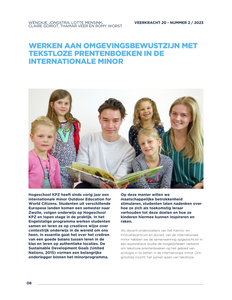
Tekstloze prentenboeken zijn beloftevol bij het versterken van omgevingsbewustzijn vanwege de vaak sterke zeggingskracht van de afbeeldingen in dit type boeken. Door gebrek aan tekst zijn ze daarnaast niet gebonden aan een bepaalde taal, dus heel goed in te zetten in internationale contexten. Een kleine studie laat zien dat lezers soms gegrepen worden door dezelfde en soms door verschillende afbeeldingen, meer of minder gedetailleerd kijken en dat de afbeeldingen soms hetzelfde en soms verschillend geduid worden.
DOCUMENT
[ENG] Water Nation is an artistic research project and short film exploring archival footage of the Institute of Sound & Vision of flooding in The Netherlands. Told from the artist’s perspective it is a reflection on how to connect and make climate change and the Dutch history around water and flooding palpable. Through artistic and AI experiments a short animated film was created. [NL] Water Nation is een artistiek onderzoeksproject en een korte film waarin archiefmateriaal van het Instituut voor Beeld & Geluid over overstromingen in Nederland is verwerkt. Vanuit het perspectief van de kunstenaar is het een reflectie op hoe klimaatverandering en de Nederlandse geschiedenis rond water en overstromingen invoelbaar kunnen worden gemaakt en met elkaar kunnen worden verbonden. Door middel van artistieke en AI-experimenten werd een korte animatiefilm gecreëerd.
LINK



