
Types
0Instelling
26Bestandstype
9Taal
5Publicatiejaar
12Thema's
14Producttype
14Publicaties met bestand / URL
2Projectstatus
3Money alone is not enough. Also, not for young refugees and migrants aspiring to become self-employed. They might be the necessary to survive, the idea to explore an opportunity or the aspirations towards growth and expansion like any other entrepreneur. Likewise, there are various forms in which they will become self-employed: it might be solo or hybrid self-employed, a micro or small enterprise, and even a medium sized one. Ans in all cases (external) financing will be needed to start and develop the new ventures but knowledge as well how to use it. The aim to the Young Migrant Entrepreneurs Capacity Building project (in brief YMCB in this guide) is to develop an innovative approach to support young migrants’ entrepreneurship through a combination of education, training, and mentoring. The overall connotation is that access to finance deals with the possibility that individuals or enterprises have to access financial services, including credit, deposit, payment, or insurances provided by third parties – formal and informal. Poor access to finance limits individuals, households, and entrepreneurs to function. Access to finance is expected to benefit society at large by accelerating economic growth and helping to raise income for those in the lower end of the income distribution pyramid in reducing income inequality and poverty. But that is only one face of the same coin. Over the past years it has become evident that effective access to finance is determined by: - How well-prepared the prospective migrant/refugee entrepreneurs are to get started - The level of preparation of trainers and coaches working with migrant or refugee entrepreneurs and how well they understand the context their clients live and operate - The level of understanding of staff for FI’s and the degree to which appraisal procedures do not automatically exclude this group as potential clients
DOCUMENT
This article examines informal entrepreneurs’ capital usage and conversion in the Thai tourism sector. On the Bourdieusian assumption that people perpetually transform tangible and intangible forms of capital, this study seeks to answer how informal tourism entrepreneurs transform intangible capital into tangible capital, and vice versa, at different stages of their development process. A visual dataset of 78 filmed interviews and of 426 photographs of informal entrepreneurs in three tourist-island destinations in Thailand was compiled and analysed using thematic qualitative analysis. The results show the importance of diversification of capital mix at informal entrepreneurs’ different development stages. Whereas cultural and symbolic capital are more salient for freelancers and small-size entrepreneurs, economic and social capital are more important for mid-size and large informal entrepreneurs. Furthermore, this study introduces dream capital as a new form of capital. Developing countries are recommended to introduce a policy on profiling informal tourism entrepreneurs so that the appropriate level of regulation can be applied in order to maintain or increase their benefits to society.
DOCUMENT
English:
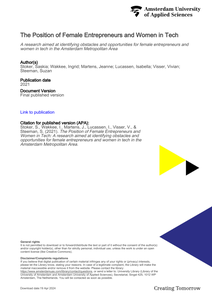
In the Netherlands female entrepreneurs and women in tech have structurally less opportunities than men. The latest numbers from October 2020 show that only 1 percent of all venture capital went to female entrepreneurs. The percentage of non-white entrepreneurs that received financing is even below 1 percent. Remarkable numbers if we look at the demographics of the Dutch population and a clear signal that bias is a structural problem in financing start-ups. Additionally, there remains an underrepresentation of women at all levels in the tech industry.
As part of the Rise project, this whitepaper will focus on the question ‘What needs to be done in the coming years to improve the position of female entrepreneurs and women in tech? Building on an expert session, a review of annual reports and a short survey amongst a selected group of support organizations, we focus on the Amsterdam Metropolitan Area (MRA) and show a clear trend towards ‘women only’ programs for female entrepreneurs and an increase in the support structures for female tech workers. In this report, the results of a baseline analysis for the state of the field for Female Entrepreneur and Women in Tech in the Amsterdam Metropolitan Area will be presented by the professorship of Entrepreneurship from the Amsterdam University of Applied Sciences (AUAS).
--
Dutch:
WOMEN Inc., HvA en We Rise hebben een rapport geschreven over de positie van vrouwelijke ondernemers en vrouwen die werken in de tech-sector. Er is onderzocht wat er momenteel wordt gedaan om de positie van vrouwelijke ondernemers en vrouwen in tech te ondersteunen en wat er de komende jaren kan veranderen om dit te verbeteren.
DOCUMENT
Entrepreneurship is a viable income-generating option for refugee women. Entrepreneurial work can bypass limits placed on work permits, obstacles in the formal economy, and familial responsibilities. Critical to success is access to and attainment of social capital, but women entrepreneurs are frequently hampered by gender and cultural biases. Due to such limitations, they face difficultly in attaining bridging and linking capitals, which are necessary for gaining access to support networks and target markets within a host society. Non-governmental organisations (NGOs) play a crucial role in enabling refugees to access support and social capital. NGOs become an instrumental component for women refugees to develop business plans, navigate host country laws and practices, access resources for start-ups, and gain mentorship. However, the types of support available are often NGO-specific, which restricts their applicability. Despite intermittent, beneficial encounters encouraged by NGOs, the long-term impact is questionable due to the variability and inconsistency of service offerings.
DOCUMENT
Presentation about student entrepreneurs.
DOCUMENT
High-tech horticulture production methods (such as vertical farming, hydroponics and other related technology possibilities), combined with evolving market side possibilities (consumer’s willingness to pay for variety, food safety and security), are opening new ways to create and deliver value. In this paper we present four emerging business models and attempt to understand the conditions under which each business model is able to create positive market value and sustained business advantage. The first of these four models is the case of a vertically integrated production to retail operation. The second model is the case of a production model with assured retail/distribution side commitment. The third model deals with a marketing/branding driven production model with differentiated market positioning. Finally, the forth is a production model with direct delivery to the end-consumer based upon the leveraging of wide spread digital technology in the consumer market. To demonstrate these four business models, we analyze practical case studies and analyze their market approach and impact. Using this analysis, we create a framework that enables entrepreneurs and businesses to adopt a business model that matches their capabilities with market opportunities.
DOCUMENT
Our paper investigates the microfoundations of sustainable entrepreneurship and aims to shed light on trade-offs made in decisions about social, ecological and economic sustainability. Balancing the three dimensions of sustainability (social, ecological and economic) inherently requires choices in which one dimension or another has less optimal outcomes. There is not much known about the rationale that sustainable entrepreneurs use for making such trade-offs. Thus, we ask how does entrepreneurial orientation affect decisions and trade-offs on sustainability impact? Our study is an exploratory, qualitative study of 24 sustainable entrepreneurs. We collected data about entrepreneurial orientation and sustainability trade-offs and held in-depth interviews with a subsample of six firms. We conducted a cluster analysis based on four entrepreneurial orientations (innovativeness, proactiveness, riskiness and futurity) and three sustainability trade-off dimensions (environmental, social and economic). From the findings, we derive a typology of three types of sustainable entrepreneurs: green-conflicted, humanitarian-oriented and holistically-oriented. We uncover salient characteristics and aspects of entrepreneurial orientation in relation to trade-off decisions. We find that the entrepreneurs accept slower economic growth or lower performance in order to maintain the integrity of their social and ecological principles and values.
DOCUMENT
Social enterprises and government share the ultimate goal of solving societal problems, which provides a lot of potential for collaboration between the two parties. While the local government level is the most relevant for social enterprises, little research has been done on the relationship between social entrepreneurs and local government officials. However, in the Netherlands, social enterprises experience these relations as far from optimal, evidenced by the fact that they named ‘regulations and government policy’ as the most important obstacle for increasing their impact in a 2015 sector survey. Therefore, a pilot project was started with social entrepreneurs in an Amsterdam neighbourhood, forming a learning network aiming to improve relations with local government. In the network, an innovative tool was developed in the form of a set of five illustrated stereotypes of social entrepreneurs with certain views towards local government. These stereotypes serve both as a reflection tool for social entrepreneurs and as a communication tool to open dialogue between social entrepreneurs and local government. We conclude that in an applied research project, it is crucial to place focus on the final phases in which results are reformulated into practical tools to match target groups, and resulting tools are distributed through targeted events and publications.
DOCUMENT
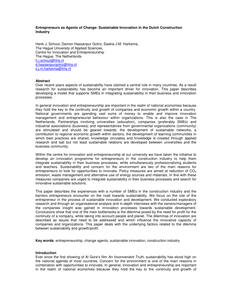
Over recent years aspects of sustainability have claimed a central role in many countries. As a result research for sustainability has become an important driver for innovation. This paper describes developing a model that supports SMEs in integrating sustainability in their business and innovation processes. In general innovation and entrepreneurship are important in the realm of national economies because they hold the key to the continuity and growth of companies and economic growth within a country. National governments are spending vast sums of money to enable and improve innovation management and entrepreneurial behaviour within organizations. This is also the case in The Netherlands. Partnerships involving universities (education), companies (preferably SMEs) and industrial associations (business) and representatives from governmental organizations (community) are stimulated and should be geared towards: the development of sustainable networks, a contribution to regional economic growth within sectors, the development of learning communities in which best practices are shared, knowledge circulates and knowledge is created through applied research and last but not least sustainable relations are developed between universities and the business community. Within the centre for innovation and entrepreneurship at our university we have taken the initiative to develop an innovation programme for entrepreneurs in the construction industry to help them integrate sustainability in their business processes, while simultaneously professionalizing students and teachers. Sustainability and concern for the environment are two of the main reasons for entrepreneurs to look for opportunities to innovate. Policy measures are aimed at reduction of CO2 emission, waste management and alternative use of energy sources and materials. In line with these measures companies are urged to integrate sustainability in their business processes and search for innovative sustainable solutions. This paper describes the experiences with a number of SMEs in the construction industry and the barriers entrepreneurs encounter on the road towards sustainability. We focus on the role of the entrepreneur in the process of sustainable innovation and development. We conducted exploratory research and through an organisational analysis and in-depth interviews with the owners/managers of the companies insight was gained in innovation processes towards sustainable development. Conclusions show that one of the main bottlenecks is the dilemma posed by the need for profit for the continuity of a company, while taking into account people and planet. The dilemmas of innovation are described as issues that need to be addressed and which influence the innovative capacity of companies and organizations. This paper deals with the underlying factors related to the dilemma between sustainability and growth/profit.
DOCUMENT
This article investigates possible pathways of habitus change by informal tourism entrepreneurs in Thailand. Bourdieu's concept of habitus is depicted as a person's understanding of the world. Do people adapt their worldview in response to only external stimuli? Through ethnographic fieldwork including participant observations and active semi-structured interviews with 53 participants, this paper identifies a classification of four modes of habitus adaptation: (1) Understanding and appreciating the field and its conditions, (2) Challenging core beliefs systems, (3) Applying a practical sense to ‘objective possibilities’, and, (4) Challenging non-reflective dispositions. We argue that charting the modes of habitus adaptation could help policymakers understand the change processes of informal entrepreneurs in the tourism sector and their willingness to change.
MULTIFILE