Types
0Instelling
26Bestandstype
9Taal
5Publicatiejaar
12Thema's
14Producttype
14Publicaties met bestand / URL
2Projectstatus
3Aware of the consequences of their inactive lifestyles, many people still struggle to integrate enough physical activity into their busy lives. Interventions that nudge to reinforce existing active behaviour seem therefore more likely to be effective than those adding an activity to daily routines. To encourage people to increase their physical activity level, we designed Discov, a network of physical waypoints triggering people to lengthen their walks. Placed in a public park, Discov encourages people to explore their surroundings in a fun and challenging way by creating an interactive walking experience. Adopting a Research-through-Design approach, we explore the potential of the design of accessible infrastructures and human-environment interactions to impact public health by nudging citizens into being more physically active. We discuss insights gathered through this process and report on first user tests of this interactive walking experience.
LINK
There is increased interest in reducing sedentary behavior of office workers to combat the negative health effects of prolonged sitting. Walking meetings offer a promising solution to this problem as they facilitate a physically active way of working. To inform future development of technologies supporting these type of meetings, in-depth qualitative insights into people’s experiences of walking meetings are needed. We conducted semi-structured walking interviews (N=16) to identify key drivers and barriers for walking meetings in a living lab setting by using the ‘WorkWalk’. The ‘WorkWalk’ is a 1.8 km walking route indicated by a dotted blue line with outdoor meeting points, integrated into the room booking system. Our findings provide insights into how walking meetings are experienced and affect the set-up and social dynamics of meetings. We offer design recommendations for the development of future technologies and service design elements to support walking meetings and active ways of working
DOCUMENT
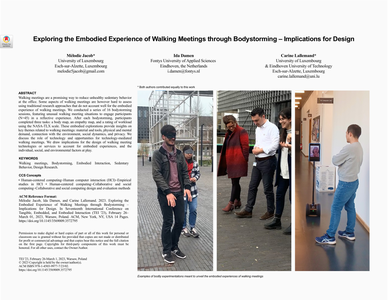
Walking meetings are a promising way to reduce unhealthy sedentary behavior at the office. Some aspects of walking meetings are however hard to assess using traditional research approaches that do not account well for the embodied experience of walking meetings. We conducted a series of 16 bodystorming sessions, featuring unusual walking meeting situations to engage participants (N=45) in a reflective experience. After each bodystorming, participants completed three tasks: a body map, an empathy map, and a rating of workload using the NASA-TLX scale. These embodied explorations provide insights on key themes related to walking meetings: material and tools, physical and mental demand, connection with the environment, social dynamics, and privacy. We discuss the role of technology and opportunities for technology-mediated walking meetings. We draw implications for the design of walking meeting technologies or services to account for embodied experiences, and the individual, social, and environmental factors at play.
DOCUMENT
In 2017 Professor Nick Shepherd started the project 'The Walking Residency' at the Reinwardt Academy, enabling students and lecturers to connect places, identities, stories, climate, nature, people and animals with each other in new ways. Together with staff and students, he explored artistic research, using walking as a methodology to engage landscapes and histories, and rethinking time, materiality and memory.
DOCUMENT
PURPOSE: Walking ability in general and specifically for lower limb amputees is of major importance for social mobility and ADL independence. Walking determines prosthesis prescription. The aim of this study was to mathematically analyse factors influencing claimed walking distance of lower limb amputees of 500 m or more.
METHOD: A total of 437 patients returned two questionnaires: the Groningen Questionnaire Problems after Leg Amputation, in which walking distance was assessed, and the RAND 36.
RESULTS: The chance of walking 500 m or more reduced when a transfemoral amputation was performed. The chance reduced even more when phantom pain or stump pains were present. If the amputation was performed because of vascular disease or because of vascular problems because of diabetes the chance reduced again. Independently of these factors, age reduced the chance of walking 500 m or more.
CONCLUSION: The chance of walking 500 m or more reduces with increase in age and a more proximal amputation. The chance reduces even further when the amputation is performed because of diabetes or vascular disease and also if phantom pain and or stump pain is present.
DOCUMENT
Although growing numbers of researchers are studying the role of social engagement in ubiquitous technologies and applications, few frameworks have been proposed that attend to the lived experience of the individual and social dynamic within which it is intimately enmeshed. We present empirical insights using grounded theory from data gathered during a 102-day walk of the second author around Wales. This study inductively developed a substantive social engagement framework of the Walking experience that appears to be simple and flexible. The main aim of this paper is to present the developed framework, where even apparently 'solitary' walking is set within a rich technical and social matrix. The primary characteristics of this framework, namely accuracy of social judgements, accountability of decisions and actions, enhancing self-esteem, and satisfying intrinsic motivation goals, are in line with social user experience and show promise of being useful in ubiquitous technologies, regardless of user activity.
DOCUMENT
Background:
The last decade has seen a substantial increase in the use of mobile health apps and research into the effects of those apps on health and health behaviors. In parallel, research has aimed at identifying population subgroups that are more likely to use those health apps. Current evidence is limited by two issues. First, research has focused on broad health apps, and little is known about app usage for a specific health behavior. Second, research has focused on comparing current users and current nonusers, without considering subgroups of nonusers.
Objective:
We aimed to provide profile distributions of current users, previous users, and informed nonusers, and to identify predictor variables relevant for profile classification.
Methods:
Data were available from 1683 people who participated in a Dutch walking event in Amsterdam that was held in September 2017. They provided information on demographics, self-reported walking behavior, and walking app usage, as well as items from User Acceptance of Information Technology, in an online survey. Data were analyzed using discriminant function analysis and multinomial logistic regression analysis.
Results:
Most participants were current walking app users (899/1683, 53.4%), while fewer participants were informed nonusers (663/1683, 39.4%) and very few were previous walking app users (121/1683, 7.2%). Current walking app users were more likely to report walking at least 5 days per week and for at least 30 minutes per bout (odds ratio [OR] 1.44, 95% CI 1.11-1.85; P=.005) and more likely to be overweight (OR 1.72, 95% CI 1.24-2.37; P=.001) or obese (OR 1.49, 95% CI 1.08-2.08; P=.005) as compared with informed nonusers. Further, current walking app users perceived their walking apps to be less boring, easy to use and retrieve information, and more helpful to achieve their goals. Effect sizes ranged from 0.10 (95% CI 0.08-0.30) to 1.58 (95% CI 1.47-1.70).
Conclusions:
The distributions for walking app usage appeared different from the distributions for more general health app usage. Further, the inclusion of two specific subgroups of nonusers (previous users and informed nonusers) provides important information for health practitioners and app developers to stimulate continued walking app usage, including making information in those apps easy to understand and making it easy to obtain information from the apps, as well as preventing apps from becoming boring and difficult to use for goal attainment.
DOCUMENT
BACKGROUND:
Exercise capacity, muscle function, and physical activity levels remain reduced in recipients of lung transplantation. Factors associated with this deficiency in functional exercise capacity have not been studied longitudinally.
OBJECTIVE:
The study aims were to analyze the longitudinal change in 6-minute walking distance and to identify factors contributing to this change.
DESIGN:
This was a longitudinal historical cohort study.
METHODS:
Data from patients who received a lung transplantation between March 2003 and March 2013 were analyzed for the change in 6-minute walking distance and contributing factors at screening, discharge, and 6 and 12 months after transplantation. Linear mixed-model and logistic regression analyses were performed with data on characteristics of patients, diagnosis, waiting list time, length of hospital stay, rejection, lung function, and peripheral muscle strength.
RESULTS:
Data from 108 recipients were included. Factors predicting 6-minute walking distance were measurement moment, diagnosis, sex, quadriceps muscle and grip strength, forced expiratory volume in 1 second (percentage of predicted), and length of hospital stay. After transplantation, 6-minute walking distance increased considerably. This initial increase was not continued between 6 and 12 months. At 12 months after lung transplantation, 58.3% of recipients did not reach the cutoff point of 82% of the predicted 6-minute walking distance. Logistic regression demonstrated that discharge values for forced expiratory volume in 1 second and quadriceps or grip strength were predictive for reaching this criterion.
LIMITATIONS:
Study limitations included lack of knowledge on the course of disease during the waiting list period, type and frequency of physical therapy after transplantation, and number of missing data points.
CONCLUSIONS:
Peripheral muscle strength predicted 6-minute walking distance; this finding suggests that quadriceps strength training should be included in physical training to increase functional exercise capacity. Attention should be paid to further increasing 6-minute walking distance between 6 and 12 months after transplantation.
LINK
BACKGROUND: Hospital stays are associated with high levels of sedentary behavior and physical inactivity. To objectively investigate physical behavior of hospitalized patients, these is a need for valid measurement instruments. The aim of this study was to assess the criterion validity of three accelerometers to measure lying, sitting, standing and walking. METHODS: This cross-sectional study was performed in a university hospital. Participants carried out several mobility tasks according to a structured protocol while wearing three accelerometers (ActiGraph GT9X Link, Activ8 Professional and Dynaport MoveMonitor). The participants were guided through the protocol by a test leader and were recorded on video to serve as reference. Sensitivity, specificity, positive predictive values (PPV) and negative predictive values (NPV) were determined for the categories lying, sitting, standing and walking. RESULTS: In total 12 subjects were included with a mean age of 49.5 (SD 21.5) years and a mean body mass index of 23.8 kg/m2 (SD 2.4). The ActiGraph GT9X Link showed an excellent sensitivity (90%) and PPV (98%) for walking, but a poor sensitivity for sitting and standing (57% and 53%), and a poor PPV (43%) for sitting. The Activ8 Professional showed an excellent sensitivity for sitting and walking (95% and 93%), excellent PPV (98%) for walking, but no sensitivity (0%) and PPV (0%) for lying. The Dynaport MoveMonitor showed an excellent sensitivity for sitting (94%), excellent PPV for lying and walking (100% and 99%), but a poor sensitivity (13%) and PPV (19%) for standing. CONCLUSIONS: The validity outcomes for the categories lying, sitting, standing and walking vary between the investigated accelerometers. All three accelerometers scored good to excellent in identifying walking. None of the accelerometers were able to identify all categories validly.
DOCUMENT
April 2015 Sudanese photographer Elsadig Mohamed and I tried to relate the photographs that Paul Julien made when traveling through the country in 1933 and 1948 to stories and realities alive in present day Sudan. This initial research was pretty successful and we thought a first presentation of the work done was in place to see how a Sudanese audience would respond to our attempts. The exhibition was installed in a minimum amount of time. There were hundreds of people (estimates range between 5 and 9 hundred) at the opening. Whether they came for the photographs or for the concert that took place outside of the museum we will never know. People did show an interest in what was on the wall and we will continue towards next presentations both in and outside of Sudan.
Walking Between Houses, the title of the Sudanese part of the larger Paul Julien project is titled ‘Walking Between Houses’. This is part of a Sudanese proverb, referring to the in between place as the source of knowledge. The photographs Julien made in Sudan can be found on this Facebook page. A film impression of the exhibition with responses of visitors was made by Rhea Schmitt for the Goethe Institute in Khartoum.
LINK