In this paper the principle of minimum relative entropy (PMRE) is proposed as a fundamental principle and idea that can be used in the field of AGI. It is shown to have a very strong mathematical foundation, that it is even more fundamental then Bayes rule or MaxEnt alone and that it can be related to neuroscience. Hierarchical structures, hierarchies in timescales and learning and generating sequences of sequences are some of the aspects that Friston (Fri09) described by using his free-energy principle. These are aspects of cognitive architectures that are in agreement with the foundations of hierarchical memory prediction frameworks (GH09). The PMRE is very similar and often equivalent to Friston's free-energy principle (Fri09), however for actions and the defi nitions of surprise there is a diff erence. It is proposed to use relative entropy as the standard definition of surprise. Experiments have shown that this is currently the best indicator of human surprise (IB09). The learning rate or interestingness can be defi ned as the rate of decrease of relative entropy, so curiosity can then be implemented as looking for situations with the highest learning rate.
DOCUMENT
Psychologist and computerscientist Geoffrey Hinton, called the godfather of AI, argued that we should stop with A(G)I. In this column it is argued that Artificial General Intelligence like ChatGPT works very differently than organic intelligence. An organic complexity works like a chain reaction. Unlike living systems, where the bigger the slower holds (r-factor well below 1), this is not true in inorganic systems. So they are uncontrollable. Scalable technology increases our planetary footprint to unjustified proportions precisely because the r-factor is greater than 1. Inorganic fortresses are characterized by this. Chain reactions do not stop their growth until everything is gone. When all technological fires are extinguished, it will be too late for us, precisely because we need basic techniques to survive. Fortunately, we have our Being (IDG1), Sense (IDG2), Sense of Responsibility for the Planet and Each Other (IDG3), and Will to Collaborate (IDG4), with which we can Change Course (IDG5).
MULTIFILE

"You did exactly, what we suggest: using the 4A model to improve alignment between business people and IT." Dat is de kern van George Westermans reactie op het IT-risico-onderzoek van Fontys Hogeschool.
DOCUMENT

Of all patients in a hospital environment, trauma patients may be particularly at risk for developing (device-related) pressure ulcers (PUs), because of their traumatic injuries, immobility, and exposure to immobilizing and medical devices. Studies on device-related PUs are scarce. With this study, the incidence and characteristics of PUs and the proportion of PUs that are related to devices in adult trauma patients with suspected spinal injury were described. From January–December 2013, 254 trauma patients were visited every 2 days for skin assessment. The overall incidence of PUs was 28⋅3% (n = 72/254 patients). The incidence of device-related PUs was 20⋅1% (n = 51), and 13% (n = 33) developed solely device-related PUs. We observed 145 PUs in total of which 60⋅7% were related to devices (88/145). Device-related PUs were detected 16 different locations on the front and back of the body. These results show that the incidence of PUs and the proportion of device-related PUs is very high in trauma patients
DOCUMENT

A keynote presentation about current and upcoming ethical questions related to the societal impact of AI, and approaches to improving these situations in the future.
DOCUMENT
Neighborhood image processing operations on Field Programmable Gate Array (FPGA) are considered as memory intensive operations. A large memory bandwidth is required to transfer the required pixel data from external memory to the processing unit. On-chip image buffers are employed to reduce this data transfer rate. Conventional image buffers, implemented either by using FPGA logic resources or embedded memories are resource inefficient. They exhaust the limited FPGA resources quickly. Consequently, hardware implementation of neighborhood operations becomes expensive, and integrating them in resource constrained devices becomes unfeasible. This paper presents a resource efficient FPGA based on-chip buffer architecture. The proposed architecture utilizes full capacity of a single Xilinx BlockRAM (BRAM36 primitive) for storing multiple rows of input image. To get multiple pixels/clock in a user defined scan order, an efficient duty-cycle based memory accessing technique is coupled with a customized addressing circuitry. This accessing technique exploits switching capabilities of BRAM to read 4 pixels in a single clock cycle without degrading system frequency. The addressing circuitry provides multiple pixels/clock in any user defined scan order to implement a wide range of neighborhood operations. With the saving of 83% BRAM resources, the buffer architecture operates at 278 MHz on Xilinx Artix-7 FPGA with an efficiency of 1.3 clock/pixel. It is thus capable to fulfill real time image processing requirements for HD image resolution (1080 × 1920) @103 fcps.
DOCUMENT

This publication is a report of the summer research School symbiocene, which took place at Zeeburgereiland amsterdam between the 28th and 30th of june 2023. This summer research school is anInitiative of an kramer, action researcher of the Symbiocene, in collaboration with Inholland University of applied sciences and sluislab, social Impact island.
DOCUMENT

Due to the environmental and nutritional benefits of insects, their consumption would be one of the solutions to feed the growing human population. Despite the increasing interest in the use of insects as food and feed, consumer acceptance is the major obstacle to successful implementation in Western countries and we studied the factors that influence consumer acceptance in a group of university students from Germany and the Netherlands. In this exploratory research, a survey was conducted (n = 222). Socio‐demographic and psychological factors were established from a theoretical review. In addition, we elaborated on questions regarding information on the health and environmental benefits of consuming insects. Initially, the data obtained are presented through descriptive statistics. The influence of the socio‐demographic and psychological factors, and the information on the willingness to accept insects as animal feed and human food was analyzed using correlations and multiple linear regressions. Results showed more willingness to accept insects as animal feed than in human food. The acceptance among German and Dutch students seems to be driven by issues similar to those in other European countries, such as visual aspects and knowledge about the benefits. The effect of the information on willingness constitutes an important finding of this study, especially for the use of insects in animal feed, since most of the previous studies have focused on the use of insects as human food. Our data support the need to inform and educate consumers about the environmental and health benefits of entomophagy. We conclude that effective efforts to implement entomophagy could increase the level of familiarity with the insect food and inform (or educate) consumers about its benefits. Insights from this study are useful to address studies focusing on specific segments of possible early adopters and consequently addressing communication strategies in this market segmentation.
DOCUMENT

In this paper, we analyse the development of the term “legal capabilities”. More specifically, we do three things. First, we track the emergence and development of the notion of legal capabilities. The term legal capabilities was used in legal research long before the capability approach was introduced in that field. Early on, its conceptualisation mainly reflected elements of legal literacy. In more recent writings, it is claimed that the notion is based on the capability approach. Second, we critically analyse the current use of the term legal capabilities and show that there is no proper theoretical grounding of this term in the capability approach. This is problematic, because it might give rise to misunderstandings and flawed policy recommendations. Third, we suggest some first steps towards a revision of the notion of legal capabilities. Starting from the concept of “access to justice”, legal capabilities have to be understood as the real opportunities someone has to get access to justice, rather than merely as formal opportunities or internal capabilities.
MULTIFILE

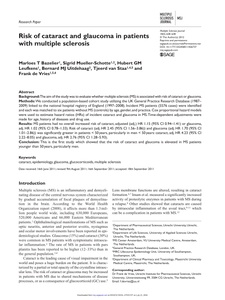
The aim of the study was to evaluate whether multiple sclerosis (MS) is associated with risk of cataract or glaucoma. We conducted a population-based cohort study utilizing the UK General Practice Research Database (1987–2009) linked to the national hospital registry of England (1997–2008). Incident MS patients (5576 cases) were identified and each was matched to six patients without MS (controls) by age, gender, and practice. Cox proportional hazard models were used to estimate hazard ratios (HRs) of incident cataract and glaucoma in MS. Time-dependent adjustments were made for age, history of diseases and drug use.
DOCUMENT