In de huidige landbouwsector worden grote hoeveelheden gewasbeschermingsmiddelen gebruikt, wat leidt tot hoge kosten voor telers. De verwachte aanscherping van wetgeving dwingt de industrie om efficiëntere spuitmethoden te onderzoeken. Een veelbelovende oplossing is het implementeren van precisiespuiten, die niet alleen het gebruik van chemicaliën vermindert, maar ook kostenbesparingen oplevert en kan voldoen aan strengere milieuwetgeving. De technologie achter precisiespuiten maakt gebruik van real-time data, verzameld door camera's op de spuit, of van taakkaarten waarvoor van tevoren het land is in gescand. Beide mogelijkheden hebben verschillende kosten en besparingen. Hoewel er momenteel onvoldoende concrete data beschikbaar is om definitieve conclusies te trekken, wordt verwacht dat met een toename van het aantal precisiespuiten op het land betrouwbaardere resultaten kunnen worden verkregen. Op de lange termijn lijkt de aanschaf van een real-time precisiespuit aantrekkelijk, vooral voor grotere telers. De ontwikkeling die gepaard gaan met het verzamelen van meer data zal ook een beter inzicht geven in de effecten van precisiespuiten op de gewaskwaliteit, wat van belang is voor het berekenen van de effecten op de kosten.
DOCUMENT
High-tech horticulture production methods (such as vertical farming, hydroponics and other related technology possibilities), combined with evolving market side possibilities (consumer’s willingness to pay for variety, food safety and security), are opening new ways to create and deliver value. In this paper we present four emerging business models and attempt to understand the conditions under which each business model is able to create positive market value and sustained business advantage. The first of these four models is the case of a vertically integrated production to retail operation. The second model is the case of a production model with assured retail/distribution side commitment. The third model deals with a marketing/branding driven production model with differentiated market positioning. Finally, the forth is a production model with direct delivery to the end-consumer based upon the leveraging of wide spread digital technology in the consumer market. To demonstrate these four business models, we analyze practical case studies and analyze their market approach and impact. Using this analysis, we create a framework that enables entrepreneurs and businesses to adopt a business model that matches their capabilities with market opportunities.
DOCUMENT

We need mental and physical reference points. We need physical reference points such as signposts to show us which way to go, for example to the airport or the hospital, and we need reference points to show us where we are. Why? If you don’t know where you are, it’s quite a difficult job to find your way, thus landmarks and “lieux de memoire” play an important role in our lives.
LINK
Digital Twins of the Ocean (DTOs) are increasingly used in Maritime Spatial Planning (MSP), yet most remain limited to 2D representations and offer minimal stakeholder interactivity. These limitations reduce their effectiveness in capturing complex socio-ecological-technical dynamics and supporting exploratory what-if scenario planning in a 3D or 4D ocean space. This paper presents Immersive Ocean, a novel Virtual Twin platform developed within EU-ILIAD DTO initiative. Built with game engine and VR technologies, it supports procedural 3D world generation and interactive exploration in both desktop and immersive VR modes. Systematic performance validation demonstrated stable frame rates across both PC and VR platforms. Initial user evaluations (n=22) report high usability and engagement but also suggest areas for improvement in UI clarity and ecological model representation. These initial findings position Immersive Ocean as a promising Virtual Twin solution for an immersive, interactive, and data-integrated approach to MSP and ocean governance. Immersive Ocean is now being piloted with stakeholders in real-world MSP scenarios, including offshore wind farm planning.
DOCUMENT
Over the past decade, journalists have created in-depth interactive narratives to provide an alternative to the relentless 24-hour news cycle. Combining different media forms, such as text, audio, video, and data visualisation with the interactive possibilities of digital media, these narratives involve users in the narrative in new ways. In journalism studies, the convergence of different media forms in this manner has gained significant attention. However, interactivity as part of this form has been left underappreciated. In this study, we scrutinise how navigational structure, expressed as navigational cues, shapes user agency in their individual explorations of the narrative. By approaching interactive narratives as story spaces with unique interactive architectures, in this article, we reconstruct the architecture of five Dutch interactive narratives using the walkthrough method. We find that the extensiveness of the interactive architectures can be described on a continuum between closed and open navigational structures that predetermine and thus shape users’ trajectories in diverse ways.
DOCUMENT

Praktijkgericht onderzoek speelt een belangrijke rol binnen de University of Applied Sciences van onze Hogeschool Inholland. Wij hebben dan ook een ijzersterk verhaal te vertellen en een schat aan relevante onderzoeksresultaten om te laten zien. En dat willen we graag delen met de wereld. Binnen ons praktijkgericht onderzoek werken we aan maatschappelijke vraagstukken. Soms groot en globaal, soms klein en regionaal. Maar altijd om de praktijk verder te helpen. Waarom? Omdat we vinden dat het onze maatschappelijke taak is. Het draagt bij aan de professionele ontwikkeling van onze studenten en aan innovatie en ontwikkeling van het werkveld . De onderzoeksgroep, Research & Innovation Centre, van het domein Agri, Food & Life Sciences wordt gevormd door lectoren, docent-onderzoekers en natuurlijk studenten. Samen met partners uit het werkveld dragen wij bij aan de Sustainable Development Goals en de Greendeal Farm to Fork (EU). Ons onderzoek en de kennisvalorisatie draagt bij aan innovatieve en duurzame ontwikkelingen, denk aan circulaire land- en tuinbouw, dieren in de stad, natuur, leefomgeving, voedsel en voeding, bodem, klimaatadaptatie en biodiversiteit.
DOCUMENT

Journalists in the 21st century are expected to work for different platforms, gather online information, become multi‐media professionals, and learn how to deal with amateur contributions. The business model of gathering, producing and distributing news changed rapidly. Producing content is not enough; moderation and curation are at least as important when it comes to working for digital platforms. There is a growing pressure on news organizations to produce more inexpensive content for digital platforms, resulting in new models of low‐cost or even free content production. Aggregation, either by humans or machines ‘finding’ news and re‐publishing it, is gaining importance. At so‐called ‘content farms’ freelancers, part‐timers and amateurs produce articles that are expected to end up high in web searches. Apart from this low‐pay model a no‐pay model emerged were bloggers write for no compensation at all. At the Huffington Post thousands of bloggers actually work for free. Other websites use similar models, sometimes offering writers a fixed price depending on the number of clicks a page gets. We analyse the background, the consequences for journalists and journalism and the implications for online news organizations. We investigate aggregation services and content farms and no‐pay or low‐pay news websites that mainly use bloggers for input.
DOCUMENT

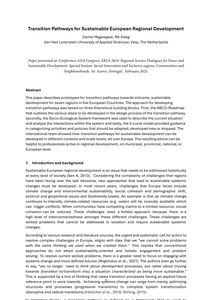
This paper describes prototypes for transition pathways towards inclusive, sustainable development for seven regions in five European Countries. The approach for developing transition pathways was based on three theoretical building blocks. First, the ABCD-Roadmap that outlines the various steps to be developed in the design process of the transition pathway, secondly, the Socio-Ecological-System framework was used to describe the current situation and analyze the interactions within the system and lastly, the X-curve model provided guidance in categorizing activities and policies that should be adapted, developed new or stopped. The international team showed how transition pathways for sustainable development can be developed in different contexts and scale levels, all over Europe. The resulting advice can be helpful to professionals active in regional development, on municipal, provincial, national, or European level.
DOCUMENT
The transition to an inclusive society through design Inclusive design can play a critical role in shaping a more equitable society. When products and services are intentionally created to be inclusive, they become more accessible to a wide audience, including people who might otherwise struggle to engage with them. In this way, designers become agents of social transformation. The project Active Inclusive Design (AID) addresses this challenge directly. It aims to enhance the capabilities of professional and future designers to create inclusive products and services, both digital and non-digital. In doing so, it supports a responsible and digital society central to the Expertise network Systemic Co-design (ESC) agenda, and is closely connected to all ESC Dynamic Learning Agenda (DLA) themes: Systemic Co-Design (SCD) in me, SCD with others, SCD in reality and SCD in time.
LINK
Through the commodification of nature, the framing of the environment as a ‘natural resource’ or ‘ecosystem service’ has become increasingly prominent in international environmental governance. The economic capture approach is promoted by international organizations such as the United Nations Environmental Program (UNEP) through Reducing Emissions from Deforestation and Forest Degradation (REDD), Payments for Ecosystem Services (PES) and The Economics of Ecosystems and Biodiversity (TEEB). This paper will inquire as to how forest protection is related to issues of social and ecological justice, exploring whether forest exploitation based on the top-down managerial model fosters an unequitable distribution of resources. Both top-down and community-based approaches to forest protection will be critically examined and a more inclusive ethical framework to forest protection will be offered. The findings of this examination indicate the need for a renewed focus on existing examples of good practice in addressing both social and ecological need, as well as the necessity to address the less comfortable problem of where compromise appears less possible. The conclusion argues for the need to consider ecological justice as an important aspect of more socially orientated environmental justice for forest protection. https://doi.org/10.1017/S0376892916000436 https://www.linkedin.com/in/helenkopnina/
MULTIFILE




