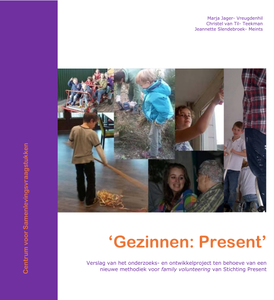
‘Gezinnen: Present!’ is de naam van het onderzoeks- en ontwikkelproject waarin Stichting Present en het Centrum voor Samenlevingsvraagstukken samenwerkten aan de ontwikkeling van een nieuwe methodiek voor family volunteering. Deze rapportage laat de opbrengst zien van anderhalf jaar samenwerken. Present heeft een subsidie gekregen van ZonMw om een aanpak te ontwikkelen speciaal voor gezinnen die zich vrijwillig in willen zetten. In 8 lokale Present-stichtingen (Amersfoort, Dordrecht, Ede, Houten, Gouda, Utrecht, Almere en Zwolle) werd in het onderzoeks- en ontwikkel-project ‘Gezinnen: Present!’ deze aanpak in de praktijk uitgeprobeerd, onderzocht en ontwikkeld. Het project vond plaats in de periode januari 2011 tot en met juni 2012. In deze periode begeleidden de Presentcoördinatoren uit de genoemde plaatsen in totaal 68 gezinnen die zich vrijwillig inzetten voor een ander. Het Centrum voor Samenlevingsvraagstukken ondersteunde het ontwikkel-proces en voerde het onderzoek uit rond de 68 gezinspro-jecten die plaatsvonden.
DOCUMENT
"Objectives: Research on what matters most to people with dementia is crucial for developing tailored interventions and support. This study explored how people with dementia experience their everyday lives, providing insight into what is important to them to live the best they can at home. Methods: Inspired by a phenomenological approach, open interviews were conducted with 15 people with dementia, supplemented by home tours and walking interviews. Data collection included one to three sessions per participant. Data were analysed using descriptive content analysis and followed the phases of open, axial, and selective coding. A co‐researcher group of seven people with dementia was consulted during the analysis to help interpret the emergent findings. Findings: Six dimensions of what matters most in everyday life were identified: 1) Engaging in meaningful activities, which included routines, household chores, leisure, day activities, and volunteering or work; 2) Keeping a sense of connection, in relationships within the home, with family, friends, groups, and the neighbourhood; 3) Having a sense of belonging, which included attachments inside and outside the home, and to cherished objects; 4) Connecting to self, which included the ability to reflect on past experiences, live in the present moment and anticipate the future; 5) Adjusting to ongoing changes, which included alterations in sensory perceptions, perceptions of the physical environment, and navigating shifts in interpersonal dynamics; 6) Being open to help and support, from professionals, community and society. Conclusions: For people with dementia, everyday life is a continuous balancing act between what matters most and what can be achieved daily. This is not only related to dementia but is also embedded in the wider perspective of life history, relational networks, and the physical environment. This study highlights the importance of identifying what matters most to people with dementia to provide person‐centred support."
MULTIFILE

Er zijn in de loop van de jaren varianten op het concept ‘Gezinnen: Present!’ project ontstaan zoals ‘adopteer een gezin of alleenstaande’ in Zwolle of ‘het leukste familie uitje’ in Utrecht. Ook wordt er bijvoorbeeld jaarlijks een ‘wapperdag’ georganiseerd in de Zaanstreek en voeren gezinnen gezamenlijk vrijwillige klussen uit voor de wijk. De commerciële markt heeft het gezin ook ontdekt en bied reizen aan om samen met je gezin vrijwilligerswerk in het buitenland te verrichten. Naast deze landelijke initiatieven is er in de afgelopen jaren weinig onderzoek verricht naar de inzet van gezinnen bij vrijwilligerswerk. Wat mee kan spelen is dat het inzetten van gezinnen meer voorbereiding vergt om ze te werven maar ook om ze te plaatsen op een project. Veel Present coördinatoren geven aan dat je het ‘Gezinnen: Present!’ project er niet ‘bij’ kunt doen en dat er continue geïnvesteerd moet worden in netwerken om gezinnen te werven. Dit is anders dan bij groepen die zich zelf aanmelden en vaak al hebben nagedacht over het project en tijdstip.
DOCUMENT
In many Western welfare states, social work services that have traditionally been provided by paid employees are being replaced by family support, community support, informal networks and volunteering. For the field of social work, it is relevant to know what it matters to beneficiaries whether services are provided by volunteers or by paid employees. The central question of this article is therefore as follows: What are the differences between unpaid and paid social services for beneficiaries? The article is based on literature review and focus groups.Our results suggest that beneficiaries do experience some differences regarding the advantages of volunteer services for beneficiaries that can be summarized in three propositions: (1) Services provided by volunteers are more relational than are services provided by paid employees, and they are therefore perceived as more equal, flexible and sincere. (2) The effects of volunteer services for beneficiaries are not exclusively positive. (3) Although particular tasks may appear to be interchangeable to some extent, the relative advantages of a given task depend upon whether it is performed by a paid worker or by a volunteer. Additional research is needed in order to provide further validation.
DOCUMENT

Within the next decade, the number of professional- and family carers will be insufficient to deal with the increasing demand for care. The shortage on the labor market for health care professionals becomes evident by the time the demand for care exceeds the supply1. In order to find solutions to make the supply of care services sufficient and fitting to the demand for care, researchers, professionals, and business administrations, all in the domain of health care, work together with SMEs in the iKOP project.
DOCUMENT

Study goal: This study was carried out to answer the following research question: which motivation do healthy volunteers have to participate in phase I clinical trials? - Methods: A literature search was done through Google Scholar and Academic Search Premier, followed by three interviews with volunteers who had recently concluded their participation in a (non-commercial) phase I trial. - Results: Our literature search revealed mainly commercial motives for volunteers to participate in phase I clinical trials. The interviews (with volunteers in a non-commercial trial) showed that other factors may also play a decisive role, such as: (1) wish to support the investigator (2) wish to contribute to science, (3) access to more/better health care (4) sociability: possibility to relax and to communicate with other participants (5) general curiosity. Precondition is that risks and burden are deemed acceptable. - Conclusions: financial remuneration appears to be the predominant motive to participate voluntarily in a clinical trial. Other reasons were also mentioned however, such as general curiosity, the drive to contribute to science and the willingness to help the investigator. In addition, social reasons were given such as possibility to relax and to meet other people. Potential subjects state that they adequately assess the (safety) risks of participating in a trial as part of their decision process.
DOCUMENT

Economische impact World Rowing Championships 2014 Van 24 tot 31 augustus 2014 vond op de Bosbaan in Amsterdam de World Rowing Championships (WRC) plaats. Met het oog op de verdere ontwikkeling van het evenement wil de World Rowing Federation (FISA inzicht krijgen in de economische impact van dit evenement. Zij heeft de Hogeschool van Amsterdam in samenwerking met Hogeschool Inholland en Sport2B gevraagd hier onderzoek naar te doen. Daarnaast heeft de FISA enkele aanvullende vragen geformuleerd over de tevredenheid van bezoekers en vrijwilligers. Bezoekers Het bezoekersaantal wordt geschat op 40.000, waarvan 30.000 unieke bezoekers. Buitenlandse bezoekers besteedden gemiddeld 77 euro per dag, Nederlandse bezoekers 27 euro en Amsterdamse bezoekers 20 euro. De bezoekers waren goed voor 28.500 overnachtingen in de dagen rondom het evenement. De totale bestedingsimpuls gerealiseerd door bezoekers bedroeg 3,1 miljoen. Deelnemers In totaal namen 1.800 atleten en begeleiders deel aan het evenement. Conservatief geschat gaven de deelnemers gemiddeld 25 euro per dag uit. De totale additionele uitgaven van atleten en begeleiders komen daarmee op 534.000 euro. In totaal waren de atleten goed voor 19.500 overnachtingen. De totale uitgaven voor de accommodatie komen daarmee op meer dan 2 miljoen euro. Zes nationale teams hebben als voorbereiding op WRC in juni deelgenomen aan de International Rowing Regatta Amsterdam (IRRA), dit genereerde een lokale economische impact van 149.000 euro. De totale bestedingsimpuls gerealiseerd door deelnemers bedroeg 2,7 miljoen euro. Organisatie en media Het saldo van in- en uitgaande geldstromen veroorzaakt door de organisatie en de media bedroeg 0,8 miljoen euro. De totale directe en indirecte economische impact: 9,2 miljoen euro.
DOCUMENT

Given the growing number of older people, society as a whole should ideally provide a higher quality of life (QoL) for its ageing citizens through the concept of personalised ageing. Information and communication technologies (ICT) are subject to constant and rapid development, and can contribute to the goal of an improved QoL for older adults. In order to utilise future ICT solutions as a part of an age-friendly smart environment that helps achieve personalised ageing with an increased QoL, one must first determine whether the existing ICT solutions are satisfying the needs of older people. In order to accomplish that, this study contributes in three ways. First, it proposes a framework for the QoL of older adults, in order to provide a systematic review of the state-of-the-art literature and patents in this field. The second contribution is the finding that selected ICT solutions covered by articles and patents are intended for older adults and are validated by them. The third contribution of the study are the six recommendations that are derived from the review of the literature and the patents which would help move the agenda concerning the QoL of older people and personalised ageing with the use of ICT solutions forward. Original article at MDPI; DOI: http://dx.doi.org/10.3390/ijerph17082940 (This article belongs to the Special Issue Feature Papers "Age-Friendly Cities & Communities: State of the Art and Future Perspectives")
MULTIFILE

This project builds upon a collaboration which has been established since 15 years in the field of social work between teachers and lecturers of Zuyd University, HU University and Elte University. Another network joining this project was CARe Europe, an NGO aimed at improving community care throughout Europe. Before the start of the project already HU University, Tallinn Mental Health Centre and Kwintes were participating in this network. In the course of several international meetings (e.g. CARe Europe conference in Prague in 2005, ENSACT conferences in Dubrovnik in 2009, and Brussels in April 2011, ESN conference in Brussels in March 2011), and many local meetings, it became clear that professionals in the social sector have difficulties to change current practices. There is a great need to develop new methods, which professionals can use to create community care.
DOCUMENT
Increasing attention has been paid to the ‘voice’ of people living with mild cognitive impairment (or dementia, but there is a lack of clarity about how everyday life is perceived from this insiderinsider’s perspective. This study aimed to explore the everyday life experiences, challenges and facilitators of individuals with MC I and dementia living at home.
DOCUMENT




