The importance of a near-native accent. This talk will discuss whether or not it is important for EFL-teachers to try and achieve a near-native generally accepted accent for their students. The focus will be on the credibility of non-native speakers of English while speaking English in a globalising world, with a heavy or mild foreign accent. These days and in the future more and more non-native speakers of English will communicate with each other in English. For a native speaker it is not that difficult to understand a non-native speaker speaking English with a lot of local or regional phonological interferences. For two non-native speakers of different origin, both speaking English with a mild or heavy accent, it might be more likely that confusion about what is being said occurs because of the foreign accent. Research (Shiri Lev-Ari &, Boaz Keysar, Why don't we believe non-native speakers? The influence of accent on credibility, 2010) proves that a near-native accent adds to the credibility of the speaker. In the Netherland most EFL-teachers were trained to speak English with an RP or GA accent. As soon as they start teaching students in secondary education they accept “World English” and most teachers do not pay a lot of attention to pronunciation mistakes made by their students, as long as they can get the message across. During the talk the audience will be asked how important they consider a near-native accent is, what mistakes they accept and don’t accept and in which way teaching pronunciation is an issue in their lessons. Some sound samples with typical mistakes the Dutch make while speaking English will be presented and discussed to see if the audience consider them to be confusing or not. Then a strategy, using phonetics as a tool, will be presented to help correcting a few typical mistakes. session type : talk (30 minutes) Audience; EFL teachers & teacher trainers
MULTIFILE
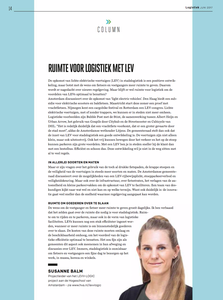
Als lector en als voorzitter van LEV ben ik dagelijks met veiligheid bezig. Hoe we daaraan werken en hoe we daarbij ook omgaan met burgers...het blijft me steeds weer boeien. En verbazen. Meestal gun ik mezelf de tijd niet mijn gedachten vast te leggen. Soms wel. Dan vindt u ze hier. Geschreven op persoonlijke titel. Deze column verscheen eerder in de rubriek Opinie van de Volkskrant (maandag 23 juni).
LINK
Presentatie van resultaten enquete over lichte elektrische voertuigen.
DOCUMENT
The New Aesthetic and Art: Constellations of the Postdigital is an interdisciplinary analysis focusing on new digital phenomena at the intersections of theory and contemporary art. Asserting the unique character of New Aesthetic objects, Contreras-Koterbay and Mirocha trace the origins of the New Aesthetic in visual arts, design, and software, find its presence resonating in various kinds of digital imagery, and track its agency in everyday effects of the intertwined physical world and the digital realm. Contreras-Koterbay and Mirocha bring to light an original perspective that identifies an autonomous quality in common digital objects and examples of art that are increasingly an important influence for today’s culture and society.Influenced by a diverse range of figures, ranging from Vilém Flusser, Arthur Schopenhauer, Immanuel Kant, David Berry, Lev Manovich, Olga Goriunova, Ernst Mayr, Bruce Sterling and, of course, James Bridle, The New Aesthetic and Art: Constellations of the Postdigital doesn’t just propose a description of a new set of objects but radically asserts that New Aesthetic objects analogously function as organisms within a broader digital-physical ecosystems of things and agents.
DOCUMENT

DOCUMENT
DOCUMENT
SEEV4-City is an innovation project funded by the European Union Interreg North Sea Region Programme. Its main objective is to demonstrate smart electric mobility and integration of renewable energy solutions and share the learnings gained. The project reports on the results of six Operational Pilots (OPs) which have different scales and are located in five different cities in four different countries in the North Sea Region.Loughborough OP (United Kingdom) is the smallest pilot, being a household with a bi-directional EV charging unit for the Nissan Leaf, a stationary battery, and a PV system. In the Kortrijk OP (Belgium), a battery system and a bi-directional charging unit for the delivery van (as well as a smart charging station for ebikes) were added to the energy system. In Leicester (United Kingdom), five unidirectional charging units were to be accompanied by four bi-directional charging units. The Johan Cruyff Arena OP is a larger pilot in Amsterdam, with a 2.8 MWh (partly) second life stationary battery storage for Frequency Control Regulation services and back-up power, 14 fast chargers and one bi-directional charger. Integrated into the existing energy system is a 1 MW PV system that is already installed on the roof. In the Oslo OP, 102 chargers were installed, of which two are fast chargers. A stationary battery energy storage system (BESS) supports the charging infrastructure and is used for peak shaving. The FlexPower OP in Amsterdam is the largest OP with over 900 EV charging outlets across the city, providing smart charging capable of reducing the energy peak demand in the evening.Before the start of the project, three Key Performance Indicators (KPIs) were determined:A. Estimated CO2 reductionB. Estimated increase in energy autonomyC. Estimated Savings from Grid Investment Deferral
DOCUMENT

Digital research is taking the humanities by storm. This can be read not only from the many digital humanities programs in education and research in universities around the world but also from the attention for new media practices in humanities and art departments. Famously, and thought-provokingly, media theorist Lev Manovich—strongly rooted in film and media studies—set out to develop a means by which the visual analysis of big data sets of digitized cultural materials could help the study of art and culture transition into the era of big data or, as he calls it, 90the era of “more media” (Manovich, 2009). Often met with scrutiny by art historians, not in favor of a quantitative approach to the arts, Manovich insisted with this “cultural analytics” program on expanding the study of culture by including the vast amounts of user-generated content. As he wrote as early as 2009: “Think about this: the number of images uploaded to Flickr every week is probably larger than all objects contained in all art museums in the world.” Manovich developed the Software Studies Initiative, where he and his team developed software such as Image Plot, for the analysis of large visual data sets. Manovich applies his methods both to digitized materials (such as Time magazine covers) as well as—more recently—to born-digital content (such as selfies on Instagram).
LINK