Fashion and textile practice transitioned over the past decade from a physically engaged design practice into a screen-based design practice with textiles simulated on digital bodies. Digital designers use tangible interaction with textiles for post-phenomenological design considerations. Our research indicates a complementary relationship between tangible interaction and drape observation, which allows for new approaches when considering textile materials. The drape observation based on drape measurement methods developed in textile science equips designers with a deeper material understanding. As the flat textile is placed in the scientific setup, the deformation and the designer's experience co-shape design considerations. The physical-to-digital paradigm shift disconnects designers from the tangible interaction with the textile. Fashion designers' approach contrasts with textile science methods to measure textile properties (needed to simulate textiles) and drape. Equipping designers with this understanding of textile technology requires interdisciplinary developments to make combined tangible drape tools accessible in physical and digital design spaces. Understanding design considerations in physical-digital practices and material drape, utilizing simulated textile properties, is essential for this endeavor. Cross-disciplinary understanding of textiles and similar soft materials between fashion designers, design researchers, textile and computer researchers, and cultural heritage researchers seems valuable in reducing measurement hurdles and creating tools to increase relationships between the physical and digital textiles and improving visual analyses and assessment of textiles. Our reflection to sharpen the post-phenomenological lens and cross-disciplinary collaborations of our past and future research contributes to understanding physical-digital textile design considerations and required cross-disciplinary interaction.
MULTIFILE
Fashion design has rapidly become a digital process where textiles are simulated as soft, conformable materials on a digital body. The embodied experience and physical interaction with the textile have been replaced by screen-based media, resulting in a gap in understanding between physical and digital textile material. Consequently, understanding digitized textile properties and characteristics has become challenging for practitioners. This research investigates fashion designers’ implicit understanding when selecting textiles, specifically how interactions with physical textiles influence design considerations. Twenty digital fashion designers interacted with ten physical textile materials via tangible and scientific drape measurements, reflecting upon their design considerations. In digital environments, a tangible understanding of material properties is vital, and scientific drape measurements add significant understanding to digital design. The research advances our understanding of integrating digital tools in textile and soft material practices, where a postphenomenological approach is employed to help formulate the design considerations in selecting materials.
DOCUMENT

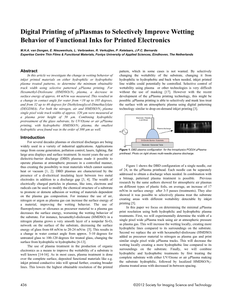
In this article we investigate the change in wetting behavior of inkjet printed materials on either hydrophilic or hydrophobic plasma treated patterns, to determine the minimum obtainable track width using selective patterned μPlasma printing. For Hexamethyl-Disiloxane (HMDSO)/N2 plasma, a decrease in surface energy of approx. 44 mN/m was measured. This resulted in a change in contact angle for water from <10 up to 105 degrees, and from 32 up to 46 degrees for Diethyleneglycol-Dimethaclylate (DEGDMA). For both the nitrogen, air and HMDSO/N2 plasma single pixel wide track widths of approx. 320 μm were measured at a plasma print height of 50 μm. Combining hydrophilic pretreatment of the glass substrate, by UV/Ozone or air μPlasma printing, with hydrophobic HMDSO/N2 plasma, the smallest hydrophilic area found was in the order of 300 μm as well.
DOCUMENT
Adhesive tape is a common piece of evidence that can contain a myriad of traces. Due to its adhesive properties, adhesive tape can potentially collect traces unrelated to the crime or relocate crime-relevant traces. This secondary transfer of traces can have crucial implications for the evaluation at the activity level. Therefore, this study investigated the secondary transfer of DNA between layers of adhesive tape and tape and other case- and laboratory-relevant substrates. A drop of diluted blood was deposited on different primary substrates (i.e. duct tape, metal, plastic, textile, nitrile gloves). Subsequently, the primary substrate was brought into contact with a secondary substrate, and DNA was collected from both surfaces to measure transfer rates. The highest transfer rates were detected between the adhesive side of the tape and plastic, whereas the lowest transfer rates were detected between the adhesive side and textile. It was shown that the adhesive readily collects DNA from plastic and nitrile gloves commonly used in the laboratory, which highlights the importance of working with DNA-free materials. Therefore, this study demonstrated the need for caution when interpreting traces on adhesive tapes, always taking possible situations of secondary transfer into account.
DOCUMENT
Network Applied Design Research (NADR) made an inventory of the current state of Circular Design Research in the Netherlands. In this publication, readers will find a summary of six promising ‘gateways to circularity’ that may serve as entry points for future research initiatives. These six gateways are: Looped Systems; Extension of Useful Lifetime; Servitisation; New Materials and Production Techniques; Information Technology and Digitization; and Creating Public and Industry Awareness. The final chapter offers an outlook into topics that require more profound examination. The NADR hopes that this publication will serve as a starting point for discussions among designers, entrepreneurs, and researchers, with the goal of initiating future collaborative projects. It is the NADR's belief that only through intensive international cooperation, we can contribute to the realization of a sustainable, circular, and habitable world.
DOCUMENT

geen samenvatting beschikbaar
DOCUMENT

What would Dutch society lose if the Tourism and Recreation sector does not survive and what is needed to preserve its societal value and, preferably even, enhance this value? In this report a combination of methods is used to answer the research question: a literature study, case studies, and a survey among entrepreneurs. A substantial number of scientific articles, advisory reports and conference contributions were analysed in various contexts and for different forms of T&R. In the literature study societal contributions were brought together in a structured manner. The cases reflect the breadth of the sector and serve as good examples of how the sector achieves its societal value, but they also illustrate the challenges. The survey produced several insights. Respondents were asked, for instance, to indicate for each societal value whether they saw a positive, negative or no contribution of the sector. By means of a points system a top 25 was composed and put into a table., this table was used to structure the findings from the study.
DOCUMENT

This essay explores the notion of resilience by providing a theoretical context and subsequently linking it to the management of safety and security. The distinct worlds of international security, industrial safety and public security have distinct risks as well as distinct ‘core purposes and integrities’ as understood by resilience scholars. In dealing with risks one could argue there are three broad approaches: cost-benefit analysis, precaution and resilience. In order to distinguish the more recent approach of resilience, the idea of adaptation will be contrasted to mitigation. First, a general outline is provided of what resilience implies as a way to survive and thrive in the face of adversity. After that, a translation of resilience for the management of safety and security is described. LinkedIn: https://www.linkedin.com/in/juul-gooren-phd-cpp-a1180622/
DOCUMENT

Closed loop or ‘circular’ production systems known as Circular Economy and Cradle to Cradle represent a unique opportunity to radically revise the currently wasteful system of production. One of the challenges of such systems is that circular products need to be both produced locally with minimum environmental footprint and simultaneously satisfy demand of global consumers. This article presents a literature review that describes the application of circular methodologies to education for sustainability, which has been slow to adopt circular systems to the curriculum. This article discusses how Bachelor and Master-level students apply their understanding of these frameworks to corporate case studies. Two assignment-related case studies are summarized, both of which analyze products that claim to be 'circular'. The students' research shows that the first case, which describes the impact of a hybrid material soda bottle, does not meet circularity criteria. The second case study, which describes products and applications of a mushroom-based material, is more sustainable. However, the students' research shows that the manufacturers have omitted transport from the environmental impact assessment and therefore the mushroom materials may not be as sustainable as the manufacturers claim. As these particular examples showed students how green advertising can be misleading, applying “ideal” circularity principles as part of experiential learning could strengthen the curriculum. Additionally, this article recommends that sustainable business curriculum should also focus on de-growth and steady-state economy, with these radical alternatives to production becoming a central focus of education of responsible citizens. https://doi.org/10.1016/j.jclepro.2019.02.005 LinkedIn: https://www.linkedin.com/in/helenkopnina/
MULTIFILE

The scope of this thesis of Gerrit Bouwhuis, lecturer at Saxion Research Centre for Design and Technology in Enschede is the development of a new industrial applicable pre-treatment process for cotton based on catalysis. The pre-treatment generally consists of desizing, scouring and bleaching. These processes can be continuous or batch wise. Advances in the science of biocatalytic pre-treatment of cotton and catalytic bleaching formed the scientific basis for this work. The work of Agrawal on enzymes for bio-scouring and of Topalovic on catalytic bleaching led to the conclusion that reduced reaction temperatures for the pre-treatment processes of cotton are possible. A second reason for the present work is a persistent and strong pressure on the industry to implement ‘more sustainable’ and environmental friendlier processes. It was clear that for the industrial implementation of the newly developed process it would be necessary to ‘translate’ the academic knowledge based on the catalysts, into a process at conditions that are applicable in textile industry. Previous experiences learned that the transition from academic knowledge into industrial applicable processes often failed. This is caused by lack of experience of university researchers with industrial product and process development as well as a lack of awareness of industrial developers of academic research. This is especially evident for the so-called Small and Medium Enterprises (SME’s). To overcome this gap a first step was to organize collaboration between academic institutes and industries. The basis for the collaboration was the prospect of this work for benefits for all parties involved. A rational approach has been adopted by first gathering knowledge about the properties and morphology of cotton and the know how on the conventional pre-treatment process. To be able to understand the conventional processes it was necessary not only to explore the chemical and physical aspects but also to evaluate the process conditions and equipment that are used. This information has been the basis for the present lab research on combined bio-catalytic desizing and scouring as well as catalytic bleaching. For the measurement of the performance of the treatments and the process steps, the performance indicators have been evaluated and selected. Here the choice has been made to use industrially known and accepted performance indicators. For the new bio-catalytic pre-treatment an enzyme cocktail, consisting of amylase, cutinase and pectinase has been developed. The process conditions in the enzyme cocktail tests have been explored reflecting different pre-treatment equipment as they are used in practice and for their different operation conditions. The exploration showed that combined bio-catalytic desizing and scouring seemed attractive for industrial application, with major reduction of the reaction and the rinsing temperatures, leading to several advantages. The performance of this treatment, when compared with the existing industrial treatment showed that the quality of the treated fabric was comparable or better than the present industrial standard, while concentrations enzymes in the cocktail have not yet been fully optimized. To explore the application of a manganese catalyst in the bleaching step of the pre-treatment process the fabrics were treated with the enzyme cocktail prior to the bleaching. It has been decided not to use conventional pre-treatment processes because in that case the combined desizing and scouring step would not be integrated in the newly developed process. To explore catalytic bleaching it has been tried to mimic the existing industrial processes where possible. The use of the catalyst at 100°C, as occurs in a conventional steamer, leads to decomposition of the catalyst and thus no bleach activation occurs. This led to the conclusion that catalytic bleaching is not possible in present steamers nor at low temperatur
MULTIFILE



