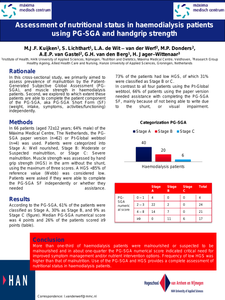
In this cross-sectional study, we primarily aimed to assess prevalence of malnutrition by the Patient Generated Subjective Global Assessment (PGSGA), and muscle strength in haemodialysis patients. Second, we explored to which extent these patients are able to complete the patient component of the PG-SGA, aka PG-SGA Short Form (SF) (weight, intake, symptoms, activities/functioning) independently.
DOCUMENT
PURPOSE: Malnutrition is frequent in hospitalized patients and is related to functional decline and poorer clinical outcomes. The Patient-Generated Subjective Global Assessment (PG-SGA) is a globally implemented malnutrition tool. We aimed to perform a linguistic and content validation of the translation and cultural adaptation of the PG-SGA for the Spanish language setting.METHODS: This study was conducted in Mexico and Spain. Cancer patients and healthcare professionals (HCPs) of both countries were enrolled. We followed the 10 steps of the International Society for Pharmacoeconomics and Outcomes Research Principles. Patients and HCPs evaluated comprehensibility (Item: I-CI, Scale: S-CI) and difficulty (Item: I-DI, Scale: S-DI) of the Spanish version of the PG-SGA. HCPs also evaluated content validity (i.e., relevance) of the Spanish PG-SGA (Item: I-CVI, Scale: S-CVI). The data were collected by a questionnaire.RESULTS: The study enrolled 84 HCPs and 196 cancer patients from both countries. HCPs rated comprehensibility and difficulty of the professional component as excellent (S-CI = 0.95, S-DI = 0.92), and content validity of the full PG-SGA also as excellent. Patients rated comprehensibility (S-CI) and difficulty (S-DI) of the patient-generated component, that is, the PG-SGA Short Form, as "excellent" (S-CI = 0.98 and S-DI = 0.98).CONCLUSION: Translation and cultural adaptation of the PG-SGA to the Spanish setting according to the International Society for Pharmacoeconomics and Outcomes Research Principles resulted in an instrument perceived as clear and easy to complete by cancer patients and relevant by HCPs to assess the nutritional status.
DOCUMENT
Rationale: The Patient-Generated Subjective Global Assessment (PG-SGA) is a validated instrument to assess malnutrition and its risk factors in clinical populations. Its patient component, PG-SGA Short Form (SF), can be used as screening instrument. In this cross-sectional study we aimed to assess agreement between the PG-SGA SF, Malnutrition Universal Screening Tool (MUST), and Short Nutritional Assessment Questionnaire (SNAQ) in patients at the University Medical Center Groningen, The Netherlands.Methods: Malnutrition risk was assessed by PG-SGA SF, MUST, and SNAQ in 81 patients from the Departments Ear Nose Throat (ENT), Oral and Maxillofacial Surgery (OMS) and Orthopedics. Point scores of PG-SGA SF=4-8, MUST=1, and SNAQ=2 were classified as ‘medium malnutrition risk’, and PG-SGA SF≥9, MUST ≥2, and SNAQ ≥3 as ‘high malnutrition risk’. Agreement in classification for malnutrition risk was assessed by weighted kappa (κ) and intra-class correlation coefficient (ICC). A p-value of <0.05 was considered statistically significant.Results: According to the PG-SGA SF, MUST and SNAQ, respectively 65%, 81%, and 80% of all patients were classified as ‘low malnutrition risk’; 24%, 8% and 6% as ‘medium malnutrition risk’; 11%, 10% and 14% as ‘high malnutrition risk’.Agreement between PG-SGA SF and MUST (κ=0.452, ICC=0.448; p<0.001), and between PG-SGA SF and SNAQ (κ=0.395, ICC=0.395; p<0.001) were both fair. In patients from the Departments ENT and OMS, PG-SGA SF classified more patients at medium/high malnutrition risk (n=26) as compared to the MUST (n=12) or SNAQ (n=14).Conclusion: We found only fair agreement between the PG-SGA SF and MUST and SNAQ, respectively. The PG-SGA SF classified three and four times more patients at medium malnutrition risk, compared to MUST and SNAQ respectively, due to its scoring on symptoms and activities/functioning. Hence, the PG-SGA SF may help facilitate proactive prevention of malnutrition.
DOCUMENT

Rationale: The PG-SGA is a validated instrument to assess malnutrition and its risk factors. Its patient component, i.e. the PG-SGA Short Form (SF), can be used as screening instrument. In this multicenter study, we aimed to assess diagnostic accuracy of the PG-SGA SF and NRS 2002, in patients at the Internal Medicine ward.Methods: In 192 patients (76.0±13.5 years; 53% female) in 9 Portuguese internal medicine wards, malnutrition risk was assessed by PG-SGA SF and NRS 2002. PG-SGA SF ≤8 was defined as low/medium malnutrition risk and NRS 2002 ≤2 as low risk. PG-SGA SF ≥9 and NRS 2002 ≥3 were defined as high malnutrition risk. Nutritional status was assessed by the full PG-SGA (reference method). Malnutrition was defined as PG-SGA Stage B (moderate/suspected malnutrition) or Stage C (severely malnourished). Diagnostic accuracy was tested by sensitivity, specificity, positive and negative predictive value, and receiver operating curve. Agreement between PG-SGA and NRS-2002 was tested by McNemar’s test and Cohen’s kappa (κ).Results: Forty-six % and 53% were categorized as at risk of malnutrition by PG-SGA SF and NRS 2002, respectively. In total, 55% were malnourished. Sensitivity, specificity, positive and negative predictive value of PG-SGA SF and NRS 2002 were 0.84, 1.00, 1.00, 0.83 and 0.74, 0.74, 0.77 and 0.70, respectively. Area under curve of PG-SGA SF and NRS 2002 was 0.987 and 0.778 respectively. McNemar’s test showed no significant disagreement (p=0.86) between PG-SGA SF and NRS 2002. Cohen’s kappa showed weak agreement (κ=0.492; p<0.001) (Table 1).Conclusion: Our findings indicate that in patients at the internal medicine ward, PG-SGA SF shows better diagnostic accuracy than NRS 2002, i.e. better sensitivity and specificity.
LINK
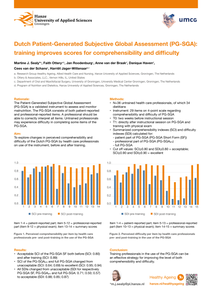
Rationale: The Patient-Generated Subjective Global Assessment (PG-SGA) is a validated instrument to assess and monitor malnutrition, which consists of both patient-reported and professional-reported items. A professional should be able to correctly interpret all items. Untrained professionals may experience difficulty in completing some items of the PG-SGA. We aimed to explore the change in perceived comprehensibility and difficulty of the Dutch PG-SGA by health care professionals on the use of the instrument, before and after training.Methods: A sample of 36 untrained health care professionals, of which 34 dietitians, completed a set of 29 items on a four point scale regarding comprehensibility and difficulty of the PG-SGA on two separate occasions: T0) two weeks before and T1) directly after an instructional session on the PG-SGA and training with the physical exam. Summarized comprehensibility indexes (SCI) and difficulty indexes (SDI) were calculated for the patient part of the PG-SGA (aka PG-SGA Short Form; PG-SGA SF), the professional part of the PG-SGA (PG-SGApro) and the full PG-SGA, to quantify the level of perceived comprehensibility and difficulty. SCI≥0.80 and SDI≥0.80 were considered acceptable, SCI≥0.90 and SDI≥0.90 were considered excellent.Results: SCI of the PG-SGA SF was acceptable both before (SCI: 0.80) and after training (SCI: 0.89). SCI of the PG-SGApro and full PG-SGA changed from unacceptable (SCI: 0.64; 0.69) to excellent (SCI: 0.95; 0.94). All SDIs changed from unacceptable (SDI for respectively PG-SGA SF, PG-SGApro and full PG-SGA: 0.71; 0.50; 0.57) to acceptable (SDI: 0.88; 0.85; 0.87).Conclusion: Training professionals in the use of the PG-SGA can be an effective strategy for improving the level of both comprehensibility and difficulty.
DOCUMENT
The Patient-Generated Subjective Global Assessment (PG-SGA) is an instrument to screen, assess and monitor malnutrition and risk factors, and to triage for interventions. After having translated and culturally adapted the original PG-SGA for the Italian setting, according to International Society for Pharmacoeconomics and Outcomes Research (ISPOR) Principles, we tested linguistic validity, i.e., perceived comprehensibility and difficulty, and content validity (relevance) of the Italian version of the PG-SGA in patients with cancer and a multidisciplinary sample of healthcare professionals (HCPs). Methods: After the translation and cultural adaptation of the original PG-SGA for the Italian setting, the patient component (i.e., PG-SGA Short Form (SF) was tested for linguistic validity (i.e., comprehensibility ad difficulty) in 120 Italian patients with cancer and 81 Italian HCPs. The full PG-SGA, i.e., patient and professional component of the PG-SGA, was tested for content validity, i.e., relevance, in 81 Italian HCPs. The data were collected by a questionnaire and evaluations were operationalized by a 4-point scale. Through item and scale indices we evaluated the comprehensibility (I–CI, S–CI), difficulty (I-DI, S-DI) and content validity (I-CVI, S-CVI). Scale indices 0.80–0.89 were considered acceptable, and scale indices ≥0.90 were considered excellent. Results: Patients perceived comprehensibility and difficulty of the PG-SGA SF (Boxes) as excellent (S–CI = 0.98, S-DI = 0.96). Professionals perceived comprehensibility of the professional component (Worksheets) as excellent (S–CI = 0.92), difficulty as acceptable (S-DI = 0.85), and content validity of the full PG-SGA as excellent (S-CVI = 0.92). Dietitians gave higher scores (indicating better scores) on comprehensibility, difficulty, and content validity of Worksheet 4 (physical exam) than the other professions. In Worksheet 4, four items were considered most difficult to complete and were considered below acceptable range. Relevance was perceived as excellent by professionals for both the patient component (S-CVI = 0.93) and the professional component (S-CVI = 0.90), resulting in S-CVI = 0.92 for the full PG-SGA. Slight textual modifications were implemented resulting in the final version of the Italian PG-SGA. Conclusions: Translation and cultural adaptation of the original PG-SGA resulted in the Italian version of the PG-SGA that maintained its original purpose and meaning and can be completed adequately and easily by patients and professionals. The Italian PG-SGA is considered relevant for screening, assessing and monitoring malnutrition and risk factors, as well as triaging for interventions by Italian HCPs.
DOCUMENT

BACKGROUND/OBJECTIVES: Traditional malnutrition screening instruments, including the Malnutrition Universal Screening Tool (MUST), strongly rely on low body mass index (BMI) and weight loss. In overweight/obese patients, this may result in underdetection of malnutrition risk. Alternative instruments, like the Patient-Generated Subjective Global Assessment Short Form (PG-SGA SF), include characteristics and risk factors irrespective of BMI. Therefore, we aimed to compare performance of MUST and PG-SGA SF in malnutrition risk evaluation in overweight/obese hospitalized patients.SUBJECTS/METHODS: We assessed malnutrition risk using MUST (≥1 = increased risk) and PG-SGA SF (≥4 = increased risk) in adult patients at hospital admission in a university hospital. We compared results for patients with BMI < 25 kg/m 2 vs. BMI ≥ 25 kg/m 2. RESULTS: Of 430 patients analyzed (58 ± 16 years, 53% male, BMI 26.9 ± 5.5 kg/m 2), 35% were overweight and 25% obese. Malnutrition risk was present in 16% according to MUST and 42% according to PG-SGA SF. In patients with BMI < 25 kg/m 2, MUST identified 31% as at risk vs. 52% by PG-SGA SF. In patients with BMI ≥ 25 kg/m 2, MUST identified 5% as at risk vs. 36% by PG-SGA SF. Agreement between MUST and PG-SGA SF was low (к = 0.143). Of the overweight/obese patients at risk according to PG-SGA SF, 83/92 (90%) were categorized as low risk by MUST. CONCLUSIONS: More than one-third of overweight/obese patients is at risk for malnutrition at hospital admission according to PG-SGA SF. Most of them are not identified by MUST. Awareness of BMI-dependency of malnutrition screening instruments and potential underestimation of malnutrition risk in overweight/obese patients by using these instruments is warranted.
DOCUMENT
Rationale: The Scored Patient-Generated Subjective Global Assessment (PG-SGA) is a multidimensional tool to assess malnutrition and risk factors. We aimed to translate and cross-culturally adapt the original PG-SGA for the Thai setting and test its linguistic validity and intra-rater reliability in cancer patients.Methods: The Thai version of the PG-SGA was developed according to the Principles of Good Practice for the Translation and Cultural Adaptation Process for the Patient Reported Outcomes by the International Society for Pharmacoeconomics and Outcomes Research (ISPOR). In 50 cancer patients and 50 healthcare professionals, linguistic validity of the Thai PG-SGA was assessed by Scale Comprehensibility Index (S-CI) and Scale Difficulty Index (S-DI) ), using a 4-point scale. Relevance was assessed in professionals only, by Scale Content Validity Index (S-CVI). In addition, intra-rater reliability (test-retest within 72 hours of admission; Intraclass Correlation Coefficient (ICC) and weighted kappa (κ)) were assessed. Results: The Thai PG-SGA showed excellent comprehensibility (S-CI=0.99) and difficulty (S-DI=0.95) as perceived by patients. It also showed excellent comprehensibility (S-CI= 0.92) and borderline acceptable difficulty (S-DI=0.79) as perceived by professionals. Relevance of the Thai PG-SGA in assessing malnutrition was considered excellent (S-CVI=0.95). Agreement between numerical scores was good to excellent (ICC=0.95) and agreement between PG-SGA categories was very good (weighted κ=0.95).Conclusion: The Thai version of the PG-SGA was considered very easy to complete by patients. Professionals evaluated it as very comprehensible, relevant, and borderline acceptable in difficulty to complete. It is a reliable tool for assessment of malnutrition and risk factors in cancer patients.
LINK
Background & aimsThe Scored Patient-Generated Subjective Global Assessment (PG-SGA©) is a validated nutritional screening, assessment, monitoring, and triage tool. When translated to other languages, the questions and answering items need to be conceptually, semantically, and operationally equivalent to the original tool. In this study, we aimed to assess linguistic and content validity of the PG-SGA translated and culturally adapted for the Norwegian setting, as perceived by Norwegian cancer patients and healthcare professionals (HCPs).MethodsWe have translated and culturally adapted the original PG-SGA for the Norwegian setting, in concordance with the International Society for Pharmacoeconomics and Outcomes Research (ISPOR). Cancer patients and HCPs, including nurses, dietitians and physicians, were invited to participate. Comprehensibility and difficulty were assessed by patients for the patient component (PG-SGA Short Form), and by HCPs for the professional component. Content validity was assessed for the full PG-SGA by HCPs only. The data were collected by a questionnaire and evaluations were operationalized by a 4-point scale. Item and scale indices were calculated for comprehensibility (Item CI, Scale CI), difficulty (Item DI, Scale DI) and content validity (Item CVI, Scale CVI).ResultsFifty-one cancer patients and 92 HCPs participated in the study. The patients perceived comprehensibility and difficulty of the Norwegian PG-SGA Short Form as excellent (Scale CI = 0.99 and DI = 0.97). However, HCPs perceived comprehensibility and difficulty of the professional component as below acceptable (Scale CI = 0.78 and DI = 0.66), and the physical exam was being rated as the most difficult part (Item DI 0.26 to 0.65). Content validity for the full Norwegian PG-SGA was considered excellent (Scale CVI = 0.99) by the HCPs.ConclusionThe patient component of PG-SGA was considered clear and easy to complete, and the full Norwegian PG-SGA was considered as relevant by HCPs. In the final Norwegian PG-SGA, changes have been made to improve comprehensibility of the professional component. To improve perceived difficulty of completing the professional component, training of professionals is indicated.
DOCUMENT

Background: Nutritional assessment is considered to be an important element in the nutrition care process of cancer patients, since nutritional status is positively associated with health outcome. The Scored Patient-Generated Subjective Global Assessment (PG-SGA) is a multidimensional nutritional assessment tool, developed for the oncology setting1. The PG-SGA was originally developed in English and until now an official Dutch translation was not available. We primarily aimed to develop a cross-cultural adaptation of the PG-SGA for the Dutch setting. Methods: The study design was developed conform the " Principles of Good Practice for the Translation and Cultural Adaption Process for Patient Reported Outcomes” by the International Society for Pharmacoeconomics and Outcomes Research (ISPOR)2. Results: The patients reported excellent understanding of the Dutch translated PG-SGA and perceived the items as easy to fill in. Comprehensibility of the items completed by the professionals was experienced as 'acceptable’, but they also experienced the items as difficult to complete. Professionals deemed the overall PG-SGA to be relevant and appropriate in the assessment of malnutrition in oncology patients. Overall, the professionals considered layout and time-consuming nature as barriers for applying the Dutch PG-SGA in daily practice. Conclusion: The Dutch cross-cultural adaptation of the PG-SGA was considered easy and was well understood by patients. Professionals evaluated the PG-SGA as relevant, but had some issues with lay out, elaborateness and difficulty of items regarding physical examination. To increase the accessibility and applicability of the PG-SGA for clinicians, training of these professionals is needed.
DOCUMENT



