Exploration of the Video Essay format about the impact of political and cultural factors in the Philippines.
LINK
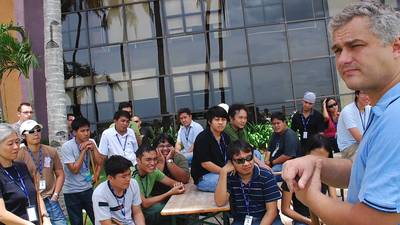
In 1996 innovative, double major teacher education programs for Physics & Mathematics and Physics & Chemistry were initiated at the University of San Carlos in Cebu, Philippines. Both programs require 4 years of study. From the outset the focus was on making a difference in the quality of Science and Mathematics Teacher Education, producing teachers with a good mastery of subject matter and able to teach the subjects in exciting and effective ways in typical Philippine crowded and resource-poor classrooms. The programs recruit top high school graduates using a promotion and scholarship scheme and then expose them to the best science lecturers at the university, and create a special learning environment for the duration of their training. Early 2011 a study was conducted to assess long term effects of the programs through a tracer study of the 300 alumni, interviews, and 22classroom visits to observe their teaching. Of the 300 alumni 245 are still teaching of whom 33 abroad (mainly USA) and 212 in the Philippines. Alumni are highly valued by principals of the top schools in Cebu and their students win many local and even national science competitions. Their teaching is competent with lots of interaction and good subject matter mastery, but they are also facing some typical Philippine education problems.
MULTIFILE

Metropolitan Cebu, the third largest agglomeration in the Philippines with a population of approximately 3 million, faces significant challenges in managing domestic wastewater and solid waste. This mismanagement has led to the pollution of its water bodies, including the Mahiga Creek and the Butuanon River, the latter of which was declared dead in 1992 and can no longer support flora and fauna. Between 2017 and 2025, seven international River Challenge Climate Cafes were conducted by Dutch universities of Applied Sciences and Filipino universities . During these events, teams of young professionals assessed the upstream, midstream, and downstream stretches of Metro Cebu's rivers and evaluated the vulnerability of 12 urban poor communities living along these rivers. The primary aim of these rapid appraisals was to raise awareness among community members, local governments, and students, as well as to build capacity. Throughout the process, there was a shift from merely gathering data on pollution levels to engaging the community, identifying risks, and finding feasible solutions to mitigate these risks. Various methods were employed to measure water quality, river width, river discharge, flood heights, ecology, plastic waste pollution, and residents' perceptions. The results were shared online via Climatescan.org with the global climate adaptation community. The findings demonstrate that river challenges are effective tools for creating context-rich learning environments for students, with more than 250 participants. The River Challenge Climate Cafe enable young professionals, primarily with technical backgrounds, to gain firsthand field experience, exposure to environmental degradation, severe pollution, and vulnerable communities, thereby enhancing their environmental awareness. Additionally, the river scan challenge proves to be a valuable tool for increasing awareness of river pollution and promoting rehabilitation effortsHow to cite: Heikoop, R., Boogaard, F., Abrenica, B., Fornis, R., Borgonia, K., Ledesma, D., Nasara, J., Boer, E., and Oudendammer, T.: Enhancing Environmental Awareness Through River Challenges: A Case Study of Metropolitan Cebu, Philippines , 12th International Conference on Urban Climate, Rotterdam, The Netherlands, 7–11 Jul 2025, ICUC12-1052, https://doi.org/10.5194/icuc12-1052, 2025.
LINK
Effects of climate change in cities are evident and are expected to increase in the future, demanding adaptation. In order to share knowledge, raise awareness, and build capacity on climate adaptation, the first concept of a “ClimateCafé” has been utilized since 2012 in 25 events all over the world. In 8 years ClimateCafé grew into a field education concept involving different fields of science and practice for capacity building in climate change adaptation. This chapter describes the need, method, and results of ClimateCafés and provides tools for organizing a ClimateCafé in a context-specific case. Early ClimateCafés in the Philippines are compared with the ClimateCafé in Peru to elucidate the development of this movement, in which one of the participants of ClimateCafé Philippines 2016 became the co-organizer of ClimateCafé Peru in 2019. The described progress of ClimateCafés provides detailed information on the dynamic methodological aspects, holding different workshops. The workshops aim at generating context-specific data on climate adaptation by using tools and innovative data collection techniques addressing deep uncertainties that come with climate change adaptation. Results of the workshops show that context-specific, relevant, multidisciplinary data can be gathered in a short period of time with limited resources, which promotes the generation of ideas that can be used by local stakeholders in their local context. A ClimateCafé therefore stimulates accelerated climate action and support for adaptation solutions, from the international and the local, from the public and private sector, to ensure we learn from each other and work together for a climate resilient future. The methodology of ClimateCafé is still maturing and the evaluation of the ClimateCafés over time leads to improvements which are applied during upcoming ClimateCafés, giving a clear direction for further development of this methodology for knowledge exchange, capacity building, and bridging the gap between disciplines within climate adaptation.
DOCUMENT

Climate change and urbanization will increase the frequency and magnitude of urban flooding and water quality problems in many regions of the world. In coastal and delta areas like The Netherlands and the Philippines, where urbanization is often high, there has been an increase in the adoption of sustainable urban drainage systems (SUDS). SUDS are installed around the world with the expectation to reduce urban flooding and reduce the pollution impact on receiving waters. Most cities in Asia are starting to implement SUDS as their strategy to make their cities sustainable and resilient.The combination of SUDS with appropriate wastewater treatment and management systems have the potential to be multifunctional in alleviating flood run-off, improving water quality, alleviating heat stress and as a source for reusing the stormwater and wastewater.Since the earliest SUDS are implemented in Europe decades ago it is advised to use the lessons learnt in this process. International knowledge exchange is promoted in projects as IWASTO where several organisations from the Philippines and The Netherlands join forces on a specific region as the Pateros riverin Manila with the aim to minimise the pollution impact on this receiving water. The first findings of this project related to storm water and wastewater management are presented in this paper. In this stage of the project high level support models that map the challenges in the city (such as flooding and heatstress) arevaluable tools for implementing cost effective sustainable drainage for improving water quality.
DOCUMENT

Implementation of the United Nations Convention on the rights of persons with disabilities (UN CRPD) requires countries to harmonise their legislative frameworks with it. This paper investigates the national legislative frameworks of four Asian countries to see the extent to which they provide support services in accordance with Article 19 of the UN CRPD. The UN CRPD requires persons with disabilities to have access to and choice and control over support services. To analyse the policy alignment with the UN CRPD, an analytical framework based on the Capability Approach (CA) was developed. The results show that most countries address support services, including assistive devices, only from the perspective of a social security measure for persons with disabilities living in poverty, failing to uphold the rights of those not meeting those eligibility criteria. However, while support services are inseparably linked to social security, they also are a right for persons with disabilities. Therefore, a paradigm shift is required in the approach of support services and the distributive systems of countries, from one that addresses persons with disabilities as those requiring care considered a burden, to one that considers them rights holders with equal opportunities, for which, support services are a pre-requisite.
DOCUMENT

We examine the ways in which a hidden crisis can be exposed from a communication point of view. In which way can organisations create general awareness of a crisis and try to understand the dynamic nature of interactions? With the help of discourse analysis, we have examined the interactional achievements of two crisis entrepreneurs in the domain of education in the Netherlands: a rector of a secondary school and the founders of BON, a social movement aimed at improving the quality of education. In this way, we will illustrate the discursive practices that play an active role when certain players signal a crisis.
DOCUMENT

From the article: "The term Internet of Things (IoT) is used for situations where one or more devices are connected to a network or possibly the Internet. Most studies focus on the possibilities that arise when a device is capable to share its data with other devices or humans. In this study, the focus is on the device itself and what kind of possibilities an Internet connection gives to the device and its owner or user. Also the data the device needs to participate in a smart way in the IoT are part of this study. Agent technology is the enabling technology for the ideas introduced here. A proof of concept is given, where some concepts proposed in the paper are put into practice."
MULTIFILE
In coastal and low-lying vulnerable delta cities, such as the Rotterdam Metropolitan region and Metropolitan Manila, there has been an increase in vulnerability of urban flooding and water quality problems. New approaches address the current and future effects of climate change and increase urban quality, reduce vulnerability and increase water quality. New arrangements for international cooperation are set up in order to address these problems in the project 'IWASTO' ('to correct and to prevent') where several organisations from the Philippines and The Netherlands join forces to rehabilitate rivers and introduce new innovations for water quality monitoring and waste collection using the 'Research Design and Manufacaturing (RDM)' approach. One of the concrete results from this RDM approach in 2016 is the development and implementation of the 'Longganisa', a waste collection tool that was designed by a Dutch- Philippine team. In addition, the waterquality was measured and mapped with innovating methods using apps in order to locate and prioritize highly polluted areas. In the near future measures will be implemented to rehabilitate the rivers in Manila and a knowledge exchange forum will be set up to share the best management practices on international scale in countries as Indonesia, India and China.
DOCUMENT



