This video presents BiebBeep, an interactive touchscreen system that has been developed with the aim to support information and social services for the New Library in Almere, The Netherlands. The constantly updated information displayed on the interactive screen concerns not only the library itself, but also features happenings in the local area. The system's distinctive feature is that people can add information to the screen themselves, such as tweets, photos, local and cultural news announcements, so that the library and its visitors can inform and connect with each other. Over the course of almost one year, several studies were conducted, including focus group, interview- and observation-based studies that have motivated the functionality, and particularly the user-generated and localized content the system supports. Consequently, the services and functionality the system offers are aimed towards supporting Library 2.0, the next generation library.
MULTIFILE

This paper presents the design and long-term study of BiebBeep, a large interactive touchscreen that has been developed with the aim to augment the information and social function of a library. BiebBeep displays user-generated and context-relevant content, such as information about local events and book trailers. The system’s distinctive feature is that people can add information to the screen themselves, such as tweets and Flickr photos, so that the library and its visitors can inform and connect with each other. For more than a year, the BiebBeep system has been iterated and studied in the library. The research approach presented is an exemplar of the study of a public screen in situ for long-term to best meet the demands for its actual use in present and future.
DOCUMENT

This paper explores how displays can be used to support human needs and activities in public spaces rather than be employed for commercial purposes only. Based on our analysis of screen usage around the world, eight different categories of usage are described and motivated. For the purpose of illustration, this paper discusses the results of a user study of BiebBeep, a touch screen application built to enhance the social and information function of a library.
DOCUMENT

The traditional paternalistic approach in health care is increasingly developing towards a patient-centered care (PCC) approach. However, not all patients are able to take advantage of the positive effects of PCC. Inadequate health literacy (HL) is an important limiting factor in the ability of patients to take on an active role and exchange information with their health care provider effectively. A provenly effective approach to improvement of provider-patient interaction and health outcomes is the use of health-related questionnaires. The aim of the research project described within this thesis was to adapt the most frequently-used questionnaire in Dutch physical therapy practice and add information and communication technology to it. A Dutch and Turkish version of the tool called Talking Touch Screen Questionnaire (TTSQ) was developed and evaluated on both usability and validity aspects. The current prototype of the tool does not yet fully solve the problems native and minority patients with low (health) literacy have with completing the adapted questionnaire. Big challenges in future development and testing the TTSQ are the recruitment of vulnerable members of the hard-to-reach native and minority target populations and finding research methods that suit the abilities and needs of these participants. This is expected to be a very challenging, labor- and time-consuming process. On the other hand, having a usable, valid and reliable TTSQ may well save a lot of time and money in both research and clinical practice in the future.
DOCUMENT
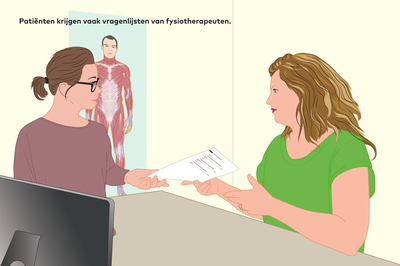
Background: The Turkish translation of the Dutch Talking Touch Screen Questionnaire (TTSQ) has been developed to help physical therapy patients with a Turkish background in the Netherlands to autonomously elucidate their health problems and impairments and set treatment goals, regardless of their level of health literacy. Objective: The aim of this study was to evaluate the usability of the Turkish TTSQ for physical therapy patients with a Turkish background with diverse levels of health literacy and experience in using mobile technology. Methods: The qualitative Three-Step Test-Interview method was carried out to gain insight into the usability of the Turkish TTSQ. A total of 10 physical therapy patients participated. The interview data were analyzed using a thematic content analysis approach aimed at determining the accuracy and completeness with which participants completed the questionnaire (effectiveness), the time it took participants to complete the questionnaire (efficiency), and the extent to which the participants were satisfied with the ease of use of the questionnaire (satisfaction). The problems encountered by the participants in this study were given a severity rating, which was used to provide a rough estimate of the need for additional usability improvements. Results: No participant in this study was able to complete the questionnaire without encountering at least one usability problem. A total of 17 different kinds of problems were found. On the basis of their severity score, 3 problems that should be addressed during future development of the tool were “Not using the navigation function of the photo gallery in Question 4 causing the participant to not see all presented response items;” “Touching the text underneath a photo in Question 4 to select an activity instead of touching the photo itself, causing the activity not to be selected;” and “Pushing too hard or tapping too softly on the touch screen causing the touch screen to not respond.” The data on efficiency within this study were not valid and are, therefore, not reported in this study. No participant was completely satisfied or dissatisfied with the overall ease of use of the Turkish TTSQ. Two participants with no prior experience of using tablet computers felt that, regardless of what kinds of improvement might be made, it would just be too difficult for them to learn to work with the device. Conclusions: As with the Dutch TTSQ, the Turkish TTSQ needs improvement before it can be released. The results of this study confirm the conclusion of the Dutch TTSQ study that participants with low levels of education and little experience in using mobile technology are less able to operate the TTSQ effectively. Using a Dutch speaking interviewer and Turkish interpreter has had a negative effect on data collection in this study.
LINK
Het aantal kwetsbare ouderen in Nederland neemt toe en huisartsen voelen vaak de behoefte om negatieve gezondheidsuitkomsten bij deze patiënten voor te zijn. Er zijn diverse screeningsinstrumenten ontwikkeld, waaronder veel vragenlijsten. Kwetsbaarheidsvragenlijsten waar onderzoek naar is gedaan, blijken negatieve gebeurtenissen echter niet beter te voorspellen dan de huisarts zelf. Het heeft dan ook geen zin om kwetsbaarheid te scoren met een standaard vragenlijst.
MULTIFILE

Objectives: Promoting unstructured outside play is a promising vehicle to increase children’s physical activity (PA). This study investigates if factors of the social environment moderate the relationship between the perceived physical environment and outside play. Study design: 1875 parents from the KOALA Birth Cohort Study reported on their child’s outside play around age five years, and 1516 parents around age seven years. Linear mixed model analyses were performed to evaluate (moderating) relationships among factors of the social environment (parenting influences and social capital), the perceived physical environment, and outside play at age five and seven. Season was entered as a random factor in these analyses. Results: Accessibility of PA facilities, positive parental attitude towards PA and social capital were associated with more outside play, while parental concern and restriction of screen time were related with less outside play. We found two significant interactions; both involving parent perceived responsibility towards child PA participation. Conclusion: Although we found a limited number of interactions, this study demonstrated that the impact of the perceived physical environment may differ across levels of parent responsibility.
MULTIFILE

We get into an Uber car, and the driver passes by the Kremlin walls, guided by GPS. At the end of the ride, the bill turns out to be three times as expensive than usual. What is the matter? We check the route, and the screen shows that we travelled to an airport outside of Moscow. Impossible. We look again: the moment we approached the Kremlin, our location automatically jumped to Vnukovo. As we learned later, this was caused by a GPS fence set up to confuse and disorient aerial sensors, preventing unwanted drone flyovers.
MULTIFILE

Municipalities increasingly seek to include citizens in decision-making processes regarding local issues, such as urban planning. This paper presents a case study on using Virtual Reality (VR) in a process of civic participation in the redesign of a public park. The municipality included citizens in intensive co-design activities to create three designs for the park and engaged the neighbourhood community in co-decision, in the form of a ballot. Through the civic participatory process, we studied the effectiveness of using VR technology to engage the community in participating in the co-decision process. The three designs were presented using highly realistic 360˚ visualisations and the effects on engagement were compared between various devices: VR headsets, smartphones, tablets, and computers. Viewing the designs in 2D paper plans was also included in the comparison. The study included over 1300 respondents that participated in the ballot. A statistical analysis of the collected data shows that participants viewing the 360˚ rendered images with VR technology expressed a significantly higher engagement in the co-decision process than those using their computer at home or viewing 2D paper plans. The paper describes the complete participatory design process and the impact of the e-governance used on the target group as well as on the actors organizing the e-governance process. We discuss how the use of new technology and active presence of a voting-support team inspired citizens to participate in the co-creation process and how the investment in this procedure helped the local authorities to generate support for the plans and strengthen its relationship with the community. The use of realistic visualisations that can be easily assessed by citizens through user-friendly technology, enabled a large and diverse audience to participate. This resulted in greater visibility of municipal efforts to enhance the living environment of citizens and is therefore an important step in increased civic engagement in municipal policy-making and implementation.
DOCUMENT

The aim of this study was to evaluate the usability, defined as the effectiveness, efficiency and satisfaction, of the prototype of the DTTSQ for Dutch physical therapy patients with diverse levels of education and experience in using mobile technology.
LINK



