The Dutch government decided to implement a road pricing system called, 'paying differently for mobility'. The main idea is that road users have to pay for using the road infrastructure instead of for owning a car. In the future, the price per kilometre will also depend on the time of the day and the location of the travel. Crowded locations and peak hours will be charged at a higher price per kilometre. In this study we examine the expected effect of the proposed road pricing scheme on logistics decisions to supply stores in urban areas based on in-depth interviews with carriers. Based on the revealed logistics reaction to current developments, such as the German LKW Maut, increasing congestion and the high fuel prices in 2008 and the stated reaction to the proposed road pricing scheme, we derive the expected impact of the scheme for urban goods transport in the Netherlands. The expected reactions differ between for-hire carries, shippers and private carriers. In the short term, carriers try to limit logistics changes by passing on extra costs or absorbing the extra costs in their margins. In the longer term, logistics changes are to be expected.
LINK
Residential public charging points are shared by multiple electric vehicle drivers, often neighbours. Therefore, charging behaviour is embedded in a social context. Behaviours that affect, or are influenced by, other publiccharging point users have been sparsely studied and lack an overarching and comprehensive definition. Consequently, very few measures are applied in practice to influence charging behaviour. We aim to classify and define the social dimension of charging behaviour from a social-psychological perspective and, using a behaviour change framework, identify and analyse the measures to influence this behaviour. We interviewed 15 experts onresidential public charging infrastructure in the Netherlands. We identified 17 charging behaviours rooted in interpersonal interactions between individuals and interactions between individuals and technology. These behaviours can be categorised into prosocial and antisocial charging behaviours. Prosocial charging behaviour provides or enhances the opportunity for other users to charge their vehicle at the public charging point, for instance by charging only when necessary. Antisocial charging behaviour prevents or diminishes this opportunity, for instance by occupying the charging point after charging, intentionally or unintentionally. We thenidentified 23 measures to influence antisocial and prosocial charging behaviours. These measures can influence behaviour through human–technology interaction, such as providing charging etiquettes to new electric vehicle drivers or charging idle fees, and interpersonal interaction, such as social pressure from other charging point users or facilitating social interactions to exchange requests. Our approach advocates for more attention to the social dimension of charging behaviour.
DOCUMENT

With a growing number of electric vehicles (EVs) on the road and charging infrastructure investments lagging, occupation of installed charging stations is growing and available charging points for EV drivers are becoming scarce. Installing more charging infrastructure is problematic from both a public(tax payers money, parking availability) and private (business case) perspective. Increasing the utilization of available charging stations is one of the solutions to satisfy the growing charging need of EV drivers and managing other stakeholders interests. Currently, in the Netherlands only 15-25% of the time connected to a public charging station is actually used for charging. The longest 4% of all sessions account for over 20% of all time connected while barely using this time for actually charging. The behaviour in which EV users stay connected to a charging station longer than necessary to charge their car is called “charging station hogging”. Using a large dataset (1.3 million sessions) on publiccharging infrastructure usage, this paper analyses the inefficient use of charging stations along three axes: where the hogging takes place (spatial), by whom (the characteristics of the user) and during which time frames (day, week and year). Using the results potential solutions are evaluated and assessed including their potential and pitfalls.
DOCUMENT

Currently EVs constitute only 1% of all vehicles on the road. We are at the eve of the large scale introduction of EVs. Large scale introduction requires a significant growth in charging infrastructure. In an urban context, in which many rely on on-street charging facilities, policy makers deal with a large number of concerns. Policy makers are uncertain about which charging deployment strategy to follow. This paper presents results from simulating different strategies for charging infrastructure roll to facilitate a large scale introduction of EVs using agent based simulation. In contrast to other models, the model uses observed charging patterns from EVs instead of travel patterns of fossil fuelled cars. The simulation incorporates different user types (Inhabitants, visitors, taxis and sharing) to model the complexity of charging in an urban environment. Different scenarios are explored along the lines of the type of charging infrastructure (level 2, clustered level 2, fast charging), the intensity of rollout (EV to Charging point ratio) and adoption rates. The simulation measures both the success rate and the additional miles cruising for a charging station. Results shows that scaling effects in charging infrastructure exist allowing for more efficient use of the infrastructure at a larger size.
DOCUMENT

Charging infrastructure deployment has taken off in many cities with the rise of the number of electric vehicles on the road. Expansion of infrastructure is a matter of prioritisation of resources to optimise the infrastructure. This paper explores how to measure charging station performance, to address the challenges that policy makers face. These performance indicators are used in a regression model, based upon current utilisation of the network, to predict which charging stations perform best. The results show that a model based on available geographical data and performance metrics of the current network are best combined to predict infrastructure performance. The variability between public charging stations is however big, as frequent user characteristics do determine the performance to a large extent.
MULTIFILE

As Vehicle-to-Everything (V2X) communication technologies gain prominence, ensuring human safety from radiofrequency (RF) electromagnetic fields (EMF) becomes paramount. This study critically examines human RF exposure in the context of ITS-5.9 GHz V2X connectivity, employing a combination of numerical dosimetry simulations and targeted experimental measurements. The focus extends across Road-Side Units (RSUs), On-Board Units (OBUs), and, notably, the advanced vehicular technologies within a Tesla Model S, which includes Bluetooth, Long Term Evolution (LTE) modules, and millimeter-wave (mmWave) radar systems. Key findings indicate that RF exposure levels for RSUs and OBUs, as well as from Tesla’s integrated technologies, consistently remain below the International Commission on Non-Ionizing Radiation Protection (ICNIRP) exposure guidelines by a significant margin. Specifically, the maximum exposure level around RSUs was observed to be 10 times lower than ICNIRP reference level, and Tesla’s mmWave radar exposure did not exceed 0.29 W/m2, well below the threshold of 10 W/m2 set for the general public. This comprehensive analysis not only corroborates the effectiveness of numerical dosimetry in accurately predicting RF exposure but also underscores the compliance of current V2X communication technologies with exposure guidelines, thereby facilitating the protective advancement of intelligent transportation systems against potential health risks.
MULTIFILE

Abstract Background: With the growing shortage of nurses, labor-saving technology has become more important. In health care practice, however, the fit with innovations is not easy. The aim of this study is to analyze the development of a mobile input device for electronic medical records (MEMR), a potentially labor-saving application supported by nurses, that failed to meet the needs of nurses after development. Method: In a case study, we used an axiomatic design framework as an evaluation tool to visualize the mismatches between customer needs and the design parameters of the MEMR, and trace these mismatches back to (preliminary) decisions in the development process. We applied a mixed-method research design that consisted of analyzing of 118 external and internal files and working documents, 29 interviews and shorter inquiries, a user test, and an observation of use. By factoring and grouping the findings, we analyzed the relevant categories of mismatches. Results: The involvement of nurses during the development was extensive, but not all feedback was, or could not be, used effectively to improve the MEMR. The mismatches with the most impact were found to be: (1) suboptimal supportive technology, (2) limited functionality of the app and input device, and (3) disruption of nurses’ workflow. Most mismatches were known by the IT department when the MEMR was offered to the units as a product. Development of the MEMR came to a halt because of limited use. Conclusion: Choices for design parameters, made during the development of labor-saving technology for nurses, may conflict with the customer needs of nurses. Even though the causes of mismatches were mentioned by the IT department, the nurse managers acquired the MEMR based on the idea behind the app. The effects of the chosen design parameters should not only be compared to the customer needs, but also be assessed with nurses and nurse managers for the expected effect on the workflow.
LINK
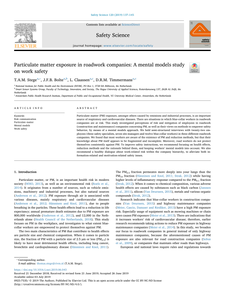
Particulate matter (PM) exposure, amongst others caused by emissions and industrial processes, is an important source of respiratory and cardiovascular diseases. There are situations in which blue-collar workers in roadwork companies are at risk. This study investigated perceptions of risk and mitigation of employees in roadwork (construction and maintenance) companies concerning PM, as well as their views on methods to empower safety behavior, by means of a mental models approach. We held semi-structured interviews with twenty-two employees (three safety specialists, seven site managers and twelve blue-collar workers) in three different roadwork companies. We found that most workers are aware of the existence of PM and reduction methods, but that their knowledge about PM itself appears to be fragmented and incomplete. Moreover, road workers do not protect themselves consistently against PM. To improve safety instructions, we recommend focusing on health effects, reduction methods and the rationale behind them, and keeping workers’ mental models into account. We also recommend a healthy dialogue about work-related risk within the company hierarchy, to alleviate both information-related and motivation-related safety issues. https://doi.org/10.1016/j.ssci.2019.06.043 LinkedIn: https://www.linkedin.com/in/john-bolte-0856134/
DOCUMENT
DOCUMENT

This report summarizes the work done by Thematic Working Group 4 (TWG4) on “Procurement and Tendering” for e-bus deployment. It further analyses the various Good Practices collected by project partners with a reference to the above aspects. This report takes the policy learning one step further and sheds light on regional similarities and differences in practices that have been found functional and worth spreading.
DOCUMENT




