At the beginning of May 2020 Inholland students received an invitation to participate in a large international study on the corona crisis impact on student life and studies. Almost 3000 students participated. This factsheet shows data on their lifestyleand their resilience. But also on their worries about corona, their knowledge of it and their opinion on the information supply.
DOCUMENT

In het middelbaar beroepsonderwijs worden hybride leeromgevingen, waarin de contexten van school en werk worden geïntegreerd, gezien als een veelbelovende manier om onderwijs en praktijk beter op elkaar aan te laten sluiten. Er is weinig bekend over het duurzaam ontwerpen van deze integratieve leeromgevingen binnen een mbo-instelling als geheel, waarbij het gaat om leeromgevingen van verschillende sectoren. In deze meervoudige, tweejarige case study zijn 45 integratieve leeromgevingen op de grens van school en werk, verspreid over zes sectoren binnen één onderwijsinstelling in kaart gebracht. Deze leeromgevingen zijn in focusgroepen geanalyseerd op 1) waar zij zich bevinden op de dimensie school-werk, 2) de ontwerpkenmerken inhoudelijk, sociaal, temporeel, instrumenteel en ruimtelijk, en 3) bevorderende en belemmerende factoren bij het ontwerpen en uitvoeren van integratieve leeromgevingen. Dit onderzoek geeft inzicht in hoe deze leeromgevingen zijn ontworpen en welke factoren daarbij van belang zijn. Integratief samenwerken met het werkveld blijkt in alle sectoren mogelijk. De ontwerpkenmerken inhoudelijk, sociaal en ruimtelijk worden vaker als integratief ervaren dan het ontwerpkenmerk temporeel. Vanuit het temporele perspectief blijken vooral kaders van school leidend en komen daarmee naar voren als een belangrijke factor in het succesvol opschalen en verduurzamen van leeromgevingen.
MULTIFILE

Abstract Aim Evaluate the impact of LS@H project participation on stakeholders. Background As populations age and workforces decline, care technology in nursing is becoming increasingly commonplace. Collaboration between nurse academia, education and practice can result in practice-based research and meaningful learning for nursing students and staff. However, little is known about the factors influencing effective collaboration. Based on the knowledge that narratives can be an effective vehicle for healthcare practice change, a Dutch school of nursing and its practice partners collaborated on the Living Longer and Safe at Home! (LS@H) project. This project aimed to explore a more person-centred approach to the use of technology in nursing care. Having gathered data from multiple sources to construct case narratives on the use of technology in older persons care, students nurses were able to contribute to practice development as their narratives were fed back to local and regional teams. Design To evaluate the impact of the LS@H project, we employed the same methodology used in the project: mixed data gathering methods to construct a case narrative. LS@H project students, supervisors, mentors and higher management shared their experiences and the research team constructed the case narrative. Methods Qualitative data were gathered via individual, duo and group interviews and supplemented with a survey among students. Transcription and thematic analysis followed, with multiple rounds of critical peer review before the thematic framework was agreed, survey results integrated and the case narrative constructed. Results According to stakeholder participants, the LS@H project led to an unfreezing of the status quo in both education and practice. The approach was new and guidelines with community support was needed to allay fears. The project design enabled a sense of shared ownership, across individuals and organisations for improving practice. Perspectives on the use of technology and older persons nursing were transformed. Critically dialoguing case narratives encouraged purposeful action to improve practice and fostered reflective practice among students and teams. Conclusions Collaborative practice-based research can be a valuable learning experience for student nurses, positively influencing their view of nursing practice as well as enabling them to actively contribute to practice development. Adequate preparation, supervision and practice mentorship is vital, alongside practice (leader) commitment to ensure continued student assignments with subsequent critical dialogue of the multi-stakeholder case narratives produced.
LINK
The purpose of this study was to provide insight into the interplay between student perceptions of competence-based assessment and student self-efficacy, and how this influences student learning outcomes. Results reveal that student perceptions of the form authenticity aspect and the quality feedback aspect of assessment do predict student self-efficacy, confirming the role of mastery experiences and social persuasions in enhancing student self-efficacy as stated by social cognitive theory. Findings do not confirm mastery experiences as being a stronger source of self-efficacy information than social persuasions. Study results confirm the predictive role of students’ self-efficacy on their competence outcomes. Mediation analysis results indicate that student’s perceptions of assessment have an indirect effect on student’s competence evaluation outcomes through student’s self-efficacy. Study findings highlight which assessment characteristics, positively influencing students’ learning, contribute to the effectiveness of competence-based education. Limitations of the study and directions for future research are indicated.
DOCUMENT

Why studying student agency? • Prepare students for lifelong learning. (Biesta & Tedder, 2007;OECD, 2018) • Agency fosters motivation, which could enhance performance. (Bandura, 2018; Ryan & Deci, 2020) • More flexibility in higher education, but not all students can handle this. (De Bruin & Verkoeijen, 2022; Van Casteren e.a., 2021)
DOCUMENT

Obtaining credits, studying for exams, attending classes, engaging with fellow students and lecturers, living alone or with others, and taking part in extra-curricular activities: there is a fair amount for students in higher education to take in. There are also numerous external factors — such as the COVID-19 pandemic and the changing labour and housing market — that affect students. However, students experience these situations differently and deal with them in different ways. How can we ensure that, notwithstanding these stress factors and differences, as many students as possible become and remain engaged and energised? Happier students tend to be more engaged and generally achieve better study results.1 That is why student well-being is also a widely researched and important topic. The search is on for measures to promote student well-being and success. Having a clear idea of how things are going for a student and what they need is a starting point. This booklet helps readers to identify different student profiles and understand what is needed to improve student success. We zoom in on two key aspects of student success: engagement and emotional exhaustion.
MULTIFILE

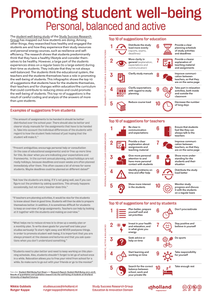
The student well-being study of the Study Success Research Group has mapped out how students are doing. Among other things, they researched how healthy and engaged the students are and how they experience their study resources and personal energy sources, such as resilience and selfefficiency. The research shows that students predominantly think that they have a healthy lifestyle and consider themselves to be healthy. However, a large part of the students experiences stress on a regular basis (to a large extent) during their time as students. This infographic shows the top 10 of suggestions that students have for the students themselves, their teachers and for changes within education/the curriculum that could contribute to reducing stress and could promote the well-being of students.
DOCUMENT
The corona pandemic has forced higher education (HE) institutes to transition to online learning, with subsequent implications for student wellbeing. Aims: This study explored influences on student wellbeing throughout the first wave of the corona crisis in the Netherlands by testing serial mediation models of the relationships between perceived academic stress, depression, resilience, and HE support.
MULTIFILE

A primary teacher needs mathematical problem solving ability. That is why Dutch student teachers have to show this ability in a nationwide mathematics test that contains many non-routine problems. Most student teachers prepare for this test by working on their own solving test-like problems. To what extent does these individual problem solving activities really contribute to their mathematical problem solving ability? Developing mathematical problem solving ability requires reflective mathematical behaviour. Student teachers need to mathematize and generalize problems and problem approaches, and evaluate heuristics and problem solving processes. This demands self-confidence, motivation, cognition and metacognition. To what extent do student teachers show reflective behaviour during mathematical self-study and how can we explain their study behaviour? In this study 97 student teachers from seven different teacher education institutes worked on ten non-routine problems. They were motivated because the test-like problems gave them an impression of the test and enabled them to investigate whether they were already prepared well enough. This study also shows that student teachers preparing for the test were not focused on developing their mathematical problem solving ability. They did not know that this was the goal to strive for and how to aim for it. They lacked self-confidence and knowledge to mathematize problems and problem approaches, and to evaluate the problem solving process. These results indicate that student teachers do hardly develop their mathematical problem solving ability in self-study situations. This leaves a question for future research: What do student teachers need to improve their mathematical self-study behaviour? EAPRIL Proceedings, November 29 – December 1, 2017, Hämeenlinna, Finland
DOCUMENT
Decisions are used by organizations to manage and execute their coordinated, value-adding decision-making and are thereby among an organization’s most important assets. To be able to manage deci-sions and underlying business rules, Decision Management (DM) and Business Rules Management (BRM) are increasingly being applied at organisations. One of the latest developments related to the domain of DM and BRM is the introduction of the Decision Model and Notation (DMN) in September 2015 by the Object Management Group (OMG). The goal of this technical paper is to provide students with a case to practice the specification, verification, validation, deployment, execution, monitoring and governance of business rules in practice.
DOCUMENT




