Next-generation sequencing technology allows culture- independent analysis of species and genes present in a complex microbial community. Such metagenomics may overcome the inability to culture microbes in isolation. Microbial communities of interest are for example responsible for making biogas. Many applications in metagenomics focus on 16S RNA analysis. We here evaluate the possibility of whole genome analysis (WGS) as approach for metagenomics studies.Samples (Table 1) from three biogas installations fed with different feedstock were used for DNA isolation and WGS analysis. Short (75b) Illumina paired-end DNA sequence reads were generated and assembled into larger continuous stretches (contigs),AcknowledgementsResults show that WGS is feasible for complex community analysis. Large groups of organisms (for example the class Methanomicrobia) are present in all samples with a possible role in the biogas production pathway.Assemble reads into contigs•meta-velveth as metagenomics reads assemblerSequencesimilaritysearch•proteome reference database from all currently available Bacteria and Achaea genomesAssign hits to taxa•Lowest common ancestor method incorporated in MEGAN4Such studies will help to identify and use microbial species for future improvements of biogas production dependence on process parameters and feedstock.
DOCUMENT
High-pressure anaerobic digestion is an appealing concept since it can upgrade biogas directly within the reactor. However, the decline of pH caused by the dissolution of CO2 is the main barrier that prevents a good operating high-pressure anaerobic digestion process. Therefore, in this study, a high-pressure anaerobic digestion was studied to treat high alkalinity synthetic wastewater, which could not be treated in a normal-pressure anaerobic digester. In the high-pressure reactor, the pH value was 7.5 ~ 7.8, and the CH4 content reached 88% at 11 bar. Unlike its normal-pressure counterpart (2285 mg/L acetic acid), the high-pressure reactor ran steadily (without volatile fatty acids inhibition). Furthermore, the microbial community changed in the high-pressure reactor. Specifically, key microbial guilds (Syntrophus (11.2%), Methanosaeta concilii (50.9%), and Methanobrevibacter (26.8%)) were dominant in the high-pressure reactor at 11 bar, indicating their fundamental roles under high-pressure treating high alkalinity synthetic wastewater.
DOCUMENT
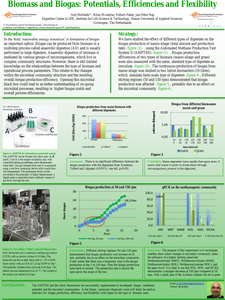
In the field of ‘renewable energy resources’ formation of biogas Biomass and biogas: potentials, efficiencies and flexibility is an important option. Biogas can be produced from biomass in a multistep process called anaerobic digestion (AD) and is usually performed in large digesters. Anaerobic digestion of biomass is mediated by various groups of microorganisms, which live in complex community structures. However, there is still limited knowledge on the relationships between the type of biomass and operational process parameters. This relates to the changes within the microbial community structure and the resulting overall biogas production efficiency. Opening this microbial black box could lead to an better understanding of on-going microbial processes, resulting in higher biogas yields and overall process efficiencies.
DOCUMENT
This study evaluated the performance of anaerobic co-digestion of cow manure (CM) and sheep manure (SM) in both batch and continuous digesters at 37 °C. Synergistic effects of co-digesting CM and SM at varying volatile solids (VS) ratios (1:0, 0:1, 3:1, 1:1, 1:3) were observed in the batch experiment, with the most effective degradation of cellulose (56%) and hemicellulose (55%), and thus, the highest cumulative methane yield (210 mL/gVSadded) obtained at a CM:SM ratio of 1:3. Co-digesting CM and SM improved the hydrolysis, as evidenced by the cellulase brought by SM and the increases of cellulolytic bacteria Clostridium. Besides, co-digestion enhanced the acidogenesis and methanogenesis, reflected by the enrichment of syntrophic bacteria Candidatus Cloacimonas and hydrogenotrophic archaea Methanoculleus (Coenzyme-B sulfoethylthiotransferase). When testing continuous digestion, the methane yield increased from 146 mL/gVS/d (CM alone) to 179 mL/gVS/d (CM:SM at 1:1) at a constant organic loading rate (OLR) of 1g VS/L/d and a hydraulic retention time (HRT) of 25 days. Furthermore, the anaerobic digestion process was enhanced when the daily feed changed back to CM alone, reflected by the improved daily methane yield (159 mL/VS/d). These results provided insights into the improvement of methane production during the anaerobic digestion of animal manure.
LINK
Waste disposal management and the energy crisis are important challenges facing most countries. The fruit-processing industry generates daily several tons of wastes, of which the major share comes from banana farms. Anaerobic digestion (AD) technology has been applied to the treatment of wastewater, animal slurry, food waste, and agricultural residues, with the primary goals of energy production and waste elimination. This study examines the effect of organic loading (OL) and cow manure (CM) addition on AD performance when treating banana peel waste (BPW). The maximum daily biogas production rates of banana peels (BPs) with a CM content of 10%, 20%, and 30% at 18 and 22 g of volatile solids (gvs) per liter were 50.20, 48.66, and 62.78 mL·(gvs·d)−1 and 40.49, 29.57, and 46.54 mL·(gvs·d)−1, respectively. However, the daily biogas yield showed no clear interdependence with OL or CM content. In addition, a kinetic analysis using first-order and cone models showed that the kinetic parameters can be influenced by the process parameters.
LINK
A bioaugmentation approach was used to enhance the performance of anaerobic digestion (AD) using cow manure (CM) as the substrate in a continuous system. To obtain the desirable microbial culture for bioaugmentation, a biochemical methane potential test (BMP) was used to evaluate three commonly used inocula namely (1) municipal solid waste (MSW), (2) wastewater treatment plant (WWTP), and (3) cow manure digester (CMMD) for their hydrolytic capacity. The highest lignocellulose removal (56% for cellulose and 50% for hemicellulose) and the most profusion of cellulolytic bacteria were obtained when CM was inoculated with CMMD. CMMD was thus used as the seed inoculum in a continuously operated reactor (Ra) with the fiber fraction of CM as the substrate to further enrich cellulolytic microbes. After 100 days (HRT: 30 days), the Bacteria fraction mainly contained Ruminofilibacter, norank_o_SBR1031, Treponema, Acetivibrio. Surprisingly, the Archaea fraction contained 97% ‘cellulolytic archaea’ norank_c_Bathyarchaeia (Phylum Bathyarchaeota). This enriched consortium was used in the bioaugmentation experiment. A positive effect of bioaugmentation was verified, with a substantial daily methane yield (DMY) enhancement (24.3%) obtained in the bioaugmented reactor (Rb) (179 mL CH4/gVS/d) than that of the control reactor (Rc) (144 mL CH4/gVS/d) (P < 0.05). Meanwhile, the effluent of Rb enjoyed an improved cellulose reduction (14.7%) than that of Rc, whereas the amount of hemicellulose remained similar in both reactors' effluent. When bioaugmentation stopped, its influence on the hydrolysis and methanogenesis sustained, reflected by an improved DMY (160 mL CH4/gVS/d) and lower cellulose content (53 mg/g TS) in Rb than those in Rc (DMY 144 mL/CH4/gVS/d and cellulose content 63 mg/g TS, respectively). The increased DMY of the continuous reactor seeded with a specifically enriched consortium able to degrade the fiber fraction in CM shows the feasibility of applying bioaugmentation in AD of CM.
LINK
In the field of ‘renewable energy resources’ formation of biogas is an important option. Biogas can be produced from biomass in a multistep process called anaerobic digestion (AD) and is usually performed in large digesters. Anaerobic digestion of biomass is mediated by various groups of microorganisms, which live in complex community structures. However, there is still limited knowledge on the relationships between the type of biomass and operational process parameters. This relates to the changes within the microbial community structure and the resulting overall biogas production efficiency. Opening this microbial black box could lead to an better understanding of on-going microbial processes, resulting in higher biogas yields and overall process efficiencies.
DOCUMENT
Anaerobic digestion (AD) can play an important role in achieving renewable goals set within the Netherlands which strives for 40 PJ bio-energy in the year 2020. This research focusses on reaching this goal with locally available biomass waste flows (e.g. manures, grasses, harvest remains, municipal organic wastes). Therefore, the bio-energy yields, process efficiency and environmental sustainability are analyzed for five municipalities in the northern part Netherlands, using three utilization pathways: green gas production; combined heat and power; and waste management. Results indicate that the Dutch goal cannot be filled through the use of local biomass waste streams, which can only reach an average of 20 PJ. Furthermore renewable goals and environmental sustainability do not always align. Therefore, understanding of the absolute energy and environmental impact of biogas production pathways is required to help governments form proper policies, to promote an environmentally and social sustainable energy system.
DOCUMENT

The energy efficiency and sustainability of an anaerobic green gas production pathway was evaluated, taking into account five biomass feedstocks, optimization of the green gas production pathway, replacement of current waste management pathways by mitigation, and transport of the feedstocks. Sustainability is expressed by three main factors: efficiency in (Process) Energy Returned On Invested (P)EROI, carbon footprint in Global Warming Potential GWP(100), and environmental impact in EcoPoints. The green gas production pathway operates on a mass fraction of 50% feedstock with 50% manure. The sustainability of the analyzed feedstocks differs substantially, favoring biomass waste flows over, the specially cultivated energy crop, maize. The use of optimization, in the shape of internal energy production, green gas powered trucks, and mitigation can significantly improve the sustainability for all feedstocks, but favors waste materials. Results indicate a possible improvement from an average (P)EROI for all feedstocks of 2.3 up to an average of 7.0 GJ/GJ. The carbon footprint can potentially be reduced from an average of 40 down to 18 kgCO2eq/GJ. The environmental impact can potentially be reduced from an average of 5.6 down to 1.8 Pt/GJ. Internal energy production proved to be the most effective optimization. However, the use of optimization aforementioned will result in les green gas injected into the gas grid as it is partially consumed internally. Overall, the feedstock straw was the most energy efficient, where the feedstock harvest remains proved to be the most environmentally sustainable. Furthermore, transport distances of all feedstocks should not exceed 150 km or emissions and environmental impacts will surpass those of natural gas, used as a reference. Using green gas as a fuel can increase the acceptable transportation range to over 300 km. Within the context aforementioned and from an energy efficiency and sustainable point of view, the anaerobic digestion process should be utilized for processing locally available waste feedstocks with the added advantage of producing energy, which should first be used internally for powering the green gas production process.
DOCUMENT



