This study aimed to evaluate outcomes and support use in 12- to 25-year-old visitors of the @ease mental health walk-in centres, a Dutch initiative offering free counselling by trained and supervised peers.
MULTIFILE

Background: Art therapy (AT) is frequently offered to children and adolescents with psychosocial problems. AT is an experiential form of treatment in which the use of art materials, the process of creation in the presence and guidance of an art therapist, and the resulting artwork are assumed to contribute to the reduction of psychosocial problems. Although previous research reports positive effects, there is a lack of knowledge on which (combination of) art therapeutic components contribute to the reduction of psychosocial problems in children and adolescents. Method: A systematic narrative review was conducted to give an overview of AT interventions for children and adolescents with psychosocial problems. Fourteen databases and four electronic journals up to January 2020 were systematically searched. The applied means and forms of expression, therapist behavior, supposed mechanisms of change, and effects were extracted and coded. Results: Thirty-seven studies out of 1,299 studies met the inclusion criteria. This concerned 16 randomized controlled trials, eight controlled trials, and 13 single-group pre–post design studies. AT interventions for children and adolescents are characterized by a variety of materials/techniques, forms of structure such as giving topics or assignments, and the use of language. Three forms of therapist behavior were seen: non-directive, directive, and eclectic. All three forms of therapist behavior, in combination with a variety of means and forms of expression, showed significant effects on psychosocial problems. Conclusions: The results showed that the use of means and forms of expression and therapist behavior is applied flexibly. This suggests the responsiveness of AT, in which means and forms of expression and therapist behavior are applied to respond to the client's needs and circumstances, thereby giving positive results for psychosocial outcomes. For future studies, presenting detailed information on the potential beneficial effects of used therapeutic perspectives, means, art techniques, and therapist behavior is recommended to get a better insight into (un)successful art therapeutic elements.
DOCUMENT

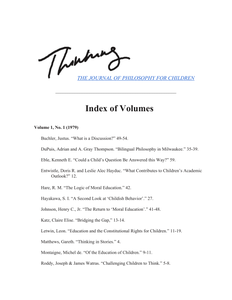
The journal was a forum for the work of both theorists and practitioners of philosophical practice with children, and published such work in all forms, including philosophical argument and reflection, classroom transcripts, curricula, empirical research, and reports from the field. The journal also maintained a tradition in publishing articles in the hermeneutics of childhood, a field of intersecting disciplines including cultural studies, social history, philosophy, art, literature and psychoanalysis.
DOCUMENT
The goal of this study was (1) to determine whether and how nursing home residents with dementia respond to the interactive art installation in general and (2) to identify whether responses change when the content type and, therefore, the nature of the interaction with the artwork changes. The interactive art installation ‘VENSTER’ evokes responses in nursing home residents with dementia, illustrating the potential of interactive artworks in the nursing home environment. Frequently observed responses were naming, recognizing or asking questions about depicted content and how the installation worked, physically gesturing towards or tapping on the screen and tapping or singing along to the music. It seemed content matters a lot. When VENSTER is to be used in routine care, the choice of a type of content is critical to the intended experience/usage in practice. In this study, recognition seemed to trigger memory and (in most cases) a verbal reaction, while indistinctness led to asking for more information. When (initially) coached by a care provider, residents actively engaged physically with the screen. Responses differed between content types, which makes it important to further explore different types of content and content as an interface to provide meaningful experiences for nursing home residents. •Implications for rehabilitation •VENSTER can facilitate different types of responses ranging from verbal reactions to active physical engagement. The choice of a type of content is critical to the intended experience/usage in practice. •Activating content seems suitable for use as a meaningful experience during the spare time in between existing activities or therapy. •Sessions with interactive content are short (avg. 30 mins) and intense and can therefore potentially be used as an activating therapy, activity or exercise. •In order to actively engage residents with dementia, the role of the care provider seems very important.
MULTIFILE

This paper reports the responses of nursing home residents who live in a psychogeriatric ward to the abstract interactive art installation ‘Morgendauw’, which was specifically designed for this study. All stakeholders were involved in designing and implementing Morgendauw. The artwork seems able to evoke responses in both the residents and their caregivers, but the amount and duration of the responses observed during the study were limited. 15 interactions over the course of 14 h were noted and almost all of them were initiated by the nursing home staff, physiotherapy students or visitors (n = 12). Interactions lasted for about 3 min on average. Although the nursing home residents initially did not seem to notice the artwork, the threshold of acknowledging and approaching the artwork was quickly overcome when staff nudged or directed the residents’ attention towards the artwork. Beyond this point, nursing home residents generally needed little explanation of the interface to interact with the artwork. The location in which Morgendauw was placed during the study or the characteristics of the installation seemed to create a threshold. Further research should focus on the importance and the effects of context when designing and implementing an interactive art installation in a nursing home environment.
DOCUMENT

Uit het vooronderzoekvan het project Duurzamelearning communities: Oogstenin de Greenportblijkt dat12 factorenhierbijvan belangrijk zijn. Deze succesfactoren staan centraal in de interactieve tool Seeds of Innovation. Ook komen uit het vooronderzoek, aangevuld met inzichten uit de literatuur en tips om de samenwerking door te ontwikkelen en meer gebruik te maken van de opbrengsten 12 succesfactoren met toelichting, belangrijkste bevindingen en tips voor ‘hoe nu verder’, Poster, Walk through, De app die learning communities helptde samenwerkingnaareenhogerplan te tillenen innovatieveopbrengstenoptimaalte benutten.
MULTIFILE

The “Age-Friendly Cities & Communities: States of the Art and Future Perspectives”publication presents contemporary, innovative, and insightful narratives, debates, and frameworks based on an international collection of papers from scholars spanning the fields of gerontology, social sciences, architecture, computer science, and gerontechnology. This extensive collection of papers aims to move the narrative and debates forward in this interdisciplinary field of age-friendly cities and communities. CC BY-NC-ND Book CC BY Chapters © 2021 by the authors Original book at: https://doi.org/10.3390/books978-3-0365-1226-6 (This book is a printed edition of the Special Issue Feature Papers "Age-Friendly Cities & Communities: State of the Art and Future Perspectives" that was published in IJERPH)
MULTIFILE

Purpose – In the domain of healthcare, both process efficiency and the quality of care can be improved through the use of dedicated pervasive technologies. Among these applications are so-called real-time location systems (RTLS). Such systems are designed to determine and monitor the location of assets and people in real time through the use of wireless sensor networks. Numerous commercially available RTLS are used in hospital settings. The nursing home is a relatively unexplored context for the application of RTLS and offers opportunities and challenges for future applications. The paper aims to discuss these issues. Design/methodology/approach – This paper sets out to provide an overview of general applications and technologies of RTLS. Thereafter, it describes the specific healthcare applications of RTLS, including asset tracking, patient tracking and personnel tracking. These overviews are followed by a forecast of the implementation of RTLS in nursing homes in terms of opportunities and challenges. Findings – By comparing the nursing home to the hospital, the RTLS applications for the nursing home context that are most promising are asset tracking of expensive goods owned by the nursing home in orderto facilitate workflow and maximise financial resources, and asset tracking of personal belongings that may get lost due to dementia. Originality/value – This paper is the first to provide an overview of potential application of RTLS technologies for nursing homes. The paper described a number of potential problem areas that can be addressed by RTLS. Published by Emerald Publishing Limited Original article: https://doi.org/10.1108/JET-11-2017-0046 For this paper Joost van Hoof received the Highly Recommended Award from Emerald Publishing Ltd. in October 2019: https://www.emeraldgrouppublishing.com/authors/literati/awards.htm?year=2019
MULTIFILE

Abstract not available (Editorial). Original publication at MDPI: https://doi.org/10.3390/ijerph18041644 © 2021 by the authors. Licensee MDPI.
MULTIFILE




