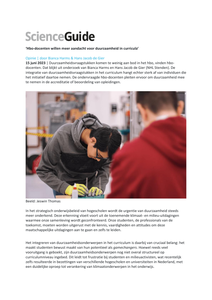
Als opbrengst van het project verbreding techniek basisonderwijs [VTB] hebben rond 2010 ruim 2500 basisscholen wetenschap en techniek opgenomen in hun curriculum. Daarnaast zien we dat ook steeds meer scholen die niet aan het VTB-project deelnemen door het "virus" aangestoken worden en hun onderwijs programma aanpassen. Het is wenselijk om heldere maatstaven en criteria (benchmarks) te ontwikkelen die scholen ondersteunen bij het vaststellen van de kwaliteit van hun wetenschap-en techniekonderwijs. Dit betekent dit dat voor het vaststllen van de kwaliteit van invoering van wetenschap en techniek aandacht moet gegeven worden aan de kwaliteit van de onderwijsdoelen, gebruikte materialen, werkvormen en toetsing. Daarbij is het fundamenteel om vast te stellen hoe het onderwijsconcept en de kwaliteiten (kennis, vaardigheden en attitude) van de individuele leraar daarbinnen een plek hebben.
DOCUMENT

While the original definition of replacement focuses on the replacement of the use of animals in science, a more contemporary definition focuses on accelerating the development and use of predictive and robust models, based on the latest science and technologies, to address scientific questions without the use of animals. The transition to animal free innovation is on the political agenda in and outside the European Union. The Beyond Animal Testing Index (BATI) is a benchmarking instrument designed to provide insight into the activities and contributions of research institutes to the transition to animal free innovation. The BATI allows participating organizations to learn from each other and stimulates continuous improvement. The BATI was modelled after the Access to Medicine Index, which benchmarks pharmaceutical companies on their efforts to make medicines widely available in developing countries. A prototype of the BATI was field-tested with three Dutch academic medical centers and two universities in 2020-2021. The field test demonstrated the usability and effectiveness of the BATI as a benchmarking tool. Analyses were performed across five different domains. The participating institutes concluded that the BATI served as an internal as well as an external stimulus to share, learn, and improve institutional strategies towards the transition to animal free innovation. The BATI also identified gaps in the development and implementation of 3R technologies. Hence, the BATI might be a suitable instrument for monitoring the effectiveness of policies. BATI version 1.0 is ready to be used for benchmarking at a larger scale.
DOCUMENT

DOCUMENT
Hoe werken organisaties in de praktijk met producten- en dienstencatalogi en waarom doen zij dat zó? Verslag van een onderzoek in een negental grote organisaties uit diverse sectoren van de maatschappij.
MULTIFILE
Anomaly detection is a key factor in the processing of large amounts of sensor data from Wireless Sensor Networks (WSN). Efficient anomaly detection algorithms can be devised performing online node-local computations and reducing communication overhead, thus improving the use of the limited hardware resources. This work introduces a fixed-point embedded implementation of Online Sequential Extreme Learning Machine (OS-ELM), an online learning algorithm for Single Layer Feed forward Neural Networks (SLFN). To overcome the stability issues introduced by the fixed precision, we apply correction mechanisms previously proposed for Recursive Least Squares (RLS). The proposed implementation is tested extensively with generated and real-world datasets, and compared with RLS, Linear Least Squares Estimation, and a rule-based method as benchmarks. The methods are evaluated on the prediction accuracy and on the detection of anomalies. The experimental results demonstrate that fixed-point OS-ELM can be successfully implemented on resource-limited embedded systems, with guarantees of numerical stability. Furthermore, the detection accuracy of fixed-point OS-ELM shows better generalization properties in comparison with, for instance, fixed-point RLS. © 2013 IEEE.
DOCUMENT
The maturing field of Wireless Sensor Networks (WSN) results in long-lived deployments that produce large amounts of sensor data. Lightweight online on-mote processing may improve the usage of their limited resources, such as energy, by transmitting only unexpected sensor data (anomalies). We detect anomalies by analyzing sensor reading predictions from a linear model. We use Recursive Least Squares (RLS) to estimate the model parameters, because for large datasets the standard Linear Least Squares Estimation (LLSE) is not resource friendly. We evaluate the use of fixed-point RLS with adaptive thresholding, and its application to anomaly detection in embedded systems. We present an extensive experimental campaign on generated and real-world datasets, with floating-point RLS, LLSE, and a rule-based method as benchmarks. The methods are evaluated on prediction accuracy of the models, and on detection of anomalies, which are injected in the generated dataset. The experimental results show that the proposed algorithm is comparable, in terms of prediction accuracy and detection performance, to the other LS methods. However, fixed-point RLS is efficiently implementable in embedded devices. The presented method enables online on-mote anomaly detection with results comparable to offline LS methods. © 2013 IEEE.
DOCUMENT
1e alinea column: Natuurlijk proberen we allemaal lessen te trekken uit wat er nu met de integratie van sociale media in de bedrijfsvoering gebeurt en waarom dit tot nieuwe business modellen en andere bedrijfsstructuren leidt. Eerder heb ik hier al toegelicht dat bedrijven projecten worden, crowd working, maar zover is het nog niet al gaat het wel snel..
LINK
Kort artikel over duurzaamheidsvraagstukken in het HBO
MULTIFILE