Research finds that the global market value of cargo bikes will hit 2.4 billion euros by 2031. Analysts with Future Market Insights assessing the growth of cargo bikes have placed the parcel courier industry as a key buyer of electric cargo bikes, forecasting that 43 per cent of sales could go to this industry. This growth is driven by city logistics trends, particularly as studies emerge showing the high efficiency and cost saving of the cargo bike versus the delivery van. It will not solely be direct incentives that drive uptake, however. The policy that restricts motoring and emissions is expected to be a key driver for businesses that seek profitability, with three-wheeled electric cargo bikes making up nearly half the market. The advance of e-bike technology has seen a strong rise in market share for assisted cargo bikes, now accounting for a 73 per cent market share. Potentially limiting the growth is the legislation governing the output and range of electric cargo bikes (FMI, 2021).To deal with the issues of faster delivery, clean delivery (low/zero emission) and less space in dense cities, the light electric freight vehicle (LEFV) can be–and is used more and more as–an innovative solution. The way logistics in urban areas is organized is being challenged, as the global growth of cities leads to more jobs, more businesses and more residents. As a result, companies, workers, residents and visitors demand more goods and produce more waste. More space for logistics activities in and around cities is at odds with the growing need for accommodation for people living and working in cities. Book: Innovations in Transport: Success, Failure and Societal Impacts
DOCUMENT

Susanne Balm, Maartje Stoop en Raymond Astudillio van Eijk waren de opdrachtgevers en hebben bijgedragen om de inhoud / boodschap vorm te geven.De maker is Turn2Improve.
YOUTUBE
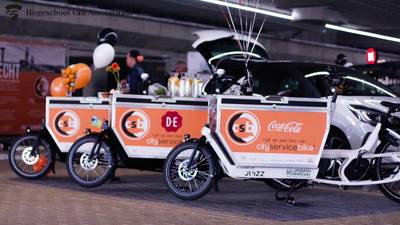
De maker is Turn2Improve.In samenwerking met:Hogeschool van AmsterdamOnderzoeksprogramma Urban TechnologyHet LokaalGreenolution2WielkoeriersTurn2Improve
YOUTUBE
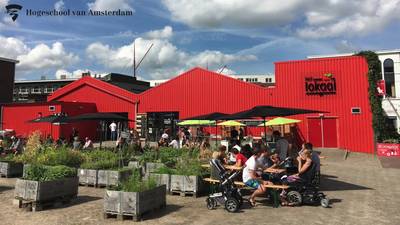
Limited data is available on the size of urban goods movement and its impact on numerous aspects with respect to livability such as emissions and spatial impact. The latter becomes more important in densifying cities. This makes it challenging to implement effective measures that aim to reduce the negative impact of urban good movement and to monitor their impact. Furthermore, urban goods movement is diverse and because of this a tailored approach is required to take effective measures. Minimizing the negative impact of a heavy truck in construction logistics requires a different approach than a parcel delivery van. Partly due to a lack of accurate data, this diversity is often not considered when taking measures. This study describes an approach how to use available data on urban traffic, and how to enrich these with other sources, which is used to gain insight into the decomposition (number of trips and kilometers per segment and vehicle type). The usefulness of having this insight is shown for different applications by two case studies: one to estimate the effect of a zero-emission zone in the city of Utrecht and another to estimate the logistics requirements in a car-free area development.
MULTIFILE
Network Applied Design Research (NADR) made an inventory of the current state of Circular Design Research in the Netherlands. In this publication, readers will find a summary of six promising ‘gateways to circularity’ that may serve as entry points for future research initiatives. These six gateways are: Looped Systems; Extension of Useful Lifetime; Servitisation; New Materials and Production Techniques; Information Technology and Digitization; and Creating Public and Industry Awareness. The final chapter offers an outlook into topics that require more profound examination. The NADR hopes that this publication will serve as a starting point for discussions among designers, entrepreneurs, and researchers, with the goal of initiating future collaborative projects. It is the NADR's belief that only through intensive international cooperation, we can contribute to the realization of a sustainable, circular, and habitable world.
DOCUMENT

The number of light commercial vehicles (LCV) in cities is growing, which puts increasing pressure on the liveability of cities. Small electric freight vehicles and cargo bikes can offer a solution, as they take less space, can manoeuvre easily and free from polluting emissions. Within the two-year LEVV-LOGIC project, (2016-2018) the use of light electric freight vehicles (LEFVs) for city logistics is explored. The project combines expertise on logistics, vehicle design, charging infrastructure and business modelling to find the optimal concept. This paper presents guidelines for the design of LEFV based on the standardized rolling container (length 800 mm, width 640 mm, height 1600 mm) and for the charging infrastructure.
DOCUMENT

The number of light commercial vehicles in cities is growing, which puts increasing pressure on the liveability of cities. Light electric freight vehicles (LEFV) and cargo bikes can offer a solution, as they occupy less space, can be manoeuvred easily and does not emit tailpipe pollutants. This paper presents the results of the first half-year of the LEVV-LOGIC project (2016-2018), aimed at exploring the potential of LEFVs for various urban freight flows. Delivery characteristics, trends, practical examples and the judgement of experts are combined to assess the potential of LEFVs for seven major urban freight flows. The preliminary analysis concludes that every urban freight flow has a certain level of potential for using LEFV. In particular parcel and food deliveries have high potential; however, deliveries related to services and the last phase of construction work can also be switched to LEFV. In comparison, non-food deliveries to retail establishments and the collection of waste collection have less potential. Though the latter can change when recycling standards become higher.
DOCUMENT

The number of light commercial vehicles (LCV) in cities is growing, which puts increasing pressure on the livability of cities. Freight vehicles are large contributors to polluting air and CO2 emissions and generate problems in terms of safety, noise and loss of public space. Small electric freight vehicles and cargo bikes can offer a solution, as they take less space, can maneuver easily and do not emit local pollution. There is an increasing interest in these vehicle, called light electric freight vehicles (LEFV’s), among logistic service providers in European cities. However, various technical and operational challenges impede large scale implementation. Within the two-year LEVV-LOGIC project, (2016-2018) the use of LEFV’s for city logistics is explored. The project combines expertise on logistics, vehicle design, charging infrastructure and business modelling to find the optimal concept in which LEFV’s can be a financial competitive alternative for conventional freight vehicles. This contribution to EVS30 will present the project’s first year results, showing the guideline for and the applied design of LEFV for future urban city logistics.
DOCUMENT





