Groningen gas field is the largest on-land gas resource in the world and is beingexploited since 1963. There are damaging earthquakes, the largest of which was 3.6 magnitude. The recursive induced earthquakes are often blamed for triggering the structural damages in thousands of houses in the area. A damage claim procedure takes place after each significantly felt earthquake. The liability of the exploiting company is related to the damages and the engineering firms and experts are asked to correlate the claimed damages with a past earthquake. Structures in the region present high vulnerabilities to the lateral forces, soilproperties are quite unfavourable for seismic resistance, and structural damages are present even without earthquakes. This situation creates a dispute area where one can claim that most structures in the region were already damaged because of the fact that the soil is soft, the ground water table oscillates, and structures are vulnerable to external conditions anyhow and deteriorate in time, which can be the main cause of such structural damages. This ambiguity of damage vs earthquake correlation is one of the main sources of the public unrest in the area up until today. This study presents the perspective of people in the region in terms of liveability and the social acceptance of earthquakes in their lives. An attempt has been made to translate these social effects and expectations into structural performance metrics for ordinary houses in the region. A new seismic design and assessment approach, called Comfort Level Earthquake (CLE) has been proposed.
DOCUMENT
Two strong earthquakes hit Thessaly region on March 3rd, 2021 (Mw = 6.3) and on March 4th, 2021 (Mw = 6.1). The epicentres of the earthquakes were located at approximately 23 and 29 km respectively NW of Larissa, one of the most populous cities in Greece. Several aftershocks followed thereafter. Although no injuries were recorded, several structures suffered significant damage close to the epicentre, while some others collapsed. Approximately 300 residents of the village of Damasi were transferred to temporary settlements and tents. The event occurred during the COVID19 lockdown and created significant stress and disruption to residents. This paper focuses on the earthquake swarm itself as well as the damages observed in residential buildings, schools, and churches in the earthquake-stricken region. The earthquakes mainly impacted low-rise domestic masonry buildings, while the more modern reinforced concrete structures built following the recent seismic regulations were almost unaffected. The typology of buildings in the region, together with photographs demonstrating the extent of damage are presented herein. Despite the rather satisfactory performance of modern buildings in recent earthquakes in Greece, the preliminary investigations from the Thessaly Earthquakes showed that there is still a significant level of vulnerability in existing masonry building stock constructed using traditional methods and materials. This issue could re-emerge in future earthquakes striking other rural areas of Greece, something that needs to be addressed systematically in the future.
DOCUMENT
''Heritage buildings are often subjected to loading conditions that they were not exposed to in their earlier life span. Induced earthquakes in non-seismic regions caused by energy exploitation activities, or strains in the ground that are caused by the climate changes, are new phenomena that alter the usual loading situations for historical buildings.In this paper, monitoring results of a historical building in Groningen (Netherlands) in case of induced seismicity as well as climate change effects has been presented. Long-term monitoring results, detected cracks and relevance of the monitoring data are discussed. In the special case of Groningen, weak and agricultural soil properties dominate the structural response in the region. The gas extraction activities caused a soil subsidence in the giant Groningen Gas Field, resulting decameters of settlement in the entire area, thus an increase of the ground water level in respect to the ground surface. This is the reason why the heritage structures in the region are more vulnerable to soil-water-foundation interactions caused by climate change as compared to the time these heritage structures were constructed. The ground water monitoring as well as the interaction of soil movements with the structural response become important. The study presented here suggests ways on how to effectively monitor historical structures subjected to induced seismicity as well as harsh climate effects at the same time.It was shown here that the newly developed cracks on the structure were detected in a very narrow time window, coinciding with extreme drought and a small induced earthquake at the same time. One explanation provided here is that the soil parameters, such as shrinking of water-sensitive soil layers, in combination with small earthquakes, may cause settlements. The soil effects may superimpose with the earthquake effects eventually causing small cracks and damage. The effects of the climate change on historical buildings is rather serious, and structures on similar soil conditions around the world would need detailed monitoring of not only the structure itself but also the soil-foundation and ground water conditions.''
DOCUMENT
In Groningen, the Netherlands, induced earthquakes occur in a relatively densely populated area, the so-called Groningen gas field. Many houses and other buildings have been facing damage, from minor cracks to severe damage. The gas extraction company (NAM, a joint venture of Shell and Exxon Mobil) is held responsible for the earthquakes and has a legal liability to compensate for the damage. In addition to damage, several houses in the area are thought to be unsafe (not allowing occupants to leave their houses alive in case of a major earthquake). Both NAM and the Dutch government play a crucial role in the gas problems; where NAM is responsible for damage, the government has to guarantee citizens’ safety. Government has given orders to develop a strengthening operation for thousands houses.For many inhabitants, the practice of damage repair and strengthening has not been very effective and satisfying. First, the system of damage compensation, is neither simple nor expeditious; many citizens experience long waiting times, arbitrariness in causality and damage judgements and, as a result, unfair treatments. Second, after plans had been launched to inspect and eventually strengthen thousands of houses, the Minister decided to gradually reduce gas extraction. Immediately after that, he also decided to pause the intended strengthening operation, leaving many inhabitants in uncertainty about the current safety of their houses. In short, Groningen citizens don’t feel taken seriously by NAM, government and executing agencies, they are dissatisfied with damage settlements and their confidence in private (oil/gas companies) and public parties (government) has reached an all-time low. This situation has turned out to be very obstinate and difficult to turn. Our statement is that the architecture of the damage and strengthening operation is based on a systematic flaw. Although several minor changes have been made in the damage settlement and strengthening system, they have been limited to executing agencies and are not substantial. Therefore it is argued that, unless this structural flaw is being solved, the Netherlands will stay confronted with Groningen citizens whose trust in government is a far cry and will eventually lead to feelings of alienation.
DOCUMENT

''On February 6th, 2023, two severe earthquakes struck southeastern Türkiye near the Syrian border. The first earthquake, Mw7.8, occurred at 04:17 local time in the East Anatolian Fault Zone near the city of Gaziantep. The second earthquake, Mw7.5, occurred approximately 9 h later at 13:24 local time near Elbistan County, in Kahramanmaraş province. These seismic events ruptured multiple segments of the East Anatolian Fault Zone (EAFZ), with rupture lengths exceeding 300 km, and deformation exceeding 5 m on both sides of the faults. In this study, we aim to analyze characteristics of the strong ground motion induced by the mainshocks, focusing on ground motion intensity measures such as the peak ground acceleration (PGA), the peak ground velocity (PGV), and the pseudo-acceleration response spectra (PSA). The first earthquake produced extremely high PGA values in both horizontal (> 2 g) and vertical (> 1 g) components. At near field distances, large PGVs are measured (> 180 cm/s) with more than 30 impulsive motions which may indicate source-related effects. Large spectral demands are also recorded for both earthquakes, partially underestimated by Ground Motion Models (GMMs), especially in the near-field. Specifically, we compare the PSA for horizontal directions with the design spectra provided by both the new and previous Turkish building codes. We also present building and ground damage observations that provide insights into the observed ground motions in the heavily damaged areas.''
DOCUMENT
I was somewhat surprized with the fog in Groningen upon my arrival. This is notthe fog that covers the beautiful landscapes of the northern Netherlands in theevening and in the early morning. No… It is the fog that obscures the real aspectsof the earthquake problem in the region and is crystallised in the phrase “Groningen earthquakes are different”, which I have encountered numerous times whenever I raised a question of the type “But why..?”. A sentence taken out of the quiver as the absolute technical argument which mysteriously overshadows the whole earthquake discussion.Q: Why do we not use Eurocode 8 for seismic design, instead of NPR?A: Because the Groningen earthquakes are different!Q: Why do we not monitor our structures like the rest of the world does?A: Because the Groningen earthquakes are different!Q: Why does NPR, the Dutch seismic guidelines, dictate some unusual rules?A: Because the Groningen earthquakes are different!Q: Why are the hazard levels incredibly high, even higher than most Europeanseismic countries?A: Because the Groningen earthquakes are different!and so it keeps going…This statement is very common, but on the contrary, I have not seen a single piece of research that proves it or even discusses it. In essence, it would be a difficult task to prove that the Groningen earthquakes are different. In any case it barricades a healthy technical discussion because most of the times the arguments converge to one single statement, independent of the content of the discussion. This is the reason why our first research activities were dedicated to study if the Groningen earthquakes are really different. Up until today, we have not found any major differences between the Groningen induced seismicity events and natural seismic events with similar conditions (magnitude, distance, depth, soil etc…) that would affect the structures significantly in a different way.Since my arrival in Groningen, I have been amazed to learn how differently theearthquake issue has been treated in this part of the world. There will always bedifferences among different cultures, that is understandable. I have been exposed to several earthquake engineers from different countries, and I can expect a natural variation in opinions, approaches and definitions. But the feeling in Groningen is different. I soon realized that, due to several factors, a parallel path, which I call “an augmented reality” below, was created. What I mean by an augmented reality is a view of the real-world, whose elements are augmented and modified. In our example, I refer to the engineering concepts used for solving the earthquake problem, but in an augmented and modified way. This augmented reality is covered in the fog I described above. The whole thing is made so complicated that one is often tempted to rewind the tape to the hot August days of 2012, right after the Huizinge Earthquake, and replay it to today but this time by making the correct steps. We would wake up to a different Groningen today. I was instructed to keep the text as well as the inauguration speech as simple aspossible, and preferably, as non-technical as it goes. I thus listed the most common myths and fallacies I have faced since I arrived in Groningen. In this book and in the presentation, I may seem to take a critical view. This is because I try to tell a different part of the story, without repeating things that have already been said several times before. I think this is the very reason why my research group would like to make an effort in helping to solve the problem by providing different views. This book is one of such efforts.The quote given at the beginning of this book reads “How quick are we to learn: that is, to imitate what others have done or thought before. And how slow are we to understand: that is, to see the deeper connections.” is from Frits Zernike, the Nobel winning professor from the University of Groningen, who gave his name to the campus I work at. Applying this quotation to our problem would mean that we should learn from the seismic countries by imitating them, by using the existing state-of-the-art earthquake engineering knowledge, and by forgetting the dogma of “the Groningen earthquakes are different” at least for a while. We should then pass to the next level of looking deeperinto the Groningen earthquake problem for a better understanding, and alsodiscover the potential differences.
DOCUMENT

It is historically a fact that Turkey experiences frequent earthquakes, on the order of one damaging earthquake of magnitude 6–7 approximately every 2 years, causing extensive losses to economy, life and limb. Every strong earthquake leaves behind poverty and tens of thousands of homeless people. In order to mitigate especially the losses of life due to earthquakes, a rapid scoring technique called the P25 – Preliminary Assessment Method is proposed herein. The purpose of the method is to determine, for a reinforced concrete-framed building, whether there is any vulnerability to collapse during a strong earthquake. By identifying those buildings, which are most likely susceptible to collapse inside a particular building stock, and consequently strengthening or demolishing them, practically no loss of life will occur. In this presentation, details of P25 – Preliminary Assessment Method are discussed and the high degree of prediction reliability of the method is demonstrated on 323 case study buildings, which experienced wide ranges of damage during past earthquakes.
LINK
The majority of houses in the Groningen gas field region, the largest in Europe, consist of unreinforced masonry material. Because of their particular characteristics (cavity walls of different material, large openings, limited bearing walls in one direction, etc.) these houses are exceptionally vulnerable to shallow induced earthquakes, frequently occurring in the region during the last decade. Raised by the damage incurred in the Groningen buildings due to induced earthquakes, the question whether the small and sometimes invisible plastic deformations prior to a major earthquake affect the overall final response becomes of high importance as its answer is associated with legal liability and consequences due to the damage-claim procedures employed in the region. This paper presents, for the first time, evidence of cumulative damage from available experimental and numerical data reported in the literature. Furthermore, the available modelling tools are scrutinized in terms of their pros and cons in modelling cumulative damage in masonry. Results of full-scale shake-table tests, cyclic wall tests, complex 3D nonlinear time-history analyses, single degree of freedom (SDOF) analyses and finally wall element analyses under periodic dynamic loading have been used for better explaining the phenomenon. It was concluded that a user intervention is needed for most of the SDOF modelling tools if cumulative damage is to be modelled. Furthermore, the results of the cumulative damage in SDOF models are sensitive to the degradation parameters, which require calibration against experimental data. The overall results of numerical models, such as SDOF residual displacement or floor lateral displacements, may be misleading in understanding the damage accumulation. On the other hand, detailed discrete-element modelling is found to be computationally expensive but more consistent in terms of providing insights in real damage accumulation.
DOCUMENT

DOCUMENT
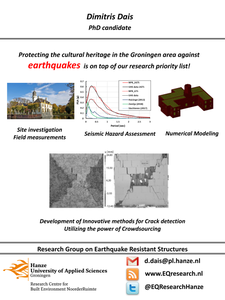
Fraeylemaborg is a noble house in an earthquake-stricken area of the Netherlands due to the induced seismicity events in the region. The structure is located in the middle of the town of Slochteren which gave its name to the largest gas field in the world upon its discovery in 1959. The gas extraction has caused small-magnitude shallow earthquakes during the last decade, damaging not only the residential inventory but also the historical structures in the area. The main building of Fraeylemaborg sits on an artificial island surrounded by water channels, rendering the problem of earthquake response even more complicated. A small part of the main structure on the island was built in the 14th century, while the construction of additional parts and morphological alterations had taken place until the 18th century. The structure has been subjected to several small magnitude earthquakes causing damages on the load bearing system. An extensive renovation and repair of damages took place in recent years, however the latest seismic events imposed again damage to the structure. This paper presents a project of monitoring, assessment and diagnosis of problems for the Fraeylemaborg, the most important “borg” of the region, underlining the particularities of the induced seismicity problem. The FE model has been calibrated by using ambient vibration tests. Combination of earthquake and soil settlement loads have been applied on the calibrated model. The paper develops scenarios that help in explaining the reasons behind the damages on this structure during the recent shallow and low-magnitude induced seismicity earthquakes.
LINK



