Trust between providers and consumers in the sharing economy are crucial to complete transactions successfully. From a consumer's perspective, a provider's profile is an important source of information for judging trustworthiness, because it contains multiple trust cues. However, the effect of a provider's self-description on perceived trustworthiness is still poorly understood. We examine how the linguistic features of a provider's self-description predict perceived trustworthiness. To determine the perceived trustworthiness of 259 profiles, real consumers on a Dutch sharing platform rated these profiles for trustworthiness. The results show that profiles were perceived as more trustworthy if they contained more words, more words related to cooking, and more words related to positive emotions. Also, a profile's perceived trustworthiness score correlated positively with the provider's actual sales performance. These findings indicate that a provider's self-description is a relevant signal to consumers, even though it seems easy to fake.
DOCUMENT
The sharing economy holds promise for the way we consume, work, and interact. However, consuming in the sharing economy is not without risk, as institutional trust measures (e.g. contracts, regulations, guarantees) are often absent. Trust between sellers and buyers is therefore crucial to complete transactions successfully. From a buyer ́s perspective, a seller ́s profile is an important source of information for judging trustworthiness, because it contains multiple trust cues such as a reputation score, a profile picture, and a textual self-description. The effect of a seller’s self-description on perceived trustworthiness is still poorly understood. We examine how the linguistic features of a seller’s self-description predict perceived trustworthiness. To determine the perceived trustworthiness of 259 profiles, 189 real buyers on a Dutch sharing platform rated their trustworthiness. The results show that profiles were perceived as more trustworthy if they contained more words (which could be an indicator of uncertainty reduction), more words related to cooking (indicator of expertise), and more words related to positive emotions (indicator of enthusiasm). Also, a profile’s perceived trustworthiness score correlated positively with the seller’s actual sales performance. These findings indicate that a seller’s self-description is a relevant signal to buyers, eventhough it is cheap talk (i.e. easy to produce). The results can guide sellers on how to self-present themselves on sharing platforms and inform platform owners on how to design their platform so that it enhances trust between platform users.
DOCUMENT
The current study analyzed blogs written by four Dutch parents of children with profound intellectual and multiple disabilities, with the aim of deepening the understanding of the parents’ concerns. Thematic analysis was conducted and five main themes were identified: Dealing with uncertainties addressed the impact of unpredictability present in the everyday lives of parents, Love and loss described the complexity of concurrently cherishing the child and grieving various types of loss, Struggling with time, energy and finances detailed imbalances and struggles related to parents’ personal resources, Feeling included in communities and society specified social consequences, and Relating to professional care services reflected on stress and support associated with professional care delivery. The study findings demonstrate how care professionals should acknowledge parents’ vulnerabilities by being aware of their existential distress and empowering parents to exercise control of family thriving.
DOCUMENT

Introduction: The contemporary scientific literature indicates that numeracy is a multifaceted concept. The ongoing societal and technological transformations underscore the imperative to re-evaluate the attributes characterizing a numerate individual and the strategic initiatives that policymakers should devise and implement to ensure that individuals are not marginalized from participation in public and private domains due to their lack of numeracy proficiency. Numerous empirical investigations on numeracy consistently affirm its pivotal role in enabling individuals to engage autonomously across diverse contexts within their daily lives. However, numeracy’s fundamental role has often been neglected in our societies. The present study scrutinizes the overarching challenges associated with numeracy, particularly emphasizing the challenges regarding healthcare, finance, and the critical utilization and interpretation of data awareness. Methods: A two-phase research framework was adopted to address this inquiry. A comprehensive literature review was conducted to discern the prevalent challenges regarding numeracy awareness. Subsequently, two illustrative case studies were undertaken in Slovenia and Spain to contrast and deliberate upon the insights derived from the literature review. Qualitative research methods were employed to engage in a nuanced exploration of the gathered data. Results: This empirical analysis deduced guidelines aimed at enhancing awareness and ameliorating some of these challenges. Discussion and Conclusion: We conclude that making visible the awareness that adults already have about numeracy in aspects of their lives, such as finance, health, or the use and critical interpretation of data, can give policymakers and curriculum developers clues to design effective numeracy programs to address the multifaceted challenges confronting contemporary society, both in the immediate and foreseeable future.
LINK
That expressive writing can be a beneficial response to trauma or grief is well-established in the literature. Grief research also shows that the majority of people are resilient in the face of the death of loved ones. That said, traditional rituals around loss are no longer ubiquitous, well-known phase models of bereavement are contested, and ‘unfinished business’ can create difficulties in the face of loss. Increasingly, bereavement scholars speak of a need for individuals in western society to make meaning of their own grief through narrative construction, though little is said about what constitutes a beneficial story. The author takes an autoethnographic approach to write and reflect on her spouse’s illness and death and explores through a multi-voiced expressive dialogue a personal issue around her bereavement. In an analysis of her writing, using Dialogical Self Theory, she identifies markers which may be indicative of the development of a beneficially constructed narrative. The model of writing-for-transformation is used to describe the overall intent of the process, while the dialogical markers show how progress may be identified. Reinekke Lengelle (2020) Writing the Self and Bereavement: Dialogical Means and Markers of Moving Through Grief, Life Writing, 17:1, 103-122, DOI: 10.1080/14484528.2020.1710796
DOCUMENT
Anthropology is traditionally broken into several subfields, physical/biological anthropology, social/cultural anthropology, linguistic anthropology, archaeology, and sometimes also applied anthropology. Anthropology of the environment, or environmental anthropology, is a specialization within the field of anthropology that studies current and historic human-environment interactions. Although the terms environmental anthropology and ecological anthropology are often used interchangeably, environmental anthropology is considered by some to be the applied dimension of ecological anthropology, which encompasses the broad topics of primate ecology, paleoecology, cultural ecology, ethnoecology, historical ecology, political ecology, spiritual ecology, and human behavioral and evolutionary ecology. However, according to Townsend (2009: 104), “ecological anthropology will refer to one particular type of research in environmental anthropology—field studies that describe a single ecosystem including a human population and frequently deal with a small population of only a few hundred people such as a village or neighborhood.” Kottak states that the new ecological anthropology mirrors more general changes in the discipline: the shift from research focusing on a single community or unique culture “to recognizing pervasive linkages and concomitant flows of people, technology, images, and information, and to acknowledging the impact of differential power and status in the postmodern world on local entities. In the new ecological anthropology, everything is on a larger scale” (Kottak 1999:25). Environmental anthropology, like all other anthropological subdisciplines, addresses both the similarities and differences between human cultures; but unlike other subdisciplines (or more in line with applied anthropology), it has an end goal—it seeks to find solutions to environmental damage. While in our first volume (Shoreman-Ouimet and Kopnina 2011) we criticized Kottak’s anthropocentric bias prioritizing environmental anthropology's role as a supporter of primarily people's (and particularly indigenous) interests rather than ecological evidence. In his newer 2 publication, Kottak (2010:579) states: “Today’s ecological anthropology, aka environmental anthropology, attempts not only to understand but also to find solutions to environmental problems.” And because this is a global cause with all cultures, peoples, creeds, and nationalities at stake, the contributors to this volume demonstrate that the future of environmental anthropology may be more focused on finding the universals that underlie human differences and understanding how these universals can best be put to use to end environmental damage. This is an Accepted Manuscript of a book chapter published by Routledge/CRC Press in "Environmental Anthropology: Future Directions" on 7/18/13 available online: https://doi.org/10.4324/9780203403341 LinkedIn: https://www.linkedin.com/in/helenkopnina/
MULTIFILE

Presentation at the ALM28 Conference: Numeracy and Vulnerability, 5-7 july, Universität Hamburg, Germany.
LINK
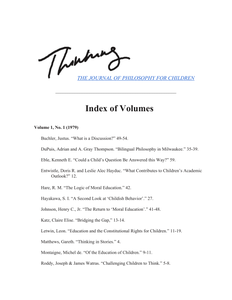
The journal was a forum for the work of both theorists and practitioners of philosophical practice with children, and published such work in all forms, including philosophical argument and reflection, classroom transcripts, curricula, empirical research, and reports from the field. The journal also maintained a tradition in publishing articles in the hermeneutics of childhood, a field of intersecting disciplines including cultural studies, social history, philosophy, art, literature and psychoanalysis.
DOCUMENT
At the age of a failing economic system and undeniable evidence of the effects humankind has had over the planet, it is necessary to look for alternatives to the way we live locally. This article explores the use of designing narratives and metanarratives to co-create imaginaries serving as the needed alternatives. This research starts by considering the historical factors to understand how industrialisation and the loss of traditional practices created a culture of disconnection from Nature in the Girona area, but also looks at why people start now reconnecting with it. The analysis is the foundation for speculative design practices to co-create a new local narrative of connection and regeneration. The project adopted the Integrative Worldviews Framework and used paradoxes to create possible future worldviews based on historical factors and literature. Citizens participated in conversational future-visioning workshops to develop and evaluate their local imagery of the previously created worldviews. This conversation-based exercise evidenced the potential of paradoxes in destructive futures to create imaginaries of regeneration. These imaginaries merge and form future stories. From the future narratives, the practice created cultural artefacts embodying a new culture of connection based on storytelling, traditional jobs, and a mythological understanding of Nature. Finally, as observed at the end of the project, these artefacts allow citizens to adopt them as their culture and expand their current worldview.
DOCUMENT

Digital surveillance technologies using artificial intelligence (AI) tools such as computer vision and facial recognition are becoming cheaper and easier to integrate into governance practices worldwide. Morocco serves as an example of how such technologies are becoming key tools of governance in authoritarian contexts. Based on qualitative fieldwork including semi-structured interviews, observation, and extensive desk reviews, this chapter focusses on the role played by AI-enhanced technology in urban surveillance and the control of migration between the Moroccan–Spanish borders. Two cross-cutting issues emerge: first, while international donors provide funding for urban and border surveillance projects, their role in enforcing transparency mechanisms in their implementation remains limited; second, Morocco’s existing legal framework hinders any kind of public oversight. Video surveillance is treated as the sole prerogative of the security apparatus, and so far public actors have avoided to engage directly with the topic. The lack of institutional oversight and public debate on the matter raise serious concerns on the extent to which the deployment of such technologies affects citizens’ rights. AI-enhanced surveillance is thus an intrinsically transnational challenge in which private interests of economic gain and public interests of national security collide with citizens’ human rights across the Global North/Global South divide.
MULTIFILE



