Wind and solar power generation will continue to grow in the energy supply of the future, but its inherent variability (intermittency) requires appropriate energy systems for storing and using power. Storage of possibly temporary excess of power as methane from hydrogen gas and carbon dioxide is a promising option. With electrolysis hydrogen gas can be generated from (renewable) power. The combination of such hydrogen with carbon dioxide results in the energy carrier methane that can be handled well and may may serve as carbon feedstock of the future. Biogas from biomass delivers both methane and carbon dioxide. Anaerobic microorganisms can make additional methane from hydrogen and carbon dioxide in a biomethanation process that compares favourably with its chemical counterpart. Biomethanation for renewable power storage and use makes appropriate use of the existing infrastructure and knowledge base for natural gas. Addition of hydrogen to a dedicated biogas reactor after fermentation optimizes the biomethanation conditions and gives maximum flexibility. The low water solubility of hydrogen gas limits the methane production rate. The use of hollow fibers, nano-bubbles or better-tailored methane-forming microorganisms may overcome this bottleneck. Analyses of patent applications on biomethanation suggest a lot of freedom to operate. Assessment of biomethanation for economic feasibility and environmental value is extremely challenging and will require future data and experiences. Currently biomethanation is not yet economically feasible, but this may be different in the energy systems of the near future.
DOCUMENT

Power to methane provides a solution to a couple of two problems: unbalanced production and demand of wind plus solar power electricity and the low methane content of biogas by storing electricity via hydrogen into methane gas using carbon dioxide from biogas and methanogenic bacteria. The four-year project is performed by a consortium of three research institutes and five companies. In WP1 the-state-of- the-art of scientific knowledge on P2M technology is reviewed and evaluated.
DOCUMENT

Excess of renewable electricity from wind turbines or solar panels is used for electrolysis of water. To store this renewable energy as methane, the hydrogen is fed to an anaerobic digester to stimulate biological methanation by hydrogenotrophic methanogens. These work packages focus on the best ways for hydrogen delivery and the community changes in a biomethanation reactor as a result of hydrogen supply.
DOCUMENT

Excess of renewable electricity from wind turbines or solar panels is used for electrolysis of water. To store this renewable energy as methane, the hydrogen is fed to an anaerobic digester to stimulate biological methanation by hydrogenotrophic methanogens. This workpackage focusses on the best ways for hydrogen delivery and the community changes in a biomethanation reactor as a result of hydrogen supply.
DOCUMENT

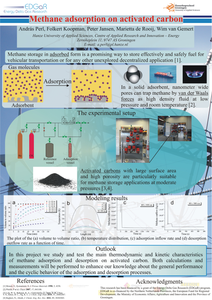
Locally produced methane, - either as biomethane or power-to-gas product, has to be stored to provide a reliable gas source for the fluctuating demand of any local gas distribution network. Additionally, methane is a prominent transportation fuel but its suitability for vehicular application depends on the ability to store an adequate amount in the onboard fuel tank. Adsorption in porous materials could enable a simple, safe and cost-effective method for storing methane at ambient temperature and at reasonably low pressure. In this project we study and test the main thermodynamic and kinetic characteristics of methane adsorption and desorption on activated carbon. Both calculations and measurements are performed to enhance our knowledge about the general performance and the cyclic behavior of the adsorption and desorption processes.
DOCUMENT

This Workpackage designs and implements ways of communication on the progress and results of the Power to Methane project to the outside world by means of target group differentiation, communication plan, design of an appropriate project logo and overall incentive to tell the world what we are doing, how and why.
DOCUMENT

Methane storage in adsorbed form is a promising way to effectively and safely store fuel for vehicular transportation or for any other potential application. In a solid adsorbent, nanometer wide pores can trap methane by van der Waals forces as high density fluid at low pressure and room temperature. This provides the suitable technology to replace bulky and expensive cylindrical compressed natural gas tanks. Activated carbons with large surface area and high porosity are particularly suitable for methane storage applications at moderate pressures. We study and test the main thermodynamic and kinetic characteristics of methane adsorption and desorption on activated carbon.
DOCUMENT
This report presents the experimental and numerical work carried out by ECN and Hanze University of Applied Sciences on methane sorption on activated carbon, as part of their activities within the EDGaR Energy Storage project. Eleven different activated carbon types were tested. It was found that MaxSorb MSC-30 offered the highest methane mass storage density (m/m ratio). However, due to the low density of the MaxSorb MSC-30 activated carbon, the highest volumetric methane storage density (V/V ratio) was found for Brightblack. An increase of the packing density and heat conductivity significantly improves the V/V ratio and shortens the time needed to reach thermal equilibrium. In the case of the Brightblack activated carbon, a total V/V ratio of 112 was found at 12 oC and 40 bar, implying an effective storage density that is 3 times higher than for compressed methane. During the adsorption of methane on activated carbon, sorption heat is released and the temperature of the bed is increased, which negatively affects the effective V/V ratio. Temperature rises up to 70 oC were experimentally observed at higher methane inflow rates. For MaxSorb MSC-30 a temperature rise of 25 oC reduced the effective V/V ratio by about 20 %. The temperature rise of the Brightblack bed caused relatively smaller reductions in the volumetric storage density. Calculations with the validated numerical models indicated an even higher temperature increase for the full scale methane storage, reaching bed temperatures up to 137-150 oC in the case of the MaxSorb MSC-30 activated carbon. At this temperature range, the models indicate a V/V ratio fall down to 46. This performance is similar to the one offered by direct methane compression to 40 bar, and is much lower than the V/V ratio of ~ 100 that was found both experimentally and by calculations for the lab scale reactor performance. The calculations showed, that the low bed permeability can limit the gas flow during adsorption and desorption. A high reactor diameter can countervail the effect of permeability, but the higher dimensions impede the heat dissipation and thus decrease the storage efficiency. Efficient temperature control and management are very important to effectively make use of the methane storage capacity through adsorption.
DOCUMENT
With increased share of energy generated from variable renewable sources, storagebecomes a critical issue to ensure constantly balanced supply/demand.Methane is a promising vector for energy storage and transport.
DOCUMENT

Power-to-gas technologies are considered to be part of the future energy sys- tem, but their viability and applicability need to be assessed. Therefore, models for the viability of farm-scale bio-power-to-methane supply chains to produce green gas were analysed in terms of levelised cost of energy, energy efficiency and saving of greenhouse gas emission. In bio-power-to-methane, hydrogen from electrolysis driven by surplus renewable electricity and carbon dioxide from biogas are converted to methane by microbes in an ex situ trickle-bed reactor. Such bio-methanation could replace the current upgrading of biogas to green gas with membrane technology. Four scenarios were compared: a refer- ence scenario without bio-methanation (A), bio-methanation (B), bio-methanation combined with membrane upgrading (C) and the latter with use of renewable energy only (all-green; D). The reference scenario (A) has the lowest costs for green gas production, but the bio-methanation scenarios (B-D) have higher energy efficiencies and environmental benefits. The higher costs of the bio-methanation scenarios are largely due to electrolysis, whereas the environmental benefits are due to the use of renewable electricity. Only the all- green scenario (D) meets the 2026 EU goal of 80% reduction of greenhouse gas emissions, but it would require a CO2 price of 200 € t−1 to achieve the levelised cost of energy of 65 €ct Nm−3 of the reference scenario. Inclusion of the intermittency of renewable energy in the scenarios substantially increases the costs. Further greening of the bio-methanation supply chain and how intermittency is best taken into account need further investigation.
DOCUMENT



