How is an academic philosopher, humanities researcher, or scientist with an interest in philosophy able to imagine, understand and reproduce a philosophical theory that’s highly abstract in a way, because the theory is a priory by nature and doesn’t use a lot of examples that relate to daily life? For example, Helmuth Plessner’s Die Stufendes Organischen und der Mensch(1928)? Talking from my own experience as a trained academic philosopher with a master’s degree and a PhD in philosophy of anthropology and technology (Müller 2009), it takes a lot of analytical training and many years of study to build a huge‘internal mental mind map’–looking like a gigantic spider’s web or grid with interrelated philosophical and other scientific concepts–that serves as a road map to compare ideas, deepen the understanding of formerly read texts and gain new perspectives on philosophy as a discipline and life in general. Working in academia, this way of reading texts, understanding theories, producing papers and a dissertation, worked very well for me for quite some time. Until I startedtoteachphilosophy myself as a PhD student. In university, students are used to lectures accompanied by PowerPoints with lots of slides packed full of theories, definitions, andquotes, and sometimes a few images are added. I liked doing ‘traditional knowledge transfer education’ during my lectures but enjoyed the work groups even better as Ilearned a lot myself from the discussions with my students. Although being the‘master’ in front of a class of‘students’ has its beautiful sides (standing in a long tradition ofteaching regarded as a craft, where knowledge is passed over like a‘guild system’), I preferred the ’democratic ways of the work group’ joining efforts together in gaining a better understanding of philosophical theories and the way they relate to history and the cultures we live in–and our own lives. I always had the feeling that teaching philosophy could be done in a different way. This made me think. Could I invent a set-ting where the traditional ways of knowledge transfer would intertwine with the spicy‘agree to disagree’ discussions and moments of synergy?
DOCUMENT

Purpose – Older people with dementia (OPD) have specific housing and technology-related needs, for which various design principles exist. A model for designing environments and its constituting items for people with dementia that has a firm foundation in neurology may help guide designers in making design choices. The paper aims to discuss these issues. Design/methodology/approach – A general design model is presented consisting of three principles for OPD, namely designing for ageing people; designing for a favourable state and designing for beautiful moments. The neurosciences as a whole give shape to an eminent framework explaining the behaviour of OPD. One of the objectives of this paper is to translate the design principles into design specifications and to show that these specifications can be translated in a design. Findings – Philosophical concepts are introduced which are required to understand design for OPD. Four case studies from Dutch nursing homes are presented that show how the theory of modal aspects of the philosopher Dooyeweerd can be used to map design specifications in a systematic way. Research limitations/implications – These examples of design solutions illustrate the applicability of the model developed in this article. It emphasises the importance of the environment for supporting the daily life of OPD. Originality/value – There is a need for a design model for OPD. The environment and technology should initiate positive behaviours and meaningful experiences. In this paper, a general model for the designing of environments for OPD was developed that has a firm foundation in neurology and behavioural sciences. This model consists of six distinct steps and each step can be investigated empirically. In other words, this model may lay the foundation for an evidence-based design. Original article at Emerald: https://doi.org/10.1108/JET-11-2017-0043 For this paper Joost van Hoof received the Highly Recommended Award from Emerald Publishing Ltd. in October 2019: https://www.emeraldgrouppublishing.com/authors/literati/awards.htm?year=2019
MULTIFILE

Purpose To analyze differences between Western and Eastern cultures in the way they conceptualize knowledge and discuss the implications of these differences for a global intellectual capital (IC) theory and practice. Design/methodology/approach A systematic metaphor analysis of the concept of knowledge and IC is used to identify common Western conceptualizations of knowledge in IC literature. A review of philosophical and religious literature was done to identify knowledge conceptualizations in the main streams of Asian philosophy. Findings Fundamental differences were found in the way knowledge is conceptualized. In Western IC literature common metaphors for knowledge include knowledge as a thing and knowledge as capital. In Asian thought, knowledge is seen as unfolding truth based upon a unity of universe and human self and of knowledge and action. Research limitations/implications The research was performed on a limited sample of literature. More research is needed to identify how knowledge is conceptualized in the practice of doing business in Asia and to test the effects of introducing IC theories to Asian businessmen and managers. Practical implications Western conceptualizations of knowledge, embedded in terms like intellectual capital and knowledge management, can not be transferred to Asian business without considering the local view on knowledge. Asian conceptualizations of knowledge should play an important role in the further development of a knowledge-based theory and practice of the firm. Originality/value The paper is the first to explore differences in knowledge conceptualizations by analyzing the underlying metaphors that are used in Western IC literature and Asian philosophy.
DOCUMENT

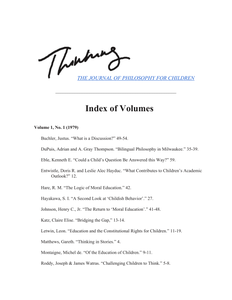
The journal was a forum for the work of both theorists and practitioners of philosophical practice with children, and published such work in all forms, including philosophical argument and reflection, classroom transcripts, curricula, empirical research, and reports from the field. The journal also maintained a tradition in publishing articles in the hermeneutics of childhood, a field of intersecting disciplines including cultural studies, social history, philosophy, art, literature and psychoanalysis.
DOCUMENT
The recent shift towards the interdisciplinary study of the human-environment relationship is largely driven by environmental justice debates. This article will distinguish four types of environmental justice and link them to questions of neoliberalism and altruism. First, environmental justice seeks to redress inequitable distribution of environmental burdens to vulnerable groups and economically disadvantaged populations. Second, environmental justice highlights the developed and developing countries’ unequal exposure to environmental risks and benefits. Third, temporal environmental justice refers to the issues associated with intergenerational justice or concern for future generations of humans. In all three cases, environmental justice entails equitable distribution of burdens and benefits to different nations or social groups. By contrast, ecological justice involves biospheric egalitarianism or justice between species. This article will focus on ecological justice since the rights of non-human species lags behind social justice debates and discuss the implications of including biospheric egalitarianism in environmental justice debates. https://doi.org/10.1186/2194-6434-1-8 https://www.linkedin.com/in/helenkopnina/
MULTIFILE

The development of an integrated ethical or normative model to design housing for persons with impairments and diseases, focusing on older persons with dementia.
LINK
This article will discuss philosophical debates on economic growth and environmental sustainability, the role of management responsibility, and the risk of subversion to business as usual. This discussion will be framed using the concepts of Cradle to Cradle (C2C) and Circular Economy about sustainable production. The case study illustrating the danger of subversion of these progressive models discussed here is based on the assignments submitted by Masters students as part of a course related to sustainable production and consumption at Leiden University. The evaluation of the supposedly best practice cases placed on the website of the Ellen MacArthur Foundation or those awarded Cradle to Cradle certificate has led some students to conclude that these cases illustrated green-washing. Larger implications of identified cases of green-washing for the field of sustainable business and ecological management are discussed. “This is a post-peer-review, pre-copyedit version of an article published in 'Philosophy of Management'. The final authenticated version is available online at: https://doi.org/10.1007/s40926-019-00108-x LinkedIn: https://www.linkedin.com/in/helenkopnina/
MULTIFILE

In this article, I present a philosophical perspective on Kunneman’s concept of ‘amor complexitatis’ based on the philosophical work of Hannah Arendt. I analyse the two constituting elements, ‘amor’ and ‘complexitas’. In opposition to most classic philosophers who engage with the vita contemplativa, the eternal decontextualized aspects of life, Arendt was concerned with the vita activa, a philosophy of the world. She distinguishes three human activities: labour, which corresponds to the biological functions of the body; work which creates enduring artefacts in the world and is a predictable, instrumental activity; and action which is political in nature and is the result of humans dealing with the inherent plurality of the world. It is the realm of difference where people engage in discussion, interaction, and narratives to generate ideas, etc. The outcome of human action is unpredictable and therefore always holds the potential for something new to emerge, which Arendt calls ‘natality’, a central concept in her philosophy. Plurality is the precondition for political life. Removal or denial of difference and plurality is catastrophic for the vita activa and the realm of the political. Arendt and Kunneman are both part of a philosophical tradition which critiques modernity’s instrumentalization of human action. Both engage with the concept of love to deal with the complexities of human action without abolishing these complexities. Drawing on the work of Biesta, I then critically discuss Arendt’s perspective on education. Arendt proclaims an education for the world and it is the role of the teacher to engage the child into this world with all its complexities. The analysis of the concept of complexitas in education reveals three dimensions, each related to a particular key concept of Arendt’s philosophy: plurality, action and natality. I end this contribution with a discussion of the practical implications of Arendt’s views for teaching in the light of normative professionalism.
LINK
The purpose of the paper is to start a dialogue about differences between Western and Eastern cultures in the way they conceptualize knowledge and discuss the implications of these differences for a global intellectual capital (IC) theory and practice. A systematic metaphor analysis of the concept of knowledge and IC is used to identify common Western conceptualizations of knowledge in IC literature. A review of philosophical and religious literature was done to identify knowledge conceptualizations in the main streams of Asian philosophy. Fundamental differences were found in the way knowledge is conceptualized. In Western IC literature common metaphors for knowledge include knowledge as a thing and knowledge as capital. In Asian thought, knowledge is seen as unfolding truth based upon a unity of universe and human self and of knowledge and action. The research was performed on a limited sample of literature. More research is needed to identify how knowledge is conceptualized in the practice of doing business in Asia and to test the effects of introducing IC theories to Asian businessmen and managers. Moreover, it might be questionable whether different types of resources (Western management literature on IC and Asian cultural philosophies) can be put in a comparative perspective to extract conclusions out of it. This methodological starting point has its confinements, but is plausible partly as long as IC theories originating from an Asian background are still missing, partly as far as philosophical notions within Western IC publications are contrasted with Asian notions of knowledge. Despite this restriction we would like to emphasize that Western conceptualizations of knowledge, embedded in terms like intellectual capital and knowledge management, can not be transferred to Asian business without considering the local view on knowledge. Asian conceptualizations of knowledge should play an important role in the further development of a knowledge-based theory and practice of the firm. We choose deliberately to contrast Western philosophy with cultural and religious connotations in Asian philosophy, as the underlying paradigm is strongly influenced by these notions. This is clearly perceivable in revivalist and reformist tendencies in Buddhism, Hinduism and Islam. Religious notions within these traditions have a strong paradigmatic function in a cognitive and normative sense. Not only in anthropology but also in epistemology, contemporary Asian thought is dominated by a discourse deeply embedded in religious and cultural traditions, in which the dimensions of 'nature', 'subjectivity' and 'history' have well defined boundaries. Anthropologically and epistemologically, all spheres of human reality are analyzed and described within the perspective of an integral and monolithic unity, in which all dimensions and spheres of being are bound. In Western philosophy these spheres of being have been separated from religious notions because of a longstanding secularization due to which religion and culture, metaphysics and philosophy have become separate disciplines.(Boom, 1993)
DOCUMENT

Stefan Bengtsson's commentary about policy hegemony discusses the alternative discourses of socialism, nationalism, and globalism. However, Stefan does not adequately demonstrate how these discourses can overcome the Dominant Western Worldview (DWW), which is imbued with anthropocentrism. It will be argued here that most policy choices promoting sustainability, and education for it, are made within a predetermined system in which the already limiting notion of environmental protection is highly contingent on human welfare. What would really contest the dominant assumptions of Vietnamese policy and, more specifically, education for sustainable development (ESD) is an alternative discourse that challenges the DWW. That alternative discourse embraces philosophical ecocentrism and practices of ecological justice between all species, and deep ecology theory - all perspectives fundamentally committed to environmental protection. https://doi.org/10.1080/00958964.2015.1048502 LinkedIn: https://www.linkedin.com/in/helenkopnina/
MULTIFILE




