Conference Proceedings EAPRIL 2015, Leuven, Belgium
DOCUMENT

Competitive and working papers as well as abstracts in these proceedings discuss recent academic insights and link academic research to the practice field in order to exchange knowledge on contexts and effects, potentials and challenges of CSR and communication, on best practices and newest developments. They give a variety of insights on CSR and communication from academia (communication, management, marketing science etc.) and the practice field (corporations, consultancies, associations).
LINK
Proceedings of the IASPM Benelux conference. Popular Music: Theory and Practice in the Lowlands.
DOCUMENT

Proceedings of the 24th International Conference of Adults Learning Mathematics – A Research Forum (ALM).
DOCUMENT

This book constitutes the refereed proceedings of the 15th International Conference on Interactive Digital Storytelling, ICIDS 2022, held in Santa Cruz, CA, USA, in December 2022.The 30 full papers and 10 short papers, presented together with 17 posters and demos, were carefully reviewed and selected from 79 submissions.
DOCUMENT
A primary teacher needs mathematical problem solving ability. That is why Dutch student teachers have to show this ability in a nationwide mathematics test that contains many non-routine problems. Most student teachers prepare for this test by working on their own solving test-like problems. To what extent does these individual problem solving activities really contribute to their mathematical problem solving ability? Developing mathematical problem solving ability requires reflective mathematical behaviour. Student teachers need to mathematize and generalize problems and problem approaches, and evaluate heuristics and problem solving processes. This demands self-confidence, motivation, cognition and metacognition. To what extent do student teachers show reflective behaviour during mathematical self-study and how can we explain their study behaviour? In this study 97 student teachers from seven different teacher education institutes worked on ten non-routine problems. They were motivated because the test-like problems gave them an impression of the test and enabled them to investigate whether they were already prepared well enough. This study also shows that student teachers preparing for the test were not focused on developing their mathematical problem solving ability. They did not know that this was the goal to strive for and how to aim for it. They lacked self-confidence and knowledge to mathematize problems and problem approaches, and to evaluate the problem solving process. These results indicate that student teachers do hardly develop their mathematical problem solving ability in self-study situations. This leaves a question for future research: What do student teachers need to improve their mathematical self-study behaviour? EAPRIL Proceedings, November 29 – December 1, 2017, Hämeenlinna, Finland
DOCUMENT
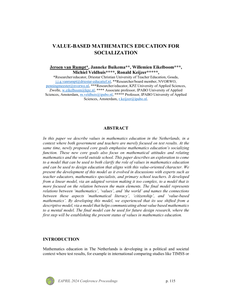
In this paper we describe values in mathematics education in the Netherlands, in a context where both government and teachers are merely focused on test results. At the same time, newly proposed core goals emphasise mathematics education’s socializing function. These new core goals also focus on mathematical attitudes and relating mathematics and the world outside school. This paper describes an exploration to come to a model that can be used to both clarify the role of values in mathematics education and can be used to design education that aligns with this value-oriented character. We present the development of this model as it evolved in discussions with experts such as teacher educators, mathematics specialists, and primary school teachers. It developed from a linear model, via an adapted version making it too complex, to a model that is more focused on the relation between the main elements. The final model represents relations between ‘mathematics’, ‘values’, and ‘the world’ and names the connections between these aspects ‘mathematical literacy’, ‘citizenship’, and ‘value-based mathematics’. By developing this model, we experienced that its use shifted from a descriptive model, via a model that helps communicating about value based mathematics to a mental model. The final model can be used for future design research, where the first step will be establishing the present status of values in mathematics education.
DOCUMENT
No summary available
DOCUMENT
Conference proceedings International Symposium on Intelligent Manufacturing Environments
DOCUMENT





