Adopted on the fifteenth anniversary of resolution 1325, Security Council resolution 2242 has recognized for the first time the substantial link between climate change and the “Women, Peace and Security” (WPS) framework. Despite this landmark resolution, the intersections of environmental factors, conflict and violence against women remain largely absent from the Security Council's WPS agenda. Competition over natural resources is generally understood as a driver of conflict. The risk of insecurity and conflict are further increased by environmental degradation and climate change. It is therefore clear that the environment and natural resources must be integrated into the WPS agenda. This should necessarily include a discussion of indigenous rights to land and the gender-related dimensions of environmental factors. Indigenous women are disproportionately affected by environmental degradation, caused by resource extraction and increasingly compounded by climatic changes. This in turn exacerbates other vulnerabilities, including sexual and gender-based violence and other forms of marginalization. This article argues, by reference to the situation in West Papua, that unfettered resource extraction not only amplifies vulnerabilities and exacerbates preexisting inequalities stemming from colonial times, it also gives rise to gendered consequences flowing from the damage wreaked on the natural environment and thus poses a danger to international peace and security. As such, the Security Council's failure to recognize the continuous struggle of women in indigenous and rural communities against extractive economies and climate change impact as a security risk forms a serious lacuna within its WPS agenda. Originally published by Oxford University Press in Global Studies Quarterly, Volume 1, Issue 3, September 2021, ksab018, https://doi.org/10.1093/isagsq/ksab018
MULTIFILE

This paper presents four Destination Stewardship scenarios based on different levels of engagement from the public and private sector. The scenarios serve to support destination stakeholders in assessing their current context and the pathway towards greater stewardship. A Destination Stewardship Governance Diagnostic framework is built on the scenarios to support its stakeholders in considering how to move along that pathway, identifying the key aspects of governance that are either facilitating or frustrating a destination stewardship approach, and the required actions and resources to achieve an improved scenario. Moreover, the scenarios and diagnostic framework support stakeholders to come together to debate and scrutinise how tourism is managed in a way that meets the needs of the destination, casting new light on the barriers and opportunities for greater destination stewardship.
DOCUMENT

Urban ageing is an emerging domain that deals with the population of older people living in cities. The ageing of society is a positive yet challenging phenomenon, as population ageing and urbanisation are the culmination of successful human development. One could argue whether the city environment is an ideal place for people to grow old and live at an old age compared to rural areas. This viewpoint article explores and describes the challenges that are encountered when making cities age-friendly in Europe. Such challenges include the creation of inclusive neighbourhoods and the implementation of technology for ageing-in-place. Examples from projects in two age-friendly cities in The Netherlands (The Hague) and Poland (Cracow) are shown to illustrate the potential of making cities more tuned to the needs of older people and identify important challenges for the next couple of years. Overall, the global ageing of urban populations calls for more age-friendly approaches to be implemented in our cities. It is a challenge to prepare for these developments in such a way that both current and future generations of older people can benefit from age-friendly strategies. CC-BY Original article: https://doi.org/10.3390/ijerph15112473 https://www.dehaagsehogeschool.nl/onderzoek/lectoraten/details/urban-ageing#over-het-lectoraat
MULTIFILE

This paper analyses the ways in which informal mediation channels facilitate service delivery in the Citizen Service Bureaus at the Municipal Corporation of Delhi and give rise to an interplay between formal and informal institutions. In particular, the personal backgrounds of brokers as informal mediators and how they ensure their acceptance amongst service seekers are explored. Further, the motivations of the service seekers to solicit help from these mediators as well as institutional responses from the municipal administration along with other relevant actors like the Government of National Capital Territory of Delhi are examined.
MULTIFILE

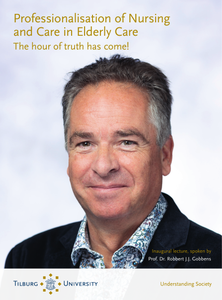
Inaugural lecture, delivered upon public acceptance of the endowed professorship in Professionalisation of Nursing and Care in Elderly Care by Prof. Dr. Robbert J.J. Gobbens at Tilburg University on 29 September 2023.
DOCUMENT
This feasibility report aims to create a solid background for Savings Groups programming in Italy, Spain, Germany, Poland and the Netherlands where partner organisations of the LETS SAVEE1 project are based. This Erasmus+ funded project aims at exploring the potential of saving groups in the European countries’ context, by improving entrepreneurial skills and access to financial services and social networks of diverse target groups. This particular report provides the partner organisation as well as other interested implementing organisations with a better understanding of how the different contexts influences the setting up and/or scale up of saving groups. This report is set up as follows: The market potential is based on literature of societal developments and how they can be linked to the emergence of saving groups in the respective countries and what kind of target groups have potential for benefitting the services offered by savings groups. By mapping partner organisations, the feasibility study identifies present and potential partners and stakeholders which could play an essential role reaching out to target groups. Then, the study will inform partner organisations and other implementers about the legal framework in each country that allows them to set up Savings Groups accordingly and identify issues that might need advocacy actions. Finally, this report provides a mapping of risk factors and ways to mitigate risks for savings groups members that were applicable for all partner organizations.
DOCUMENT

This text is structured as follows. Section 1 concerns the background to this public lecture: the fact that social participation is becoming increasingly important in our society. This is evident, for example, from the way we are evolving from a protective welfare state into an activational, participative society. This development has consequences for the social sector and therefore also for the professionals who work in it. Social work professionals are not necessarily expected to identify or solve participation problems; they are seen as intermediaries who enable citizens to take responsibility themselves. Social work professionals are therefore expected to provide the individual applicant with less direct support and to focus more on strengthening the social networks of people and the social contexts in which they find themselves. Section 2 connects sections 1 and 3, but may also be read independently. It is about the fact that social work professionals are not yet in the habit of providing systematic insight into the results of their actions, while policy makers, for example, are increasingly looking to them precisely for this. First of all, I set out the reasons why it is so important to make the products of their interventions more visible, not only to policy makers, but also to social work professionals themselves and to the customers/citizens who depend on them. Secondly, I set out how the results of social interventions can be made more visible than they are at present; and what research can contribute. In this, I advocate a change in thinking: from thinking in terms of the evidence to thinking in terms of the evident. This argument forms the basis of the type of research that is being taken up from within the research group. In section 3, I describe a number of research projects that will be conducted during my tenure. I also set out the main proposition of this address, which states that social work professionals should do more with the knowledge that peoples behaviour is determined to a significant degree by contexts. In particular, social contexts could play a bigger role in promoting citizen participation. At present, social work professionals normally intervene directly in peoples behaviour, such as with therapies for combating problem behaviour. Interventions in a broader, social, context are rare. Why is this? And couldnt citizen participation be more effectively promoted by these means than through direct behavioural interventions? I put forward four propositions in this regard, and explain each of them in reference to one of the current research projects within the research group. With this, in combination with the general outlines of the research presented in section 2, I hope to provide a clear and inspiring overview of the research that will be carried out within the research group in the coming years. Finally, in section 4, I will discuss the significance of the research group to the faculty of Society and Law at Hogeschool Utrecht University of Applied Sciences, and to parties outside of Hogeschool Utrecht University of Applied Sciences.
DOCUMENT

Within the Erasmus+ project Common European Numeracy Framework (CENF) (2018-2021) a framework was developed on numeracy in response to the challenges and needs of the 21st century.
DOCUMENT




