The goal of this paper is twofold: i) to design a viable business model for community owned solar farms that will be setup in the north of the Netherlands. ii) To present the findings from this case study, and to propose generalisations that are relevant for the development of artefacts that can be used to facilitate the design of viable business models in a business ecosystem setting.USE 2015
DOCUMENT

The rapid implementation of large scale floating solar panels has consequences to water quality and local ecosystems. Environmental impacts depend on the dimensions, design and proportions of the system in relation to the size of the surface water, as well as the characteristics of the water system (currents, tidal effects) and climatic conditions. There is often no time (and budget) for thorough research into these effects on ecology and water quality. A few studies have addressed the potential impacts of floating solar panels, but often rely on models without validation with in situ data. In this work, water quality sensors continuously monitored key water quality parameters at two different locations: (i) underneath a floating solar park; (ii) at a reference location positioned in open water. An underwater drone was used to obtain vertical profiles of water quality and to collect underwater images. The results showed little differences in the measured key water quality parameters below the solar panels. The temperature at the upper layers of water was lower under the solar panels, and there were less detected temperature fluctuations. A biofouling layer on the floating structure was visible in the underwater images a few months after the construction of the park
DOCUMENT

Citizen participation in local renewable energy projects is often promoted as many suppose it to be a panacea for the difficulties that are involved in the energy transition process. Quite evidently, it is not; there is a wide variety of visions, ideologies and interests related to an ‘energy transition’. Such a variety is actually a precondition for a stakeholder participation process, as stakeholder participation only makes sense if there is ‘something at stake’. Conflicting viewpoints, interests and debates are the essence of participation. The success of stakeholder participation implies that these differences are acknowledged, and discussed, and that this has created mutual understanding among stakeholders. It does not necessarily create ‘acceptance’. Renewable energy projects often give rise to local conflict. The successful implementation of local renewable energy systems depends on the support of the local social fabric. While at one hand decisions to construct wind turbines in specific regions trigger local resistance, the opposite also occurs! Solar parks sometimes create a similar variation: Various communities try to prevent the construction of solar parks in their vicinity, while other communities proudly present their parks. Altogether, local renewable energy initiatives create a rather chaotic picture, if regarded from the perspective of government planning. However, if we regard the successes, it appears the top down initiatives are most successful in areas with a weak social fabric, like industrial areas, or rather recently reclaimed land. Deeply rooted communities, virtually only have successful renewable energy projects that are more or less bottom up initiatives. This paper will first sketch why participation is important, and present a categorisation of processes and procedures that could be applied. It also sketches a number of myths and paradoxes that might occur in participation processes. ‘Compensating’ individuals and/or communities to accept wind turbines or solar parks is not sufficient to gain ‘acceptance’. A basic feature of many debates on local renewable energy projects is about ‘fairness’. The implication is that decision-making is neither on pros and cons of various renewable energy technologies as such, nor on what citizens are obliged to accept, but on a fair distribution of costs and benefits. Such discussions on fairness cannot be short cut by referring to legal rules, scientific evidence, or to standard financial compensations. History plays a role as old feelings of being disadvantaged, both at individual and at group level, might re-emerge in such debates. The paper will provide an overview of various local controversies on renewable energy initiatives in the Netherlands. It will argue that an open citizen participation process can be organized to work towards fair decisions, and that citizens should not be addressed as greedy subjects, trying to optimise their own private interests, but as responsible persons.
DOCUMENT

With the effects of climate change linked to the use of fossil fuels, as well as the prospect of their eventual depletion, becoming more noticeable, political establishment and society appear ready to switch towards using renewable energy. Solar power and wind power are considered to be the most significant source of global low-carbon energy supply. Wind energy continues to expand as it becomes cheaper and more technologically advanced. Yet, despite these expectations and developments, fossil fuels still comprise nine-tenths of the global commercial energy supply. In this article, the history, technology, and politics involved in the production and barriers to acceptance of wind energy will be explored. The central question is why, despite the problems associated with the use of fossil fuels, carbon dependency has not yet given way to the more ecologically benign forms of energy. Having briefly surveyed some literature on the role of political and corporate stakeholders, as well as theories relating to sociological and psychological factors responsible for the grassroots’ resistance (“not in my backyard” or NIMBYs) to renewable energy, the findings indicate that motivation for opposition to wind power varies. While the grassroots resistance is often fueled by the mistrust of the government, the governments’ reason for resisting renewable energy can be explained by their history of a close relationship with the industrial partners. This article develops an argument that understanding of various motivations for resistance at different stakeholder levels opens up space for better strategies for a successful energy transition. https://doi.org/10.30560/sdr.v1n1p11 LinkedIn: https://www.linkedin.com/in/helenkopnina/
MULTIFILE

Column.
LINK
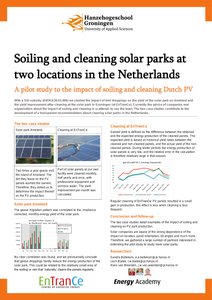
De opbrengst van het zonnepark van Ameland heeft nauwelijks te leiden onder de ganzen die periodiek op Ameland neerstrijken. De vervuiling die zij veroorzaken is ieder jaar met name in april duidelijk zichtbaar maar zorgt amper voor een vermindering van de stroomproductie van het zonnepark. Dat hebben studenten en onderzoekers van de Hanzehogeschool Groningen vastgesteld. Mogelijke redenen hiervoor zijn het wegspoelen van de vervuiling door regen of de beperkte oppervlakte die de vervuiling inneemt.
DOCUMENT
: To have sustainable societies, we need to accelerate the energy transition towards clean energy solutions, however, awareness and understanding of the process is still limited, especially among young people. In addition, the topichas mainly been approached from an engineering angle, ignoring the social challenges: lack of public support for solar farms and large wind turbines could stop the need to act. An optimal balance considering the point of view from all parties involved is out of sight without a focus on social structures and a dialogue among all parties. In this context, universities have a critical role to play: these institutions build capacity through the development of new knowledge, new understanding and new insights, and can therefore provide effective solutions to complex societal challenges. In search of innovative approaches to reach young people, whose communicative paradigm has become more interactive and participatory, the use of serious gaming in formal education is gaining attention among scholars and practitioners: they can foster skills and abilities, contribute to content development of complex issues by integrating insights from different disciplines, and permit learning experiences that are not possible in real life. In this paper, we introduce “We-Energy Game”, which aims to create understanding on the urgency and complexities in the provision of affordable energy from renewable sources for an entire town. During the game, players negotiate, from their respective roles, which energy source they want to employ and on which location, with the goal to make a village or city energy neutral. Then, we present findings from a pre-test and posttest completed by a hundred university students in The Netherlands to analyze the effects of the game on players awareness and understanding. Results reveal positive outcomes on awareness, as well as understanding of the complexity of energy transition and the importance (and difficulty) of collaboration among stakeholders.
DOCUMENT