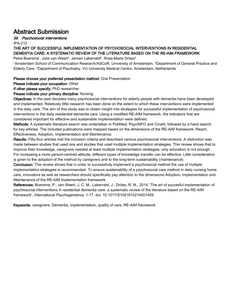
Presentatie gegeven over de review in Brussel Objectives: In the past decades many psychosocial interventions for elderly people with dementia have been developed and implemented. Relatively little research has been done on the extent to which these interventions were implemented in the daily care. The aim of this study was to obtain insight into strategies for successful implementation of psychosocial interventions in the daily residential dementia care. Using a modified RE-AIM framework, the indicators that are considered important for effective and sustainable implementation were defined.
MULTIFILE
Background: Interprofessional collaboration (IPC) among health and social care providers is crucial to effectively implement community-based fall prevention. Several factors hinder successful and sustainable IPC, highlighting the need to both design and evaluate context-specific implementation strategies. However, there remains a fundamental gap in the detailed description and evaluation of such strategies. Therefore, this study aims to (1) monitor the implementation process over time and (2) evaluate the impact of a multifaceted implementation strategy aimed at improving interprofessional collaboration among health and social care professionals in community-based fall prevention. Methods: This study was conducted in two districts and one municipality in the Netherlands. We conducted a longitudinal mixed-methods study with a convergent design, emphasizing qualitative methodology. Over 24 months, qualitative (focus groups and regular meetings) and quantitative (questionnaires) data were collected semi-annually from three working groups of health and social care professionals (HSCPs). Qualitative and quantitative data were initially analyzed separately, followed by an integrated analysis for comprehensive insights on themes influencing the implementation process and the impact of the strategy on IPC and implementation outcomes. Results: In total, 32 HSCPs originating from three communities participated in this study. Monitoring and evaluation of the multifaceted implementation strategy revealed four overarching themes: (1) “Network building”, including aspects and activities that contribute to network building; (2) “Team dynamics”, referring to interactions within the working groups; (3) “Coordination”, addressing the coordination of implementation and establishment of protocols and work flows; and (4) “Implementation dynamics” highlighting aspects that influence the implementation process and outcomes. Conclusions This study identified four key themes influencing the implementation process and impact of a multifaceted implementation strategy aimed at improving IPC among HSCPs in community-based fall prevention: network building, team dynamics, coordination and implementation dynamics. Monitoring and evaluation are crucial.
MULTIFILE
Recent economic crises, environmental problems and social challenges have urged us to drastically change our consumption and production patterns and transform organisations to contribute to socio-technical transitions that positively impact these challenges. Therefore, sustainable development and the transition towards a circular economy are gaining increased attention from academics and are being widely adopted by national and local governments, companies and other organisations and institutions. Since the implementation of more sustainable solutions lags behind expectations and technological possibilities, scholars and practitioners are increasingly seeing sustainable business model innovation as the key pathway to show the value potential of new sustainable technology and stress the importance of integrating the interests of multiple stakeholders and their economic, environmental and social value goals in the business model’s development. However, there is limited research that elucidates which stakeholders are actively involved, how they interact and what the effect is on the collaborative business modelling process for sustainability. This thesis addresses this research gap by building on the notion of business models as boundary-spanning activity-systems and studies stakeholder interaction from the level of a focal firm, as well as from the level of cross-sector actors collaborating in innovation ecosystems. Through four independent studies, three empirical studies and a design science study, this thesis aims to provide a better understanding of how stakeholder interaction affects collaborative business modelling for sustainability.The first study (Chapter 2) took a process perspective on interaction with network ties from the perspective of a focal firm. Based on two case studies of SMEs successfully introducing sustainable technology in the market, value shaping was identified as the operative mechanism describing the relation between networking and business modelling, from ideation to growth of the business. A stage model with five successive forms of value shaping describes how, in each stage, interaction with network ties help firms to clarify the types of economic, environmental and social value that a sustainable technology can deliver and who possible beneficiaries are. In return, changes in the business model clarify what other network ties are needed, demonstrating how the boundary-spanning function of business models spurs firms to expand and strengthen the value network.The second study (Chapter 3) focused on the commercialisation stage, in which a cognitive change in the manager’s mind was found during the development of a sustainable business model. Based on three empirical cases of business model innovations for sustainability, the study explored how stakeholder interaction may trigger and support managerial cognitive change and hence business model innovation. The findings suggest that the influence of stakeholders on the manager’s understanding of the business runs via three interrelated shaping processes: market approach shaping, product and/or service offering shaping and credibility shaping. In these shaping processes, new or latent stakeholders are found to have a bigger impact than existing ones. A research agenda is presented to further unravel the role of stakeholders affecting managerial cognition around business model innovation for sustainability.The third study (Chapter 4) examined innovation ecosystems’ processes of developing a collaborative business model for sustainability. Based on a study of four sustainably innovative cross-sector collaborations, this chapter studied how innovation ecosystems resolve the tensions that emerge from the collaborating actors’ divergent goals and interests. This study finds that innovation ecosystems engage in a process of valuing value that helps the actors to manage the tensions and find a balance of environmental, social and economic value creation and capture that satisfies all involved actors. The findings reveal that valuing value occurs in two different patterns – collective orchestration and continuous search – that open up a research agenda that can shed further light on the conditions that need to be in place in order for an innovation ecosystem to develop effective sustainable business models. The final study (Chapter 5) used a design science approach, developing a tool for innovation ecosystems’ actors to manage the degree to which stakeholders are involved throughout the process of collaborative business modelling for sustainability. The resulting ‘degree of engagement diagram’ and accompanying stepwise approach makes it possible to identify stakeholders from six cross-sector stakeholder groups that represent economic, social and environmental aspects of sustainable value and visualise their roles. By discriminating between four concentric and permeable circles of engagement, the tool integrates different degrees of involvement of stakeholders and enables users of the DoE diagram to accommodate changes that may occur in the evolving business model and its context. The tool enables innovation ecosystems’ actors to keep the collaboration manageable during the development of a joint and viable sustainable business model. Overall, this thesis extends the understanding of the dynamics of collaborative business modelling for sustainability and the role of stakeholder interaction therein. The research makes three key contributions to the sustainable business model innovation literature. First, it extends the literature by exploring the interplay between stakeholder interaction and business modelling over time. It establishes that stakeholder interaction and business modelling have a reciprocal relationship and contributes with two frameworks – value shaping and valuing value – that explain this reciprocal relationship for firms and innovation ecosystems. Second, the thesis unravels the micro-processes and mechanisms that elucidate how stakeholder interaction actually influences the direction into which the sustainable business model develops. Third, this thesis enriches the scholarly understanding of stakeholder interaction by identifying the main contributors to business model innovation for sustainability, by differentiating between stakeholders and their roles and by providing a tool that accommodates this. The research contributes to practice by offering practitioners useful insights on how they can increase, improve and effectuate stakeholder interaction in order to develop viable business models for sustainability and hence contribute to the desired socio-technical transitions.
DOCUMENT

Evidence concerning psychosocial interventions for children and young people with externalizing behavior problems has amassed at an impressive pace in recent years. Interventions that have been proven effective are now considered vehicles through which the knowledge of “what works” can be applied in practice. Outcomes for children, young people, and their families, however, have not improved in line with these advances in knowledge. This difference between the knowledge of “what works” and the application of this knowledge in real-life practice has become known as the “implementation gap”. This dissertation explores questions considering the implementation gap, with a focus on whether professionals are delivering the interventions as intended (treatment integrity).The results of the research underlying this dissertation show that 1) although measuring treatment integrity is important, it is often missing or not examined under adequate circumstances in studies, 2) applying interventions with a high level of treatment integrity makes a real difference to the end-users of the services and 3) targeted and continued support to professionals with a focus on providing feedback on levels of treatment integrity is necessary to enable them to deliver interventions as intended. Organizing support around common factors of interventions can be a first step in integrating and providing feasible support for professionals that provide more than one intervention.
MULTIFILE
The shift towards a more sustainable circular economy will require innovations. While SMEs can contribute to this development, financing innovations within SMEs is difficult. Various authors have not ed moreover that the concept of the circular economy has further increased the complexity of investment decisions concerning sustainable innovations, due to the multiple value creation and new business models involved . On the other hand
DOCUMENT

Background Literature on self-management innovations has studied their characteristics and position in healthcare systems. However, less attention has been paid to factors that contribute to successful implementation. This paper aims to answer the question: which factors play a role in a successful implementation of self-management health innovations? Methods We conducted a narrative review of academic literature to explore factors related to successful implementation of self-management health innovations. We further investigated the factors in a qualitative multiple case study to analyse their role in implementation success. Data were collected from nine self-management health projects in the Netherlands. Results Nine factors were found in the literature that foster the implementation of self-management health innovations: 1) involvement of end-users, 2) involvement of local and business partners, 3) involvement of stakeholders within the larger system, 4) tailoring of the innovation, 5) utilisation of multiple disciplines, 6) feedback on effectiveness, 7) availability of a feasible business model, 8) adaption to organisational changes, and 9) anticipation of changes required in the healthcare system. In the case studies, on average six of these factors could be identified. Three projects achieved a successful implementation of a self-management health innovation, but only in one case were all factors present. Conclusions For successful implementation of self-management health innovation projects, the factors identified in the literature are neither necessary nor sufficient. Therefore, it might be insightful to study how successful implementation works instead of solely focusing on the factors that could be helpful in this process.
LINK
Digitization of activities in hospitals receives more attention, due to Covid-19 related regulations. The use of e-health to support patient care is increasing and efficient ways to implement digitization of processes and other technological equipment are needed. We constructed a protocol for implementation and in this study, we evaluate this protocol based on a case to implement a device in the OR. We used various data sources to evaluate this protocol: semi-structured interviews, questionnaires, and project documents. Based on these findings, this protocol, including identified implementation activities and implementation instructions can be used for implementations of other devices. Implementation activities include setting up a project plan, organizational and technological preparation, maintenance, and training. In future research, these activities and instructions need to be evaluated in more complex projects and a flexible tool needs to be developed to select relevant activities and instructions for implementations of information systems or devices.
LINK
This manifesto describes the notion of sustainable development according to its basic appeal for economic, social and environmental value-creation, together with the implications of its meaning at the level of the individual (the manager), the organisation (the business) and society. As sustainable tourism is focused on the long term, foresight is used to develop four scenarios for a sustainable tourism industry in 2040: “back to the seventies”, “captured in fear”, “unique in the world”, and “shoulders to the wheel”. The implications of the scenarios are mapped for four distinct types of organisational DNA: the blue organisation focusing on quality, professionalism and efficiency, the red organisation for whom challenge, vision and change are most important, the yellow organisation addressing energy, optimism and growth, and the green organisation which is led by care, tradition and security. The manifest concludes with strategic propositions for tourism organisations in each of the four business types and each of the four scenarios.
DOCUMENT

Aims and objectives: To describe the process of implementing evidence-based practice (EBP) in a clinical nursing setting. Background: EBP has become a major issue in nursing, it is insufficiently integrated in daily practice and its implementation is complex. Design: Participatory action research. Method: The main participants were nurses working in a lung unit of a rural hospital. A multi-method process of data collection was used during the observing, reflecting, planning and acting phases. Data were continuously gathered during a 24-month period from 2010 to 2012, and analysed using an interpretive constant comparative approach. Patients were consulted to incorporate their perspective. Results: A best-practice mode of working was prevalent on the ward. The main barriers to the implementation of EBP were that nurses had little knowledge of EBP and a rather negative attitude towards it, and that their English reading proficiency was poor. The main facilitators were that nurses wanted to deliver high-quality care and were enthusiastic and open to innovation. Implementation strategies included a tailored interactive outreach training and the development and implementation of an evidence-based discharge protocol. The academic model of EBP was adapted. Nurses worked according to the EBP discharge protocol but barely recorded their activities. Nurses favourably evaluated the participatory action research process. Conclusions: Action research provides an opportunity to empower nurses and to tailor EBP to the practice context. Applying and implementing EBP is difficult for front-line nurses with limited EBP competencies. Relevance to clinical practice: Adaptation of the academic model of EBP to a more pragmatic approach seems necessary to introduce EBP into clinical practice. The use of scientific evidence can be facilitated by using pre-appraised evidence. For clinical practice, it seems relevant to integrate scientific evidence with clinical expertise and patient values in nurses’ clinical decision making at the individual patient level.
DOCUMENT

From the list of content: " Smart sustainable cities & higher education, Essence: what, why & how? Developing learning materials together; The blended learning environment; Teaching on entrepreneurship; Utrecht municipality as a client; International results; Studentexperiences; International relations; City projects in Turku, Alcoy and Utrecht ".
DOCUMENT




