The adoption of tablets by young children has raised enthusiasm and concern among speech and language pathologists. This study investigated whether tablet games can be used as effectively as real play objects in vocabulary intervention for children with developmental language disorder (DLD). A randomized, controlled non-inferiority trial was conducted with 70 3-year-old children with DLD. The novel intervention group (n = 35) received 12 10-min scripted intervention sessions with symbolic play using a tablet game spread out over 8–9 weeks. The standard intervention group (n = 35) received the same amount of intervention with real objects using the same vocabulary scripts. In each session, children were exposed to 22 target words. The primary outcome was the number of new target words learned. This was measured using a picture selection task including 22 target words and 22 control words at 3 time intervals: before the intervention, immediately post-intervention, and 5 weeks later. In both intervention groups, the children learned significantly more target words than control words. No significant differences in gains between the two intervention conditions were found. This study provides evidence that vocabulary intervention for toddlers with DLD using a tablet game is equally as effective as an intervention using real objects.
LINK
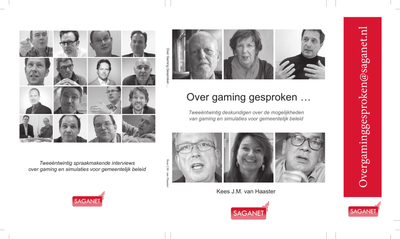
Korte interviews met deskundigen over de kracht van simulaties en gaming voor openbaar bestuur en gemeentelijk beleid. Voorwoord van Annemarie Jorritsma, voorzitter van de Vereniging van Nederlandse Gemeenten
DOCUMENT
Een van de belangrijkste ontwikkelingen in het onderwijs is het gebruik van nieuwe kennismedia: media voor het genereren, begrijpen en delen van kennis. Denk aan social media, serious gaming, apps, tablets en smartphones. De grote vraag is: hoe ga je als school om met deze mediaontwikkelingen? In dit whitepaper presenteren we de roadmap van ons onderzoek naar de educatieve implementatie van de iPad (Engelstalig document)
DOCUMENT

Het doel van deze handreiking is om logopedisten te ondersteunen bij het Samen Gamen, het toepassen van tabletgames in taaltherapie met jonge kinderen. We geven aanbevelingen over hoe je tabletgames op een juiste manier kunt inzetten om de communicatie en interactie tijdens het Samen Gamen te optimaliseren. Om tot deze aanbevelingen te komen is binnen het project DigiTaal onderzoek gedaan naar de verschillen in de interactie en communicatie tussen kind en logopedist tijdens taaltherapie met tabletgames en tijdens taaltherapie met traditioneel materiaal. Daarnaast hebben logopedisten onder begeleiding van een video-interactiebegeleider aan de hand van gemaakte videobeelden positieve interactiemomenten tijdens gamen geïdentificeerd en besproken. De logopedisten hebben geleerd om deze interactiemomenten vervolgens zelf te herkennen en uit te bouwen, waardoor hun expertise over Samen Gamen is vergroot. De opbrengst aan best practices hebben wij vertaald naar aanbevelingen voor logopedisten.
DOCUMENT

Introduction: Success of e-health relies on the extent to which the related technology, such as the electronic device, is accepted by its users. However, there has been limited research on the patients’ perspective on use of e-health-related technology in rehabilitation care. Objective: To explore the usage of common electronic devices among rehabilitation patients with access to email and investigate their preferences regarding their usage in rehabilitation. Methods: Adult patients who were admitted for inpatient and/or outpatient rehabilitation and were registered with an email address were invited to complete an electronic questionnaire regarding current and preferred use of information and communication technologies in rehabilitation care. Results: 190 out of 714 invited patients completed the questionnaire, 94 (49%) female, mean age 49 years (SD 16). 149 patients (78%) used one or more devices every day, with the most frequently used devices were: PC/laptop (93%), smartphone (57%) and tablet (47%). Patients mostly preferred to use technology for contact with health professionals (mean 3.15, SD 0.79), followed by access to their personal record (mean 3.09, SD 0.78) and scheduling appointments with health professionals (mean 3.07, SD 0.85). Conclusion: Most patients in rehabilitation used one or more devices almost every day and wish to use these devices in rehabilitation. https://doi.org/10.1080/17483107.2017.1358302
MULTIFILE

The current study investigated how individual differences among children affect the added value of social robots for teaching second language (L2) vocabulary to young children. Specifically, we investigated the moderating role of three individual child characteristics deemed relevant for language learning: first language (L1) vocabulary knowledge, phonological memory, and selective attention. We expected children low in these abilities to particularly benefit from being assisted by a robot in a vocabulary training. An L2 English vocabulary training intervention consisting of seven sessions was administered to 193 monolingual Dutch five-year-old children over a three- to four-week period. Children were randomly assigned to one of three experimental conditions: 1) a tablet only, 2) a tablet and a robot that used deictic (pointing) gestures (the no-iconic-gestures condition), or 3) a tablet and a robot that used both deictic and iconic gestures (i.e., gestures depicting the target word; the iconic-gestures condition). There also was a control condition in which children did not receive a vocabulary training, but played dancing games with the robot. L2 word knowledge was measured directly after the training and two to four weeks later. In these post-tests, children in the experimental conditions outperformed children in the control condition on word knowledge, but there were no differences between the three experimental conditions. Several moderation effects were found. The robot's presence particularly benefited children with larger L1 vocabularies or poorer phonological memory, while children with smaller L1 vocabularies or better phonological memory performed better in the tablet-only condition. Children with larger L1 vocabularies and better phonological memory performed better in the no-iconic-gestures condition than in the iconic-gestures condition, while children with better selective attention performed better in the iconic-gestures condition than the no-iconic-gestures condition. Together, the results showed that the effects of the robot and its gestures differ across children, which should be taken into account when designing and evaluating robot-assisted L2 teaching interventions.
DOCUMENT
Background: The Turkish translation of the Dutch Talking Touch Screen Questionnaire (TTSQ) has been developed to help physical therapy patients with a Turkish background in the Netherlands to autonomously elucidate their health problems and impairments and set treatment goals, regardless of their level of health literacy. Objective: The aim of this study was to evaluate the usability of the Turkish TTSQ for physical therapy patients with a Turkish background with diverse levels of health literacy and experience in using mobile technology. Methods: The qualitative Three-Step Test-Interview method was carried out to gain insight into the usability of the Turkish TTSQ. A total of 10 physical therapy patients participated. The interview data were analyzed using a thematic content analysis approach aimed at determining the accuracy and completeness with which participants completed the questionnaire (effectiveness), the time it took participants to complete the questionnaire (efficiency), and the extent to which the participants were satisfied with the ease of use of the questionnaire (satisfaction). The problems encountered by the participants in this study were given a severity rating, which was used to provide a rough estimate of the need for additional usability improvements. Results: No participant in this study was able to complete the questionnaire without encountering at least one usability problem. A total of 17 different kinds of problems were found. On the basis of their severity score, 3 problems that should be addressed during future development of the tool were “Not using the navigation function of the photo gallery in Question 4 causing the participant to not see all presented response items;” “Touching the text underneath a photo in Question 4 to select an activity instead of touching the photo itself, causing the activity not to be selected;” and “Pushing too hard or tapping too softly on the touch screen causing the touch screen to not respond.” The data on efficiency within this study were not valid and are, therefore, not reported in this study. No participant was completely satisfied or dissatisfied with the overall ease of use of the Turkish TTSQ. Two participants with no prior experience of using tablet computers felt that, regardless of what kinds of improvement might be made, it would just be too difficult for them to learn to work with the device. Conclusions: As with the Dutch TTSQ, the Turkish TTSQ needs improvement before it can be released. The results of this study confirm the conclusion of the Dutch TTSQ study that participants with low levels of education and little experience in using mobile technology are less able to operate the TTSQ effectively. Using a Dutch speaking interviewer and Turkish interpreter has had a negative effect on data collection in this study.
LINK
Logopedisten en klinisch linguïsten onderzoeken de taalontwikkeling van jonge kinderen met een vermoedelijke of al vastgestelde taalontwikkelingsstoornis. Ze onderzoeken ook de taalvaardigheid van personen met afasie. Naast gestandaardiseerde tests worden samples spontane taal geanalyseerd. Hiervoor worden uitingen ontlokt aan de patiënten via vaste protocollen. De sessies worden opgenomen, getranscribeerd en vervolgens grammaticaal geanalyseerd. Bij de grammaticale analyse wordt bepaald welke soorten constructies en fouten voorkomen en in welke mate, en dit wordt vergeleken met een norm. Taal- en spraaktechnologie (TST) kan er in prin-cipe aan bijdragen om het proces van transcriptie en grammaticale analyse efficiënter te maken en mogelijk zelfs om de kwaliteit van de assessments te verhogen. In dit artikel richten we ons op de mogelijkheden van TST voor de analyse van kindertaal.
LINK
The uptake of eRehabilitation programs in stroke care is insufficient, despite the growing availability. The aim of this study was to explore which factors influence the uptake of eRehabilitation in stroke rehabilitation, among stroke patients, informal caregivers, and healthcare professionals. A qualitative focus group study with eight focus groups (6–8 participants per group) was conducted: six with stroke patients/informal caregivers and two with healthcare professionals involved in stroke rehabilitation (rehabilitation physicians, physical therapists, occupational therapists, psychologists, managers). Focus group interviews were audiotaped, transcribed in full, and analyzed by direct content analysis using the implementation model of Grol. Results Thirty-two patients, 15 informal caregivers, and 13 healthcare professionals were included. A total of 14 influencing factors were found, grouped to 5 of the 6 levels of the implementation model of Grol (Innovation, Organizational context, Individual patient, Individual professional, and Economic and political context). Most quotes of patients, informal caregivers, and healthcare professionals were classified to factors at the level of the Innovation (e.g., content, attractiveness, and feasibility of eRehabilitation programs). In addition, for patients, relatively many quotes were classified to factors at the level of the individual patient (e.g., patients characteristics as fatigue and the inability to understand ICT-devices), and for healthcare professionals at the level of the organizational context (e.g., having sufficient time and the fit with existing processes of care). Although there was a considerable overlap in reported factors between patients/informal caregivers and healthcare professionals when it concerns eRehabilitation as innovation, its seems that patients/informal caregivers give more emphasis to factors related to the individual patient, whereas healthcare professionals emphasize the importance of factors related to the organizational context. This difference should be considered when developing an implementation strategy for patients and healthcare professionals separately. https://doi.org/10.1186/s13012-018-0827-5
MULTIFILE

Objective: Despite the increasing availability of eRehabilitation, its use remains limited. The aim of this study was to assess factors associated with willingness to use eRehabilitation. Design: Cross-sectional survey. Subjects: Stroke patients, informal caregivers, health-care professionals. Methods: The survey included personal characteristics, willingness to use eRehabilitation (yes/no) and barri-ers/facilitators influencing this willingness (4-point scale). Barriers/facilitators were merged into factors. The association between these factors and willingness to use eRehabilitation was assessed using logistic regression analyses. Results: Overall, 125 patients, 43 informal caregivers and 105 healthcare professionals participated in the study. Willingness to use eRehabilitation was positively influenced by perceived patient benefits (e.g. reduced travel time, increased motivation, better outcomes), among patients (odds ratio (OR) 2.68; 95% confidence interval (95% CI) 1.34–5.33), informal caregivers (OR 8.98; 95% CI 1.70–47.33) and healthcare professionals (OR 6.25; 95% CI 1.17–10.48). Insufficient knowledge decreased willingness to use eRehabilitation among pa-tients (OR 0.36, 95% CI 0.17–0.74). Limitations of the study include low response rates and possible response bias. Conclusion: Differences were found between patients/informal caregivers and healthcare professionals. Ho-wever, for both groups, perceived benefits of the use of eRehabilitation facilitated willingness to use eRehabili-tation. Further research is needed to determine the benefits of such programs, and inform all users about the potential benefits, and how to use eRehabilitation. Lay Abstract The use of digital eRehabilitation after stroke (e.g. in serious games, e-consultation and education) is increasing. However, the use of eRehabilitation in daily practice is limited. As a first step in increasing the use of eRehabilitation in stroke care, this study examined which factors influence the willingness of stroke patients, informal caregivers and healthcare professionals to use eRehabilitation. Beliefs about the benefits of eRehabilitation were found to have the largest positive impact on willingness to use eRehabilitation. These benefits included reduced travel time, increased adherence to therapy or motivation, and better health outcomes. The willingness to use eRehabilitation is limited by a lack of knowledge about how to use eRehabilitation.
MULTIFILE




