Urban delta areas are facing problems related with land scarcity and are impacted by climate change and flooding. To meet the current demands and future challenges, innovative and adaptive urban developments are necessary [de Graaf, 2009]. Floating urban development is a promising solutions, as it offers the flexibility and multifunctionality required to efficiently face the current challenges for delta cities. It provides flood proof buildings and opportunities for sustainable food and energy production
LINK
Lebanon’s economic crisis has disrupted the country’s energy and water sectors, highlighting their interdependence. The methodologyinvolves surveying 150 municipalities across all Lebanese governorates, ensuring a comprehensive coverage of public and private waterresources. Data on water and energy were collected before and during the crisis to explore this nexus during periods of economic turmoil.The findings reveal a decline in water provision during the crisis, with the average weekly water supply plummeting from 49 h in 2019 to 22 hin 2023. Concurrently, the use of water tankers has surged from 26 to 44%, indicating a concerning shift in water acquisition methods.Despite the crisis, conventional water sources remain predominant, while unconventional sources account for less than 1% of the totalsupply. In response to the energy shortage, renewable energy sources have gained traction in residential, commercial, and industrial sectors.The scarcity and rising cost of electricity have driven the adoption of solar photovoltaics in the water sector, reaching 4.8% for extraction fromunderground reservoirs and 2.8% for distribution. Similarly, the use of solar water heaters has increased from 7.9 to 15.4% in 2023. Thesefindings underscore the interplay between energy and water security during periods of economic instability.
DOCUMENT
The need of an adaptive sustainable solution for the increased land scarcity, growing urbanization, climate change and flood risks resulted in the concept of the floating urbanization. In The Netherlands this new type of housing attracted the interest of local authorities, municipalities and water boards. Moreover, plans to incorporate floating houses in the urban planning have already been developed. However, the knowledge gap regarding the potential effect on the water quality halts the further development of the floating houses. This paper shows the results of a water quality measurement campaign, as part of the national program “Knowledge for climate”, at a small floating houses project in Delft and serves as a case study for addressing the environmental-ecological knowledge gap on this topic.
DOCUMENT

Large floating projects have the potential to overcome the challenge of land scarcity in urban areas and offer opportunities for energy and food production, or even for creating sustainable living environments. However, they influence the physical, chemical, biological and ecological characteristics of water bodies. The interaction of the floating platforms affect multiple complex aquatic processes, and the potential (negative/positive) effects are not yet fully understood. Managing entities currently struggle with lack of data and knowledge that can support adequate legislation to regulate future projects.In the Netherlands the development of small scale floating projects is already present for some years (e.g. floating houses, restaurants, houseboats), and more recently several large scale floating photovoltaic plants (FPV) have been realized. Several floating constructions in the Netherlands were considered as case-studies for a data-collection campaign.To obtain data and images from underneath floating buildings, underwater drones were equipped with cameras and sensors. The drones were used in multiple locations to scan for differences in concentrations of basic water quality parameters (e.g. dissolved oxygen, electrical conductivity, algae, light intensity) from underneath/near the floating structures, which were then compared with data from locations far from the influence of the buildings. Continuous data was also collected over several days using multi-parameter water quality sensors permanently installed under floating structures.
DOCUMENT

Floating urbanization is a promising solution to reduce the vulnerability of cities against climate change, population growth or land scarcity. Although this type of construction introduces changes to aquatic systems, there is a lack of research studies addressing potential impacts. Water quality data collected under/near floating structures were compared with the corresponding parameters measured at the same depth at open water locations by (i) performing scans with underwater drones equipped with in situ sensors and video cameras and (ii) fixing two sets of continuous measuring in situ sensors for a period of several days/months at both positions. A total of 18 locations with different types of floating structures were considered in this study. Results show small differences in the measured parameters, such as lower dissolved oxygen concentrations or higher temperature measured underneath the floating structures. The magnitudes of these differences seem to be linked with the characteristics and type of water system. Given the wide variety and types of water bodies considered in this study, results suggest that water quality is not critically affected by the presence of the floating houses. Underwater images of biofouling and filter feeders illustrate the lively ecosystems that can emerge shortly after the construction of floating buildings.
DOCUMENT
Large floating projects have the potential to overcome the challenge of land scarcity in urban areas and offer opportunities for energy and food production, or even for creating sustainable living environments. However, they influence the physical, chemical, biological and ecological characteristics of water bodies. The interaction of the floating platforms affect multiple complex aquatic processes, and the potential (negative/positive) effects are not yet fully understood. Managing entities currently struggle with lack of data and knowledge that can support adequate legislation to regulate future projects. In the Netherlands the development of small scale floating projects is already present for some years (e.g. floating houses, restaurants, houseboats), and more recently several large scale floating photovoltaic plants (FPV) have been realized. Several floating constructions in the Netherlands were considered as case-studies for a data-collection campaign. To obtain data and images from underneath floating buildings, underwater drones were equipped with cameras and sensors. The drones were used in multiple locations to scan for differences in concentrations of basic water quality parameters (e.g. dissolved oxygen, electrical conductivity, algae, light intensity) from underneath/near the floating structures, which were then compared with data from locations far from the influence of the buildings. Continuous data was also collected over several days using multi-parameter water quality sensors permanently installed under floating structures. Results show some differences in concentrations of water quality parameters between open water and shaded areas were detected, and some interesting relations between parameters and local characteristics were identified. Recommendations are given, in order to minimise the undesired impacts of floating platforms. Considering the complexity of the interactions between water quality parameters and the influence of the surrounding environment it is recommended to continue and to improve the monitoring campaign (e.g. include new parameters).
DOCUMENT
Urban delta areas require innovative and adaptive urban developments to face problems related with land scarcity and impacts of climate change and flooding. Floating structures offer the flexibility and multi-functionality required to efficiently face these challenges and demands. The impact of these structures on the environment, however, is currently unknown and research on this topic is often disregarded. This knowledge gap creates a difficulty for water authorities and municipalities to create a policy framework, and to regulate and facilitate the development of new projects.Monitoring the effects of floating structures on water quality and ecology has been difficult until now because of the poor accessibility of the water body underneath the structures. In this work, a remote controlled underwater drone equipped with water quality sensors and a video camera was used to monitor dissolved oxygen near and under floating structures. The collected data showed that most water quality parameters remain at acceptable levels, indicating that the current small scale floating structures do not have a significant influence on water quality. The underwater footage revealed the existence of a dynamic and diverse aquatic habitat in the vicinity of these structures, showing that floating structures can have a positive effect on the aquatic environment. Future floating structures projects therefore should be encouraged to proceed.
DOCUMENT

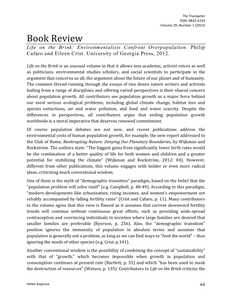
Life on the Brink is an unusual volume in that it allows non-‐academic, activist voices as well as politicians, environmental studies scholars, and social scientists to participate in the argument that concerns us all, the argument about the future of our planet and of humanity. The common thread running through the essays of two dozen nature writers and activists hailing from a range of disciplines and offering varied perspectives is their shared concern about population growth. All contributors see population growth as a major force behind our most serious ecological problems, including global climate change, habitat loss and species extinctions, air and water pollution, and food and water scarcity. Despite the differences in perspectives, all contributors argue that ending population growth worldwide is a moral imperative that deserves renewed commitment. https://www.linkedin.com/in/helenkopnina/
DOCUMENT
Hydrosystem Restoration Handbook: Groundwater Natural Recharge (GNR), Second Edition covers the essentials of GNR with a range of global case studies that encompass the most up-to-date management approaches in streams. The book provides comprehensive methods for sustainable water supply through debris removal, along with conservation practices to assist researchers and graduate students specializing in this field.
LINK
The need of an adaptive sustainable solution for the increased land scarcity, growing urbanization, climate change and flood risks resulted in the concept of the floating urbanization. In The Netherlands this new type of housing attracted the interest of local authorities, municipalities and water boards. Moreover, plans to incorporate floating houses in the urban planning have already been developed. However, the knowledge gap regarding the potential effect on the water quality halts the further development of the floating houses. This paper shows the results of a water quality measurement campaign, as part of the national program “Knowledge for climate”, at a small floating houses project in Delft and serves as a case study for addressing the environmental-ecological knowledge gap on this topic.
DOCUMENT




