This book provides a sample of studies and concepts created within the project Media ENriched Sport ExperienceS (MENSES). A project powered by Hilversum Media Campus, ZIGGO and Breda University of Applied Sciences. MENSES aims to create new media enriched sport experiences, by means of introducing innovative digital concepts combining media entertainment and live sport content. It wants to share building stones and blueprints to be accessed in Hilversum. As such it will help organizations to answer the question how live and broadcasted sport experiences can be enriched by means of new digital strategies. By combining interaction, transformation and data enrichment, the mediated and live sport events should be turned into a memorable sport experience
DOCUMENT

Social media users can be forgiven for feeling dissatisfied. ‘Old media’ news, based on the perpetual celebrity comeback, has hit a conceptual impasse with new cancel culture. Geert Lovink calls for the renewal of social networking tools giving users a constructive voice.
MULTIFILE
The broad field of environmental ethics, animal welfare, animal liberation, and animal rights literature indicate that all encounters between humans and animals are ethically charged. In this article, I shall examine how environmental ethics or animal welfare/rights/liberation literature translate into public media. The case study will delve into the representation of animals in the Dutch newspapers, using content analysis to provide an empirical basis for monitoring public opinion. Assuming that attitudes to animals are influenced by media coverage, the results of this case study will be brought to bear upon the discussion of the representation of animals beyond a specific national context. LinkedIn: https://www.linkedin.com/in/helenkopnina/
DOCUMENT

Nixon and Metiary argue that the notion of protest needs to be included in the global education system as a distinct activity. It needs to take its place alongside other social sciences and humanities courses in the school curricula. They stress that the ability to impact society, to incite societal change, to participate through more means than voting, needs to be taught. It needs to be implemented into the global education system.
DOCUMENT

Elk jaar wordt een afgelegen locatie, zoals een eiland, getransformeerd tot een internationale ontmoetingsplaats waar workshops over kunst, media, gaming, wetenschap, technologie en duurzame innovatie worden gegeven. De uitwisselingsweek is transdisciplinair en stimuleert dialoog en actieve interactie tussen studenten, docenten, gastartiesten en deelnemende bezoekers, wat uiteindelijk leidt tot een klein festival. De publicatie 'Crisis! Re/Constructing Europe' gaat over de Island CQ editie die plaatsvond in Hongarije van 1 tot 13 mei, 2013. Tijdens de voorbereidingen van deze editie werden de media en het politieke debat beheerst door de financiële crisis in Europa. Elk land heeft een andere geschiedenis en dus een unieke relatie met Europa. Dit bracht de vraag naar boven wat de crisis eigenlijk betekende voor de mensen in verschillende Europese landen, en hoe ieder daar op zijn eigen manier mee omging.
DOCUMENT

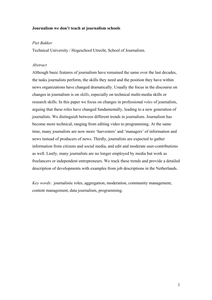
Although basic features of journalism have remained the same over the last decades, the tasks journalists perform, the skills they need and the position they have within news organizations have changed dramatically. Usually the focus in the discourse on changes in journalism is on skills, especially on technical multi-media skills or research skills. In this paper we focus on changes in professional roles of journalists, arguing that these roles have changed fundamentally, leading to a new generation of journalists. We distinguish between different trends in journalism. Journalism has become more technical, ranging from editing video to programming. At the same time, many journalists are now more ‘harvesters’ and ‘managers’ of information and news instead of producers of news. Thirdly, journalists are expected to gather information from citizens and social media, and edit and moderate user-contributions as well. Lastly, many journalists are no longer employed by media but work as freelancers or independent entrepreneurs. We track these trends and provide a detailed description of developments with examples from job descriptions in the Netherlands.
DOCUMENT
This paper contributes to a better understanding of the home exchange phenomenon by considering the historical developmentof the home exchange intermediation processes, membership profiles and the role of the media. The Internet has enableda more interactive process and facilitated home exchange kernels which, by the way they are organised, allow a degree ofself-organisation. Processes of specialisation and differentiation change the home exchange intermediation landscape.
MULTIFILE
Introduction to a special issue of the IASPM journal. This special issue on fan studies aims to build a bridge with the study of popular music in order to inspire further investigation of music fandom.
DOCUMENT

The guidance offered here is intended to assist social workers in thinking through the specific ethical challenges that arise whilst practising during a pandemic or other type of crisis. In crisis conditions, people who need social work services, and social workers themselves, face increased and unusual risks. These challenging conditions are further compounded by scarce or reallocated governmental and social resources. While the ethical principles underpinning social work remain unchanged by crises, unique and evolving circumstances may demand that they be prioritised differently. A decision or action that might be regarded as ethically wrong in ‘normal’ times, may be judged to be right in a time of crisis. Examples include: prioritising individual and public health considerations by restricting people’s freedom of movement; not consulting people about treatment and services; or avoiding face-to-face meetings.
MULTIFILE

This report summarises the findings of an international study of the ethical challenges faced by social workers during the Covid-19 pandemic, undertaken during 6th-18th May 2020. 607 responses from 54 countries were received via an online survey, additional interviews and local surveys. Six key themes relating to social workers’ ethical challenges and responses were identified: 1. Creating and maintaining trusting, honest and empathic relationships via phone or internet with due regard to privacy and confidentiality, or in person with protective equipment. 2. Prioritising service user needs and demands, which are greater and different due to the pandemic, when resources are stretched or unavailable and full assessments often impossible. 3. Balancing service user rights, needs and risks against personal risk to social workers and others, in order to provide services as well as possible. 4. Deciding whether to follow national and organisational policies, procedures or guidance (existing or new) or to use professional discretion in circumstances where the policies seem inappropriate, confused or lacking. 5. Acknowledging and handling emotions, fatigue and the need for selfcare, when working in unsafe and stressful circumstances. 6. Using the lessons learned from working during the pandemic to rethink social work in the future.
LINK



