Matrix-assisted laser desorption/ionisation time of-flight mass spectrometry (MALDI-TOF MS) is a fast and reliable method for the identification of bacteria from agar media. Direct identification from positive blood cultures should decrease the time to obtaining the result. In this study, three different processing methods for the rapid direct identification of bacteria from positive blood culture bottles were compared. In total, 101 positive aerobe BacT/ALERT bottles were included in this study. Aliquots from all bottles were used for three bacterial processing methods, i.e. the commercially available Bruker's MALDI Sepsityper kit, the commercially available Molzym's MolYsis Basic5 kit and a centrifugation/washing method. In addition, the best method was used to evaluate the possibility of MALDI application after a reduced incubation time of 7 h of Staphylococcus aureus- and Escherichia coli-spiked (1,000, 100 and 10 colony-forming units [CFU]) aerobe BacT/ALERT blood cultures. Sixty-six (65%), 51 (50.5%) and 79 (78%) bottles were identified correctly at the species level when the centrifugation/washing method, MolYsis Basic 5 and Sepsityper were used, respectively. Incorrect identification was obtained in 35 (35%), 50 (49.5%) and 22 (22%) bottles, respectively. Gram-positive cocci were correctly identified in 33/52 (64%) of the cases. However, Gram-negative rods showed a correct identification in 45/47 (96%) of all bottles when the Sepsityper kit was used. Seven hours of pre-incubation of S. aureus- and E. coli-spiked aerobe BacT/ALERT blood cultures never resulted in reliable identification with MALDI-TOF MS. Sepsityper is superior for the direct identification of microorganisms from aerobe BacT/ALERT bottles. Gram-negative pathogens show better results compared to Gram-positive bacteria. Reduced incubation followed by MALDI-TOF MS did not result in faster reliable identification.
DOCUMENT

UPLC-MS is a commonly used technique to first separate complex samples and subsequently quantify molecules of interest. Herein we describe the use of UPLC-MS using an amide stationary phase to quantify non-derivatized amino acids extracted from fingerprints. As detector either a triple-quadrupole MS/MS or a TOF-MS detector was used. This method allows for a simple and fast sample preparation, which facilitates the analysis of large amounts of samples.
DOCUMENT
Plastic is one of the biggest contributors to pollution of the planet. Due to the low recyclability of oil-based plastics, most plastic is being disposed into the environment. According to plastic oceans, 10 million tons of plastic are dumped into oceans annually. Currently, researchers are developing recycling methods for oil-based plastics and are looking for biobased alternatives. One of these alternatives are a class of polymers called polyhydroxyalkanoates (PHA’s). PHA’s differ from other biobased polymers, due to the process of fabrication. PHA’s are a natural polymer, acting as an energy and carbon storage for different strains of bacteria. Functioning as an energy storage, nature can break down PHA’s and PHA-based waste. (1) Different companies are working on PHA’s production, but a large deviations in physical properties were observed. This research aims to establish a relationship between the chemical and physical properties of the different PHA’s, using gel permeability chromatography (GPC), nuclear magnetic resonance (NMR) and gas chromatography-mass spectroscopy (GC-MS).
DOCUMENT
Five methods were compared to determine the best technique for accurate identification of coagulase-negative staphylococci (CoNS) (n=142 strains). MALDI-TOF MS showed the best results for rapid and accurate CoNS differentiation (correct identity in 99.3%). An alternative to this approach could be Vitek2 combined with partial tuf gene sequencing.
DOCUMENT

Fingerprints are widely used in forensic science for individualization purposes. However, not every fingermark found at a crime scene is suitable for comparison, for instance due to distortion of ridge detail, or when the reference fingerprint is not in the database. To still retrieve information from these fingermarks, several studies have been initiated into the chemical composition of fingermarks, which is believed to be influenced by several donor traits. Yet, it is still unclear what donor information can be retrieved from the composition of one's fingerprint, mainly because of limited sample sizes and the focus on analytical method development. It this paper, we analyzed the chemical composition of 1852 fingerprints, donated by 463 donors during the Dutch music festival Lowlands in 2016. In a targeted approach we compared amino acid and lipid profiles obtained from different types of fingerprints. We found a large inter-variability in both amino acid and lipid content, and significant differences in L-(iso)leucine, L-phenylalanine and palmitoleic acid levels between male and female donors. In an untargeted approach we used full-scan MS data to generate classification models to predict gender (77.9% accuracy) and smoking habit (90.4% accuracy) of fingerprint donors. In the latter, putatively, nicotine and cotinine are used as predictors.
MULTIFILE

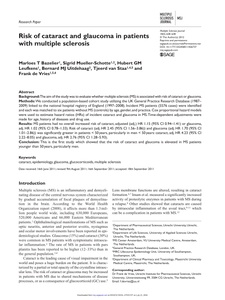
The aim of the study was to evaluate whether multiple sclerosis (MS) is associated with risk of cataract or glaucoma. We conducted a population-based cohort study utilizing the UK General Practice Research Database (1987–2009) linked to the national hospital registry of England (1997–2008). Incident MS patients (5576 cases) were identified and each was matched to six patients without MS (controls) by age, gender, and practice. Cox proportional hazard models were used to estimate hazard ratios (HRs) of incident cataract and glaucoma in MS. Time-dependent adjustments were made for age, history of diseases and drug use.
DOCUMENT
The amino acid profile obtained from a fingerprint may provide valuable information on its donor. Unfortunately, the collection of chemicals from the fingerprint is often destructive to the fingerprint ridge detail. Herein we detail the use of cross-linkable solutions of dextran-methacrylate to form hydrogels capable of collecting amino acids from surfaces followed by extraction and quantification with UPLC-MS. This method allows for the amino acid profile analysis of fingerprints while allowing for their increased visualization at a later stage using the standard method of cyanoacrylate fuming followed by basic-yellow dyeing.
DOCUMENT
Background: Multiple sclerosis often leads to fatigue and changes in physical behavior (PB). Changes in PB are often assumed as a consequence of fatigue, but effects of interventions that aim to reduce fatigue by improving PB are not sufficient. Since the heterogeneous nature of MS related symptoms, levels of PB of fatigued patients at the start of interventions might vary substantially. Better understanding of the variability by identification of PB subtypes in fatigued patients may help to develop more effective personalized rehabilitation programs in the future. This study aimed to identify PB subtypes in fatigued patients with multiple sclerosis based on multidimensional PB outcome measures. Methods: Baseline accelerometer (Actigraph) data, demographics and clinical characteristics of the TREFAMS-ACE participants (n = 212) were used for secondary analysis. All patients were ambulatory and diagnosed with severe fatigue based on a score of ≥35 on the fatigue subscale of the Checklist Individual Strength (CIS20r). Fifteen PB measures were used derived from 7 day measurements with an accelerometer. Principal component analysis was performed to define key outcome measures for PB and two-step cluster analysis was used to identify PB types. Results: Analysis revealed five key outcome measures: percentage sedentary behavior, total time in prolonged moderate-to-vigorous physical activity, number of sedentary bouts, and two types of change scores between day parts (morning, afternoon and evening). Based on these outcomes three valid PB clusters were derived. Conclusions: Patients with severe MS-related fatigue show three distinct and homogeneous PB subtypes. These PB subtypes, based on a unique set of PB outcome measures, may offer an opportunity to design more individually-tailored interventions in rehabilitation.
MULTIFILE

The thoracic and peritoneal cavities are lined by serous membranes and are home of the serosal immune system. This immune system fuses innate and adaptive immunity, to maintain local homeostasis and repair local tissue damage, and to cooperate closely with the mucosal immune system. Innate lymphoid cells (ILCs) are found abundantly in the thoracic and peritoneal cavities, and they are crucial in first defense against pathogenic viruses and bacteria. Nanomaterials (NMs) can enter the cavities intentionally for medical purposes, or unintentionally following environmental exposure; subsequent serosal inflammation and cancer (mesothelioma) has gained significant interest. However, reports on adverse effects of NMon ILCs and other components of the serosal immune systemare scarce or even lacking. As ILCs are crucial in the first defense against pathogenic viruses and bacteria, it is possible that serosal exposure to NMmay lead to a reduced resistance against pathogens. Additionally, affected serosal lymphoid tissues and cells may disturb adipose tissue homeostasis. This review aims to provide insight into key effects of NMon the serosal immune system.
DOCUMENT





