In this paper, we analyse the development of the term “legal capabilities”. More specifically, we do three things. First, we track the emergence and development of the notion of legal capabilities. The term legal capabilities was used in legal research long before the capability approach was introduced in that field. Early on, its conceptualisation mainly reflected elements of legal literacy. In more recent writings, it is claimed that the notion is based on the capability approach. Second, we critically analyse the current use of the term legal capabilities and show that there is no proper theoretical grounding of this term in the capability approach. This is problematic, because it might give rise to misunderstandings and flawed policy recommendations. Third, we suggest some first steps towards a revision of the notion of legal capabilities. Starting from the concept of “access to justice”, legal capabilities have to be understood as the real opportunities someone has to get access to justice, rather than merely as formal opportunities or internal capabilities.
MULTIFILE

Open access combined with Web 2.0 networking tools is fast changing the traditional journal's functions and framework and the publisher's role. As content is more and more available online in digital repositories and on the web, an integrated, interconnected, multidisciplinary information environment is evolving and Oldenburg's model disintegrates: the journal is no longer the main referring unit for scholarly output, as it used to be, for Scientific, Technical, and Medical disciplines, but scholars' attention is now more focused on the article level. New journals models are thus evolving. The first part of this paper discusses these new experimental journal models, i.e. overlay journals, interjournals and different levels journals. The second part directs readers' attention to the role commercial publishers could play in this digital seamless writing arena. The authors consider that publishers should concentrate much more on value-added services for authors, readers and libraries, such as navigational services, discovery services, archiving and evaluation services.
LINK
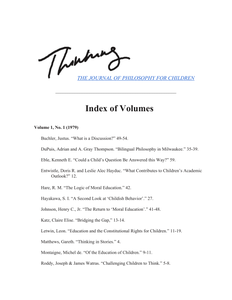
The journal was a forum for the work of both theorists and practitioners of philosophical practice with children, and published such work in all forms, including philosophical argument and reflection, classroom transcripts, curricula, empirical research, and reports from the field. The journal also maintained a tradition in publishing articles in the hermeneutics of childhood, a field of intersecting disciplines including cultural studies, social history, philosophy, art, literature and psychoanalysis.
DOCUMENT
OBJECTIVES: To review recent literature on student nurses' perceptions of different areas of nursing practice, in particular community care. Healthcare is changing from care delivery in institutional settings to care to patients in their own homes. Problematic is that nursing students do not see community care as an attractive line of work, and their perceptions of community care do not reflect the realities of the profession. Understanding the factors influencing the perception of the professional field is important to positively influence students' willingness to see community nursing as a future profession.DESIGN: Literature search with accompanying narrative synthesis of primary research.DATA SOURCES: ERIC(®), PsycInfo(®), Pubmed(®), and CINAHL(®) (2004-2014) databases using the search terms: 'nursing student', 'student nurse', 'community care', 'community nurse', 'image', 'attitude', and 'perception'.REVIEW METHODS: After screening 522 retrieved article titles with abstracts, the number of articles was reduced based upon specified inclusion/exclusion criteria leading to inclusion of 34. Evaluation of the references in those articles yielded an additional 5 articles. A narrative synthesis of those articles was created to uncover students' perception of community care, other areas of professional practice, and the factors influencing those perceptions.RESULTS: 39 articles were selected. Results show that many nursing students begin their education with a lay person's conception of the profession, shaped by media representations. Work placements in different settings offer clinical experience that helps students orient themselves towards a future profession. Students prefer hospitals as a place of work, because of the acute nature and technologically advanced level of care offered there. Few students perceive mental health and elderly care as appealing. Perceptions of community care can vary widely, the most prevalent view being that it is unattractive because of its chronic care profile, with little technical skill, untrained workers, and a high workload. However, another view is that it offers challenging and meaningful work because of the variety of caregiving roles and the opportunity to work independently.CONCLUSIONS: Few nursing students choose community nursing as a future profession. They have a limited and often mistaken view of community care, and they underestimate the field's complexity because it is less visible than in the environment of acute care. Providing students with specific curricular content and employing a structured approach to preparation for work placement could help build a more positive perception of community care, leading to more students seeing/choosing community care as a desirable field of work.
DOCUMENT
This study aims to explore the experiences and needs of individuals after a first episode of psychosis with regard to the way in which information about diagnosis, treatment options and prognosis is communicated with them. psychosis, communicating, stigma, needs, individual’s perception
MULTIFILE

This study evaluates psychometric properties of the Individual Recovery Outcomes Counter (I.ROC) in a Dutch population of participants with a schizophrenia spectrum disorder (SSD). B. Esther Sportel1*† , Hettie Aardema1†, Nynke Boonstra2 , Johannes Arends1 , Bridey Rudd3 , Margot J. Metz4 , Stynke Castelein5 and Gerdina H.M. Pijnenborg6
MULTIFILE

Nursing Leadership is an important competence to develop in order to provide quality of care and prevent attrition of nurses. This research program looked into the perceptions and experiences of nurses on practising leadership. Next to that supporting the development of nursing leadership was addressed. The program has a mixed-method, action research design in which 75 in-depth interviews and 24 focus group interviews and quantitative data of 435 nurses form the backbone. According to hospital nurses, nursing leadership is related to proactiveness and voicing expertise in order to deliver good nursing care. Nevertheless, they do not feel fully competent and knowledge deficits were detected on aspects of the bachelor nursing profile, such as evidence based practice. Working-culture factors can either inhibit or encourage nursing leadership. The further awareness of unconsciously using expertise and knowledge deficits as well as team development towards a continuous safe learning environment are necessary steps for the enhancement of nursing leadership. A Nursing Leadership model was developed in which generic personal leadership competencies combined with expertise of the nurses' level of education and degrees form the essence of shared leadership in teams focussed on the realisation of good nursing care.
MULTIFILE

BACKGROUND: Overweight and obesity is a growing health problem worldwide. The most effective strategy to reduce weight is energy restriction (ER). ER has been shown to be beneficial in disease prevention and it reduces chronic inflammation. Recent studies suggest that reducing the protein quantity of a diet contributes to the beneficial effects by ER. The organ most extensively affected during ER is white adipose tissue (WAT).OBJECTIVE: The first objective was to assess changes in gene expression between a high-protein diet and a normal protein diet during ER. Second, the total effect of ER on changes in gene expression in WAT was assessed.METHODS: In a parallel double-blinded controlled study, overweight older participants adhered to a 25% ER diet, either combined with high-protein intake (HP-ER, 1.7 g kg-1 per day), or with normal protein intake (NP-ER, 0.9 g kg-1 per day) for 12 weeks. From 10 HP-ER participants and 12 NP-ER participants subcutaneous WAT biopsies were collected before and after the diet intervention. Adipose tissue was used to isolate total RNA and to evaluate whole-genome gene expression changes upon a HP-ER and NP-ER diet.RESULTS: A different gene expression response between HP-ER and NP-ER was observed for 530 genes. After NP-ER, a downregulation in expression of genes linked to immune cell infiltration, adaptive immune response and inflammasome was found, whereas no such effect was found after HP-ER. HP-ER resulted in upregulation in expression of genes linked to cell cycle, GPCR signalling, olfactory signalling and nitrogen metabolism. Upon 25% ER, gene sets related to energy metabolism and immune response were decreased.CONCLUSIONS: Based on gene expression changes, we concluded that consumption of normal protein quantity compared with high-protein quantity during ER has a more beneficial effect on inflammation-related gene expression in WAT.
DOCUMENT
OBJECTIVE: Protein supplementation increases gains in lean body mass following prolonged resistance-type exercise training in frail older adults. We assessed whether the greater increase in lean body mass can be attributed to muscle fiber type specific hypertrophy with concomitant changes in satellite cell (SC) content.DESIGN: A total of 34 frail elderly individuals (77 ± 1 years, n = 12 male adults) participated in this randomized, double-blind, placebo-controlled trial with 2 arms in parallel.INTERVENTION: Participants performed 24 weeks of progressive resistance-type exercise training (2 sessions per week) during which they were supplemented twice-daily with milk protein (2 × 15 g) or a placebo.METHODS: Muscle biopsies were taken at baseline, and after 12 and 24 weeks of intervention, to determine type I and type II muscle fiber specific cross-sectional area (CSA), SC content, and myocellular characteristics.RESULTS: In the placebo group, a trend for a 20% ± 11% increase in muscle fiber CSA was observed in type II fibers only (P = .051), with no increase in type I muscle fiber CSA. In the protein group, type I and II muscle fiber CSA increased by 23% ± 7% and 34% ± 10% following 6 months of training, respectively (P < .01). Myonuclear domain size increased over time in both groups and fiber types (P < .001), with no significant differences between groups (P > .05). No changes in myonuclear content and SC contents were observed over time in either group (both P > .05). Regression analysis showed that changes in myonuclear content and domain size are predictive of muscle fiber hypertrophy.CONCLUSIONS: Protein supplementation augments muscle fiber hypertrophy following prolonged resistance-type exercise training in frail older people, without changes in myonuclear and SC content.
DOCUMENT
BACKGROUND & AIMS: Oral supplementation with vitamin D is recommended for older adults to maintain a sufficient 25-hydroxyvitamin D (25(OH)D) status throughout the year. While supplementation with vitamin D2 or D3 is most common, alternative treatment regimens exist which require further investigation with respect to increasing 25(OH)D concentration. We investigated the dose-response effects of supplementation with calcifediol compared to vitamin D3 and assessed the dose which results in mean serum 25(OH)D3 concentrations between 75 and 100 nmol/L.METHODS: This randomized, double-blind intervention study included men and women aged ≥65 years (n = 59). Participants received either 5, 10 or 15 μg calcifediol or 20 μg vitamin D3 per day, for a period of 24 weeks. Blood samples were collected every four weeks to assess response profiles of vitamin D related metabolites; serum vitamin D3, 25(OH)D3, 1,25-dihydroxyvitamin D3 (1,25(OH)2D3) and 24,25-dihydroxyvitamin D3 (24,25(OH)2D3). Further, serum calcium, plasma parathyroid hormone, and urinary calcium were evaluated.RESULTS: Supplementation with 20 μg vitamin D3 increased 25(OH)D3 concentrations towards 70 nmol/L within 16 weeks. Supplementation with 10 or 15 μg calcifediol increased 25(OH)D3 levels >75 nmol/L in 8 and 4 weeks, respectively. Steady state was achieved from week 12 onwards with serum 25(OH)D3 levels stabilizing between 84 and 89 nmol/L in the 10 μg calcifediol group. A significant association was observed between the changes in 25(OH)D3 and 24,25(OH)2D3 (R2 = 0.83, P < 0.01), but not between 25(OH)D3 and 1,25(OH)2D3 (R2 = 0.04, P = 0.18). No cases of hypercalcemia occurred in any treatment during the study period.CONCLUSIONS: Calcifediol supplementation rapidly and safely elevates serum 25(OH)D3 concentrations to improve vitamin D status in older adults. A daily dose of 10 μg calcifediol allows serum 25(OH)D3 concentrations to be maintained between 75 and 100 nmol/L.TRIAL REGISTRATION NUMBER: NCT01868945.
DOCUMENT



