Dit is het eerste deel van een blogreeks over groene chemie. Hier introduceer ik dit paradoxale begrip. Hoe kan iets smerigs als chemie nou groen zijn of worden?
DOCUMENT

Inkjet printing is a rapidly growing technology for depositing functional materials in the production of organic electronics. Challenges lie among others in the printing of high resolution patterns with high aspect ratio of functional materials to obtain the needed functionality like e.g. conductivity. μPlasma printing is a technology which combines atmospheric plasma treatment with the versatility of digital on demand printing technology to selectively change the wetting behaviour of materials. In earlier research it was shown that with μPlasma printing it is possible to selectively improve the wetting behaviour of functional inks on polymer substrates using atmospheric air plasma. In this investigation we show it is possible to selectively change the substrate wetting behaviour using combinations of different plasmas and patterned printing. For air and nitrogen plasmas, increased wetting of printed materials could be achieved on both polycarbonate and glass substrates. A minimal track width of 320 μm for a 200 μm wide plasma needle was achieved. A combination of N2 with HMDSO plasma increases the contact angle for water up from <100 to 1050 and from 320 to 460 for DEGDMA making the substrate more hydrophobic. Furthermore using N2-plasma in combination with a N2/HMDSO plasma, hydrophobic tracks could be printed with similar minimal track width. Combining both N2 -plasma and N2/HMDSO plasma treatments show promising results to further decrease the track width to even smaller values.
DOCUMENT

The reaction of the alkyl complexes Cp*2LnCH(SiMe 3)2 (Ln = Y 1-Y, Ce 1-Ce, La 1-La; Cp* = η5-C5Me5) and Me2Si(η 5-C5Me4)2LnCH(SiMe3) 2 (Ln = Ce 5-Ce) with 1-methylalk-2-ynes CH3C≡CR (R = Me 3a, Et 3b, nPr 3c, tBu 3d, SiMe3 3e, Ph 3f, C6H4Me-2 3g, C6H3Me 2-2,6 3h, C6H3iPr2-2,6 3i, C6F5 3j) affords the corresponding η3-propargyl/allenyl complexes Cp*2LnCH 2CCR (4a-j-Ln) and Me2Si(η5-C 5Me4)2CeCH2CCR (6a-j-Ce) via propargylic metalation. The hydride complexes [Cp*2Ln(μ-H)] 2 (Ln = Y 2-Y, Ce 2-Ce, La 2-La) react rapidly with 3 to produce mixtures of insertion and propargylic metalation products, and the relative rate of these processes depends on the metal and alkyne substituent. Selected η3-propargy/allenyl complexes Cp*2YCH 2CCR (R = Me 4a-Y, Ph 4f-Y), Cp*2CeCH2CCR (R = Me 4a-Ce, Ph 4f-Ce), Cp*2CeCH(Me)CCEt (9b-Ce), Cp*2LaCH2CCR (R = Ph 4f-La, C6H 3Me2-2,6 4h-La) are obtained on a preparative scale and characterized by NMR spectroscopy, IR spectroscopy, and cryoscopy. Compounds 4f-Y and 4f-La are also characterized by single-crystal X-ray diffraction. The reactions of the η3-propargyl/allenyl complexes with Brønsted acids, such as alcohols and acetylenes, afford the corresponding substituted allenes (RCH=C=CH2) and 1-methylalk-2-ynes (CH 3C≡CR) as organic products. The reactions of 4f-Y and 4f-La with Lewis bases, such as pyridine and THF, yield die corresponding base adducts. The adduct 4f-La · py is characterized by single-crystal X-ray diffraction, revealing an η3-coordinated propargyl/allenyl ligand. © 2008 American Chemical Society.
DOCUMENT
In manufacturing of organic electronics, inkjet printing as an alternative technique for depositing materials is becoming increasingly important. Aside to the ink formulations challenges, improving the resolution of the printed patterns is a major goal. In this study we will discuss a newly developed technique to selectively modify the substrate surface energy using plasma treatment as a means to achieve this goal. First, we look at the effects of the μPlasma treatment on the surface energy for a selection of plastic films. Second, we investigated the effects of the μPlasma treatment on the wetting behaviour of inkjet printed droplets to determine the resolution of the μPlasma printing technique. We found that the surface energy for all tested films increased significantly reaching a maximum after 3-5 repetitions. Subsequently the surface energy decreased in the following 8-10 days after treatment, finally stabilizing at a surface energy roughly halfway between the surface energy of the untreated film and the maximum obtained surface energy. When μPlasma printing lines, an improved wetting abillity of inkjet printed materials on the plasma treated areas was found. The minimal achieved μPlasma printed line was found to be 1 mm wide. For future application it is important to increase the resolution of the plasma print process. This is crucial for combining plasma treatment with inkjet print technology as a means to obtain higher print resolutions.
DOCUMENT

Natural Deep Eutectic Solvents (NADES) represent a green chemistry alternative to utilization of common hazardous organic solvents. They were introduced by Abbott et al. [1], and were found to have a wide range of compositions and favorable properties. NADES are typically obtained by mixing hydrogen-bond acceptors (HBA), with hydrogen bond donors (HBD), leading to a significant depression of the melting point. The availability of components, simple preparation, biodegradability, safety, re usability and low cost are the significant advantages that call for research on their analytical applications. Three methods are most commonly used for preparing NADES: a) heating and stirring: the mixture until a clear liquid is formed; b) evaporating solvent from components solution with a rotatory evaporator; c) freeze drying of aqueous solutions.The common solvents for the extraction of anthocyanins are acidified mixtures of water with ethanol, methanol, or acetone. The anthocyanins extracts are susceptible to degradation due to high temperature, and the solvent properties (e.g. high pH) and the whole process can often be time-consuming. Extraction of anthocyanins from red cabbage by four NADES was investigated. It was demonstrated that NADES have comparable extraction efficiencies with conventional method with 0.1 M water solution of HCl. This indicates a possibility of utilization the Green chemistry extraction processes as a promising new green-extraction technology with low cost efficiency and environment friendly technology for production of safe food additives.
DOCUMENT

Wat is de rol van prijs in duurzaam consumentengedrag? ‘Omdat het te duur is’ is een veelgehoord argument wanneer mensen wordt gevraagd waarom ze geen duurzame producten kopen. Maar is dat werkelijk zo, of is dit een makkelijk alibi van mensen om niet hun gedrag te hoeven veranderen? We zijn over het algemeen niet bepaald armlastig in de westerse wereld, dus is het werkelijk een gebrek aan geld, of is er een andere oorzaak van dit gedrag? Om daar een uitspraak over te kunnen doen, hebben we de literatuur onderzocht op de relatie tussen prijs en duurzaamheid. Overall conclusie: een bepaalde groep mensen geeft in onderzoeken aan best bereid te zijn om meer te betalen voor duurzamere oplossingen, tot wel 29%. Maar sociale wenselijkheid speelt daarbij waarschijnlijk een grote rol. Want gezien het nog geringe marktaandeel van duurzame producten is de realiteit weerbarstiger. De meerderheid van de mensen is kennelijk nog niet zodanig overtuigd van de meerwaarde dat ze er ook extra geld voor over hebben. Dit document is opgedeeld in twee secties: 1. sectie 1 beschrijft een analytische beschouwing van de literatuur. Dit onderzoek schetst de ontwikkeling van de artikelen die tot dusverre gepubliceerd zijn over bereidheid van consumenten om een meerprijs te betalen voor duurzame producten; 2. sectie 2 beschrijft een inhoudelijke beschouwing van een selectie van de literatuur: specifiek artikelen die (experimenteel) onderzoek beschrijven naar de willingness to pay voor duurzame producten en diensten.
DOCUMENT

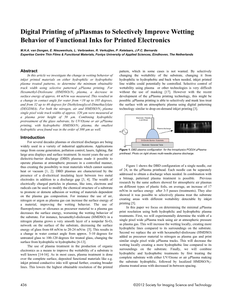
In this article we investigate the change in wetting behavior of inkjet printed materials on either hydrophilic or hydrophobic plasma treated patterns, to determine the minimum obtainable track width using selective patterned μPlasma printing. For Hexamethyl-Disiloxane (HMDSO)/N2 plasma, a decrease in surface energy of approx. 44 mN/m was measured. This resulted in a change in contact angle for water from <10 up to 105 degrees, and from 32 up to 46 degrees for Diethyleneglycol-Dimethaclylate (DEGDMA). For both the nitrogen, air and HMDSO/N2 plasma single pixel wide track widths of approx. 320 μm were measured at a plasma print height of 50 μm. Combining hydrophilic pretreatment of the glass substrate, by UV/Ozone or air μPlasma printing, with hydrophobic HMDSO/N2 plasma, the smallest hydrophilic area found was in the order of 300 μm as well.
DOCUMENT