In ESSENCE (European Sustainable Solutions for Existing and New City Environments) "five European Higher Education Institutions and three municipalities worked together to train future professionals to overcome the complex challenges of achieving smart sustainable cities. Students worked on behalf of the three local governments on useful solutions to sustainability issues in the urban environment. New teaching methods were applied, such as blended learning and creative solution searching methods. "
DOCUMENT

Anthropocentrism is the belief that value is human-centered and that all other beings are means to human ends. The Oxford English Dictionary defines anthropocentrism as “regarding humankind as the central or most important element of existence”. Anthropocentrism focuses on humanistic values as opposed to values found in non-human beings or ecosystems. With the popularization of the concept of ecosystem services, the idea of protecting the environment for the sake of human welfare is reflected in the SDGs. Within the SDGs, the instrumental use of the environment for the sake of alleviating poverty, combatting climate change, and addressing a range of other social and economic issues is promoted. Since the conception of the SDGs, there has been a discussion about anthropocentrism in ‘sustainable development’ (e.g., Kopnina 2016a and 2017, Strang 2017, Adelman 2018; Kotzé and French 2018) and how the SDGs can be antithetical to effective responses to sustainability challenges. The SDGs’ accent on economic growth and social equality as well as environmental protection actually result in ethical as well as practical paradoxes. While central to the SDG’s is ‘sustained and inclusive economic growth’ (UN 2015), the prioritization is on the economy, NOT the planet that nurtures both social and economic systems. Anthropocentrism, in this case, refers to the exclusive focus on short-term human benefits, whereas biodiversity loss is not considered a great moral wrong (Cafaro and Primack 2014). The three overarching anthropocentric SDG goals, economic growth, resilience, and inclusion, will be critically examined below and ways forward will be proposed. https://www.springer.com/gp/book/9783319959801 LinkedIn: https://www.linkedin.com/in/helenkopnina/
MULTIFILE

From the list of content: " Smart sustainable cities & higher education, Essence: what, why & how? Developing learning materials together; The blended learning environment; Teaching on entrepreneurship; Utrecht municipality as a client; International results; Studentexperiences; International relations; City projects in Turku, Alcoy and Utrecht ".
DOCUMENT

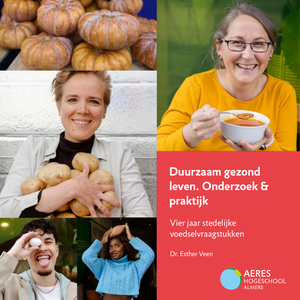
Deze publicatie beschrijft de 4 jaar van het lectoraat Stedelijke Voedselvraagstukken. Dit wordt gedaan aan de hand van de vijf onderzoekslijnen die zijn ontwikkeld, door telkens de focus van de onderzoekslijn toe te lichten, en te vertellen overde projecten die we hebben gedaan, de publicaties die daaruit zijn voortgekomen, en de studenten die erbij betrokken waren.De behandelde thema's zijn: de multiculinaire voedselomgeving, de eiwittransitie, voedselverspilling, voedsel en armoede, eetgedrag en omgeving van jongeren. Het lectoraat werdgefinancierd door de gemeente Almere, dus het lectoraat bestudeerde de voedselstrategie van de gemeente. En omdat er een duidelijke link met onderzoeks- en actielab Flevo Campus was, zijn de doelen en richting van Flevo Campus ook meegenomen.
DOCUMENT
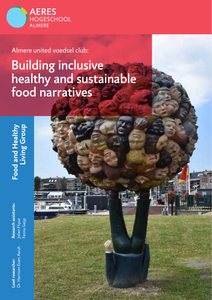
The aim was to study the needs, opportunities and effects of citizen engagement in the urban food system transition. This addresses the issue of - ‘how’, ‘in what ways’ and ‘through what methods’ - citizens can be engaged in the developments towards a more sustainable and healthy regional food system. The research project sought to investigate the roles citizen engagement can take in the transformation of the urban food environment towards healthier and sustainable food consumption patterns. The study covers desired food futures; food discourse; the message our bodies convey about our eating habits; the effect of Covid-19 on food pattern transformations; the term 'organic' in relation to food; mass media as a source of information about food.
DOCUMENT
Aeres Hogeschool is een hogeschool, waarin de thema’s agro, food en leefomgeving centraal staan. Onze studenten zijn afkomstig uit geheel Nederland en van over onze landsgrenzen. Met ons onderwijs en praktijkgericht onderzoek staan we midden in de samenleving. Wij willen bijdragen aan deze samenleving die veel uitdagingen kent en daarmee ambities heeft. Daarom sluiten we ons in dit instellingsplan aan bij de Sustainable Development Goals (SDG’s). Met ons onderwijs en onderzoek willen we bijdragen aan acht van de zeventien SDG’s. Daarmee laten we onze studenten ervaren dat zij opgeleid worden om bij te dragen aantransities in de samenleving. Met hun keuzes werken ze aan een andere wereld.
DOCUMENT
Publicatie naar aanleiding van de door Stadslab European Urban Design Laboratory georganiseerde Master Class met als thematiek het ontwerpen van een Innovative District voor de Poolse stad Lublin. De Master Class werd gevolgd door 8 internationale deelnemers en stond onder supervisie van Didier Rebois (Europan, Parijs), Marc Glaudemans (Fontys) en Juliette van der Meijden (Fontys)
DOCUMENT

Expos, festivals and events have become increasingly important as tools of urban developmentin recent decades. The competitive drive to put cities on the global map has led many to adoptevent-based strategies, including the creation of ‘eventful cities’, ‘festival cities’ and ‘eventportfolios’. World Expos have taken on a particular significance as ‘pulsar events’ that canshape the host city through urban development, increased tourism and place branding. Eachhost city also uses the event in a different way, and gives it a unique flavour that tempers theeventual effects. This paper reviews the literature on World Expos and their effects, identifyingthemes including Place branding, Tourism flows, Resident attitudes and Architecture and urbandevelopment. It then analyses the experience of Barcelona, twofold Expo host and a‘paradigmatic’ example of a city developed through mega events.
MULTIFILE




