Comparisons of visual perception, response-selection, and response-execution performance were made between Type 2 diabetes mellitus patients and a matched nondiabetic control group. 10 well-controlled male patients with Type 2 diabetes without diabetic complications (M age 58 yr.) and an age and IQ-matched non-diabetic control group consisting of 13 male healthy volunteers (M age 57 yr.) were included. Significant differences were found only between the two groups on response-selection performance, which concerns the selection and preparation of an appropriate motor action.
DOCUMENT

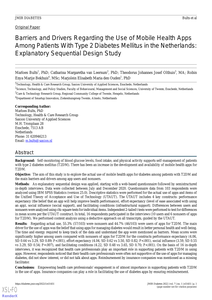
andlt;pandgt;Self-monitoring of blood glucose levels, food intake, and physical activity supports self-management of patients with type 2 diabetes mellitus (T2DM). There has been an increase in the development and availability of mobile health apps for T2DM.andlt;/pandgt;
MULTIFILE
(1) Background: Recent research showed that subtypes of patients with type 2 diabetes may differ in response to lifestyle interventions based on their organ-specific insulin resistance (IR). (2) Methods: 123 Subjects with type 2 diabetes were randomized into 13-week lifestyle intervention, receiving either an enriched protein drink (protein+) or an isocaloric control drink (control). Before and after the intervention, anthropometrical and physiological data was collected. An oral glucose tolerance test was used to calculate indices representing organ insulin resistance (muscle, liver, and adipose tissue) and β-cell functioning. In 82 study-compliant subjects (per-protocol), we retrospectively examined the intervention effect in patients with muscle IR (MIR, n = 42) and without MIR (no-MIR, n = 40). (3) Results: Only in patients from the MIR subgroup that received protein+ drink, fasting plasma glucose and insulin, whole body, liver and adipose IR, and appendicular skeletal muscle mass improved versus control. Lifestyle intervention improved body weight and fat mass in both subgroups. Furthermore, for the MIR subgroup decreased systolic blood pressure and increased VO2peak and for the no-MIR subgroup, a decreased 2-h glucose concentration was found. (4) Conclusions: Enriched protein drink during combined lifestyle intervention seems to be especially effective on increasing muscle mass and improving insulin resistance in obese older, type 2 diabetes patients with muscle IR.
DOCUMENT

Using stable isotope techniques, this study shows that plasma free fatty acid oxidation is not impaired during exercise in non-obese type II diabetic patients.
DOCUMENT

Inhibition of the sodium−glucose cotransporter 2 (SGLT2) by canagliflozin in type 2 diabetes mellitus results in large between-patient variability in clinical response. To better understand this variability, the positron emission tomography (PET) tracer [18F]canagliflozin was developed via a Cu-mediated 18F-fluorination of its boronic ester precursor with a radiochemical yield of 2.0 ± 1.9% and a purity of >95%. The GMP automated synthesis originated [18F]canagliflozin with a yield of 0.5−3% (n = 4) and a purity of >95%. Autoradiography showed [18F]canagliflozin binding in human kidney sections containing SGLT2. Since [18F]canagliflozin is the isotopologue of the extensively characterized drug canagliflozin and thus shares its toxicological and pharmacological characteristics, it enables its immediate use in patients.
DOCUMENT

The studies in this thesis aim to increase understanding of the effects of various characteristics of scientific news about a common chronic disease, i.e., diabetes, on the cognitive responses (e.g., emotions, attitudes, intentions) of diabetes patients. The research questions presented in this thesis are guided by the Health Belief Model, a theoretical framework developed to explain and predict healthrelated behaviours based on an individual’s beliefs and attitudes. The model asserts that perceived barriers to a recommended health behavior, advantages of the behavior, self-efficacy in executing the behavior, and disease severity and personal susceptibility to the disease are important predictors of a health behavior. Communication is one of the cues to action (i.e., stimuli) that may trigger the decision-making process relating to accepting a medical or lifestyle recommendation.
DOCUMENT

Talloze studies tonen aan dat een fysiek actieve leefstijl bloeddruk, cholesterol en gewicht verlaagt, botten en spieren versterkt en het risico van hart- en vaatziekten, darmkanker en diabetes type II vermindert. Bewegen kan dus worden gezien als een medicijn wat voor iedereen toegankelijk is.
DOCUMENT

OBJECTIVE: Periodontitis, mostly associated with Porphyromonas gingivalis, has frequently been related to adverse pregnancy outcomes. We therefore investigated whether lipopolysaccharides of P. gingivalis (Pg-LPS) induced pregnancy complications in the rat.METHODS: Experiment 1: pregnant rats (day 14) received increasing Pg-LPS doses (0.0-50.0 μg kg-1 bw; n = 2/3 p per dose). Maternal intra-aortic blood pressure, urinary albumin excretion, placental and foetal weight and foetal resorptions were documented. Experiment 2: 10.0 μg kg-1 bw (which induced the highest blood pressure together with decreased foetal weight in experiment 1) or saline was infused in pregnant and non-pregnant rats (n = 7/9 p per group). Parameters of experiment 1 and numbers of peripheral leucocytes as well as signs of inflammation in the kidney and placenta were evaluated.RESULTS: Pg-LPS infusion in pregnant rats increased maternal systolic blood pressure, reduced placental weight (dose dependently) and decreased foetal weight and induced foetal resorptions. It, however, did not induce proteinuria or a generalised inflammatory response. No effects of Pg-LPS were seen in non-pregnant rats.CONCLUSION: Pg-LPS increased maternal blood pressure, induced placental and foetal growth restriction, and increased foetal resorptions, without inducing proteinuria and inflammation. Pg-LPS may therefore play a role in pregnancy complications induced by periodontitis.
LINK
Regular physical activity is considered to be an important component of ahealthy lifestyle that decreases the risk of coronary heart disease, diabetesmellitus type 2, hypertension, colon and breast cancer, obesity and otherdebilitating conditions. Physical activity can also improve functionalcapacity and therefore also the quality of life in older adults. Despite all thesefavorable effects, a substantial part of the Dutch older adult population stillunderactive or even sedentary. To change this for the beĴer, the GroningenActive Living Model (GALM) was developed.
DOCUMENT

Aim: To explore which factors are associated with psychological insulin resistance in insulin-naive patients with Type 2 diabetes in primary care.Methods: A sample of 101 insulin-naive patients with Type 2 diabetes completed self-administered questionnaires including demographic and clinical characteristics, the Insulin Treatment Appraisal Scale and the Center for Epidemiological Studies Depression scale. Psychological insulin resistance was denoted by negative appraisal of insulin (Insulin Treatment Appraisal Scale).Results: Thirty-nine per cent of the sample were unwilling to accept insulin therapy. Unwilling participants perceived taking insulin more often as a failure to control their diabetes with tablets or lifestyle compared with willing participants (59 vs. 33%), unwilling participants were more reluctant to accept the responsibilities of everyday management of insulin therapy (49 vs. 24%). Multiple linear regression analysis revealed that depression and objection to lifelong insulin therapy were independently associated with psychological insulin resistance.Conclusions: In this study in primary care, depression and objection to lifelong insulin therapy are associated with psychological insulin resistance. Analysis of the objection to the indefiniteness of insulin therapy showed a sense of limitation of daily life and loss of independence that should not be underestimated. Insulin should be offered as a means to improve health as this might facilitate the acceptance of insulin therapy.
DOCUMENT



