In this paper, the importance of modern technology in forensic investigations is discussed. Recent technological developments are creating new possibilities to perform robust scientific measurements and studies outside the controlled laboratory environment. The benefits of real-time, on-site forensic investigations are manifold and such technology has the potential to strongly increase the speed and efficacy of the criminal justice system. However, such benefits are only realized when quality can be guaranteed at all times and findings can be used as forensic evidence in court. At the Netherlands Forensic Institute, innovation efforts are currently undertaken to develop integrated forensic platform solutions that allow for the forensic investigation of human biological traces, the chemical identification of illicit drugs and the study of large amounts of digital evidence. These platforms enable field investigations, yield robust and validated evidence and allow for forensic intelligence and targeted use of expert capacity at the forensic institutes. This technological revolution in forensic science could ultimately lead to a paradigm shift in which a new role of the forensic expert emerges as developer and custodian of integrated forensic platforms.
DOCUMENT
Digital forensic scientists primarily rely on individual internal reasoning and categorical conclusions when evaluating evidence in casework. This can make it difficult to maintain structured reasoning that is logically sound, balanced, robust, and transparent. Trojan horse defense cases exemplify these challenges in evaluating digital forensic findings. The key challenge in such cases is combining multiple observations into a logically sound probabilistic evaluation while maintaining an understandable forensic report for court and other recipients. To address these challenges, we propose using the likelihood ratio framework to evaluate digital findings in Trojan horse defense cases, with Bayesian networks serving to visualize the evaluation and derive a likelihood ratio. We will illustrate this approach by demonstrating the construction of a Bayesian network through a case example. We show that these networks are very suitable to model the evaluation of digital evidence in Trojan horse defense cases and that they can be easily adapted for various case circumstances. Based on our findings, we strongly recommend broader exploration of Bayesian networks in digital forensic casework.
DOCUMENT
The past decades have shown an accelerated development of technology-enhanced or digital education. Although an important and recognized precondition for study success, still little attention has been paid to examining how an affective learning climate can be fostered in online training programs. Besides gaining insight into the dynamics of affective learning itself it is of vital importance to know what predicts trainees’ intention to transfer new knowledge and skills to other contexts. The present study investigated the influence of five affective learner characteristics from the transfer literature (learner readiness, motivation to learn, expected positive outcomes, expected negative outcomes, personal capacity) on trainees’ pre-training transfer intention. Participants were 366 adult students enrolled in an online course in information literacy in a distance learning environment. As information literacy is a generic competence, applicable in various contexts, we developed a novel multicontextual transfer perspective and investigated within one single study the influence of the abovementioned variables on pre-training transfer intention for both the students’ Study and Work contexts. The hypothesized model has been tested using structural equation modeling. The results showed that motivation to learn, expected positive personal outcomes, and learner readiness were the strongest predictors. Results also indicated the benefits of gaining pre-training insight into the specific characteristics of multiple transfer contexts, especially when education in generic competences is involved. Instructional designers might enhance study success by taking affective transfer elements and multicontextuality into account when designing digital education.
MULTIFILE
An effective implementation approach is crucial for successful integration of structured risk assessment instruments into practice. This qualitative study explored barriers and facilitators to the implementation of the Short-Term Assessment of Risk and Treatability: Adolescent Version (START:AV) in a Dutch residential youth care service. Perceptions of staff members from various disciplines were gathered through focus group interviews at three consecutive occasions. After inductive coding of the interview extracts using thematic analysis, the identified codes were linked to the consolidated framework for implementation research. Through this framework, factors that influence an implementation project can be organized into multiple domains and constructs. In the present study, staff members described implementation barriers related to characteristics of the risk assessment instrument, staff, and the implementation process. In addition, features of the setting were frequently mentioned as hindering the implementation, such as hierarchy, culture, communication, as well as implementation climate and readiness for change. Staff members also identified multiple facilitators, such as experienced advantages of the START:AV compared to the previous risk assessment practice and positive beliefs about the instrument. The article concludes with recommendations for successful implementation of structured risk assessment instruments in forensic-clinical practice.
DOCUMENT

In dit artikel worden de mogelijke gevolgen belicht van de introductie van nieuwe en bestaande toepassingen van Bitcoin-technologie. De transnationale, decentrale en gedistribueerde peer-to-peer-structuur van de Bitcoin-technologie en van nieuwe toepassingen hiervan, hebben de potentie om bestaande sociale relaties en instituties te ontregelen. Het krachtenveld waarin maatschappelijke actoren staan kan hierdoor uit balans worden gebracht. De meest radicale van deze nieuwe technologieën is Ethereum. Met name het concept van de Digital Autonomous Organisation (DOA) heeft mogelijkerwijs verregaande consequenties. Ethereum is een ‘contract validating and enforcing system’, een gedistribueerd systeem dat een platform biedt voor autonome computerprogramma’s die in staat zijn om zelfstandig overeenkomsten met rechtspersonen en andere DOA’s aan te gaan en te ontbinden. Ik richt mij op de mogelijkheden van deze toepassingen als nieuwe platformen voor International Financial (Cyber) Crime.
DOCUMENT

At this moment, no method is available to objectively estimate the temperature to which skeletal remains have been exposed during a fire. Estimating this temperature can provide crucial information in a legal investigation. Exposure of bone to heat results in observable and measurable changes, including a change in colour. To determine the exposure temperature of experimental bone samples, heat related changes in colour were systemically studied by means of image analysis. In total 1138 samples of fresh human long bone diaphysis and epiphysis, varying in size, were subjected to heat ranging from room temperature to 900 °C for various durations and in different media. The samples were scanned with a calibrated flatbed scanner and photographed with a Digital Single Lens Reflex camera. Red, Green, Blue values and Lightness, A-, and B-coordinates were collected for statistical analysis. Cluster analysis showed that discriminating thresholds for Lightness and B-coordinate could be defined and used to construct a model of decision rules. This model enables the user to differentiate between seven different temperature clusters with relatively high precision and accuracy. The proposed decision model provides an objective, robust and non-destructive method for estimating the exposure temperature of heated bone samples.
DOCUMENT

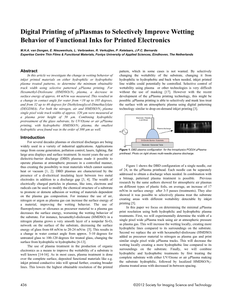
In this article we investigate the change in wetting behavior of inkjet printed materials on either hydrophilic or hydrophobic plasma treated patterns, to determine the minimum obtainable track width using selective patterned μPlasma printing. For Hexamethyl-Disiloxane (HMDSO)/N2 plasma, a decrease in surface energy of approx. 44 mN/m was measured. This resulted in a change in contact angle for water from <10 up to 105 degrees, and from 32 up to 46 degrees for Diethyleneglycol-Dimethaclylate (DEGDMA). For both the nitrogen, air and HMDSO/N2 plasma single pixel wide track widths of approx. 320 μm were measured at a plasma print height of 50 μm. Combining hydrophilic pretreatment of the glass substrate, by UV/Ozone or air μPlasma printing, with hydrophobic HMDSO/N2 plasma, the smallest hydrophilic area found was in the order of 300 μm as well.
DOCUMENT
This research investigates the integration of stakeholders' values into the digital frameworks of Collective Management Organizations (CMOs) within the Dutch music copyright system. Utilizing Q methodology, the study captures diverse perspectives from composers, lyricists, publishers, and CMO representatives on values, value tensions, norms, and system requirements. A pilot study with four experts tested data collection methods and refined the study design for a larger, follow-up study involving 30 participants. Preliminary findings, based on factor analysis of participant rankings of 30 statements, reveal two distinct perspectives: one focused on "Fairness and Accountability," emphasizing trust-building and equitable treatment, and the other on "Technological Efficiency and Transparency," prioritizing clear information, verification mechanisms, and advanced IT systems. Qualitative insights from participant interviews provide nuanced understanding, highlighting the importance of transparency in royalty processes, balanced application of technology, and equitable royalty distribution in the digital age. This research contributes to the modernization of copyright management systems offering a conceptual model adaptable to other creative (Intellectual Property) industries
MULTIFILE
In this thesis several studies are presented that have targeted decision making about case management plans in probation. In a case management plan probation officers describe the goals and interventions that should help offenders stop reoffending, and the specific measures necessary to reduce acute risks of recidivism and harm. Such a plan is embedded in a judicial framework, a sanction or advice about the sanction in which these interventions and measures should be executed. The topic of this thesis is the use of structured decision support, and the question is if this can improve decision making about case management plans in probation and subsequently improve the effectiveness of offender supervision. In this chapter we first sketch why structured decision making was introduced in the Dutch probation services. Next we describe the instrument for risk and needs assessment as well as the procedure to develop case management plans that are used by the Dutch probation services and that are investigated in this thesis. Then we describe the setting of the studies and the research questions, and we conclude with an overview of this thesis.
DOCUMENT

Aan patiënten opgenomen in de forensische zorg zit een steekje los. Maar volgens de publieke opinie ook aan de professionals, en in de processen hapert ook het een en ander. In haar oratie ging Vivienne de Vogel in op deze losse steekjes en hoe deze te herstellen zijn. Ze benadrukt daarbij het belang van onderzoek vanuit drie perspectieven: patiënten, professionals en processen. ‘Een geïntegreerd perspectief is nodig om de kwaliteit van de forensische zorg verder te verbeteren.’
DOCUMENT




