Green Urban Solutions is de overkoepelende benaming voor innovatieve toepassingen van groen in stedelijk gebied, zoals bijvoorbeeld groene daken, groene gevels, indoor groen en specifiek ontworpen aanplant op pleinen en perken. Ondanks de vele waarden die Green Urban Solutions genereren en het brede scala aan stakeholders die hier belang bij hebben, ontbreekt het tot nog toe aan solide business modellen voor Green Urban Solutions waarin deze stakeholders gekoppeld worden aan de verschillende waarden die ze genereren. Het doel van dit onderzoek is om drie nieuwe business modellen te ontwikkelen en een advies te geven voor het betrekken van stakeholders om deze modellen te versterken en te verwezenlijken. Hiervoor is de volgende hoofdvraag opgesteld: ‘’Wat is het Nederlandse business model voor Green Urban Solutions dat de schakel vormt met de stakeholders waar ze waarde voor creëert?’’.
DOCUMENT

Green spaces play an important role in urban areas. We study the accessibility of green urban areas by combining open data sets about green with population size data. We develop a mathematical model to define the population density of a green area and calculate the available green space depending on the location. To this end, we do not only consider walking distance to and size of the green area, but also take into account the local population size. Our model quantifies how the available green space depends on the location in the city, such that heavily populated areas have a small amount of green available, even when closely located to a green area.
DOCUMENT

Post-war urban neighbourhoods in industrialised countries have been shown to negatively affect the lifestyles of their residents due to their design. This study aims at developing an empirical procedure to select locations to be redesigned and the determinants of health at stake in these locations, with involvement of residents’ perspectives as core issue. We addressed a post-war neighbourhood in the city of Groningen, the Netherlands. We collected data from three perspectives: spatial analyses by urban designers, interviews with experts in local health and social care (n = 11) and online questionnaires filled in by residents (n = 99). These data provided input for the selection of locations to be redesigned by a multidisciplinary team (n = 16). The procedure yielded the following types of locations (and determinants): An area adjacent to a central shopping mall (social interaction, traffic safety, physical activity), a park (experiencing green, physical activity, social safety, social interaction) and a block of low-rise row houses around a public square (social safety, social interaction, traffic safety). We developed an empirical procedure for the selection of locations and determinants to be addressed, with addressing residents’ perspectives. This procedure is potentially applicable to similar neighbourhoods internationally.
DOCUMENT

Increasing urbanization and the effects of climate change will bring new challenges for cities, such as energy saving and supply of renewable energy, preventing urban heat islands and water retention to deal with more frequent downpours. A major urban surface, the surface of roofs, is nowadays hardly exploited and could be used to make cities more ‘future proof’ or resilient. Many Dutch municipalities have become aware that the use of green roofs as opposed to bituminous roofs positively contributes to these challenges and are stimulating building-owners to retrofit their building with green roofs. This study aims at comparing costs and benefits of roof types, focused on green roofs (intensive and extensive) both on building- and city scale. Core question is the balance between costs and benefits for both scales, given varying local conditions. Which policy measures might be needed in the future in order to apply green roofs strategically in regard to local demands? To answer this question the balance of costs and benefits of green roofs is divided into a public and an individual part. Both balances use a strengths, weaknesses, opportunities and threats framework to determine the chance of success for the application of green roofs, considering that the balance for green roofs on an individual scale influences the balance on a public scale. The outcome of this combined analyses in the conclusion verifies that a responsible policy and a local approach towards green roofs is necessary to prepare the city sufficiently for future climate changes. http://dx.doi.org/10.13044/j.sdewes.d6.0225
MULTIFILE
This article will explore the Cradle to Cradle (C2C) framework for urban environments, focusing on the perception, utilization and maintenance of parks. The case study explores the perception of urban flora and the value of greenery in everyday life in The Netherlands. The reflection section addresses the difference between conventional and C2C approaches to greenery on the one hand and current green management policies and public opinion on the other hand. The author reflects on how urban planning policies can be better geared towards public awareness of C2C, and towards the implementation of ecologically benign management of urban flora. It is proposed that an implementation of urban green management consistent with C2C is feasible and desirable. It is feasible given the favorable shifts in public opinion in relation to urban sustainability, and it is desirable due to the basic cost-benefit analysis and increased need for urban sustainability. This is a post-peer-review, pre-copyedit version of an article published in Urban Ecosystems. The final authenticated version is available online at: https://doi.org/10.1007/s11252-015-0468-2 https://www.linkedin.com/in/helenkopnina/
MULTIFILE

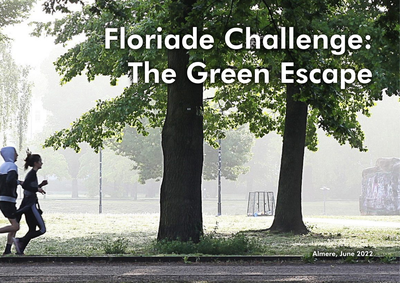
Almere is a green city where the greenery extends into the centre through a framework of nature, forests, parks and canals. With this green environment, Almere fulfils an important condition for a liveable city, where it is pleasant to live and work. An important goal for the municipality is to challenge its residents to develop a healthy lifestyle by using that green framework.But what really motivates Almeerders to go outside to exercise, enjoy the surroundings and meet each other? Are there sufficient green meeting or sports facilities nearby? Could the routes that connect the living and working environment with the larger parks or forests be better designed? And can those routes simultaneously contribute to climate adaptation?With the Green Escape Challenge, we invited students and young professionals to work on these assignments together.
DOCUMENT
In opdracht van het ministerie van Binnenlandse Zaken en Koninkrijksrelaties heeft het lectoraat Changing Role of Europe van De Haagse Hogeschool de rol van de Dutch Urban Envoy geëvalueerd. De betekenis, de inzet, het vervolg en de toekomstige invulling van de rol van de Dutch Urban Envoy komen aan bod. Op basis van de inzichten van 37 interviews met 39 betrokken partijen (van het Ministerie van BZK, Nederlandse steden, Europese steden, koepelorganisaties, Europese instellingen en andere ministeries binnen de Rijksoverheid) en deskresearch zijn de volgende conclusies en aanbevelingen geformuleerd.
DOCUMENT

More and more people worldwide live in urban areas, and these areas face many problems, of which a sustainable food provision is one. In this paper we aim to show that a transition towards more sustainable, regionally organized food systems strongly contributes to green, livable cities. The article describes a case study in the Dutch region of Arnhem–Nijmegen. Partners of a network on sustainable food in this region were interviewed on how they expect the food system to develop, and in design studies possible futures are explored. Both the interviews and the designs give support to the idea that indeed sustainable food systems can be developed to contribute to green livable cities. They show that the quality and meaning of existing green areas can be raised; new areas can be added to a public green system, and connections with green surroundings are enforced. They also show that inhabitants or consumers can be stimulated to become so called food citizens, highlighting that the relation of food systems and livable cities is a very close one.
DOCUMENT

Cities worldwide are growing at unprecedented rates, compromising their surrounding landscapes, and consuming many scarce resources. As a consequence, this will increase the compactness of cities and will also decrease the availability of urban green space. In recent years, many Dutch municipalities have cut back on municipal green space and itsmaintenance. To offer a liveable environment in 30 to 50 years, cities must face challenges head-on and strive to create green urban areas that build on liveable and coherent sustainable circular subsystems.
DOCUMENT

Nature in cities serves a multitude of purposes, one of which is that it provides citizens opportunities to recover from stressful daily urban life. Such stress recovering effects of nature can be experienced through urban green, which in urban planning and design contexts can be divided into large natural areas - urban green space - and small scale elements in urban streets: the urban greenscape. The current study aims at finding the extent to which various small scale natural elements in residential streets and their possible configurations influence citizens' preferences for those streets. The research was conducted through an online survey in four cities in the Netherlands (n = 4,956). It used stated choice methods in a virtual environment street design. The method yielded high quality data, indicating that the use of virtual environments and imagery is suitable for stated choice research in the built environment. The results show that especially trees very strongly influence preference, indicating they deserve more attention and space in cities. Grass, which is typically favored by local governments, and vertical green have the smallest effects in residential streets. Furthermore, the concept of greenscape intensity is introduced as the intensities of both the element and the configuration were found to be highly relevant. The results clearly show that the higher either of these intensities, the more likely a respondent will prefer the greenscape design. Furthermore, low intensity on the one can be compensated by high intensity on the other. With these results, urban design professionals and local governments can better trade-off the different aspects of costs versus positive effects of urban greenscape designs.
MULTIFILE



