De introductie van nieuwe media, zoals de iPad, in het onderwijs kunnen het onderwijs versterken en een interessante leeromgeving scheppen. Voor een school valt het echter in de praktijk van alledag niet mee om deze mogelijkheden te zien en toe te passen. Dit whitepaper bevat een beschrijving van de opzet en uitkomsten van de ‘What’s next’-week: een multidisciplinaire aanpak om te komen tot innovatieve manieren om iPads in te zetten binnen een middelbare school
DOCUMENT

Train today’s students for tomorrow’s jobs and let today’s professionals develop themselves alongside the progress in their field - these are the two most urgent demands we need and want to meet in vocational education. However, the world is changing so rapidly that the focus of Universities of Applied Sciences (UAS) only on the design of initial education is no longer enough. Education must connect with industry, governments, NGOs and population in a more intensive and permanent manner.In the Northern Netherlands, in particular in the city of Groningen, higher and secondary vocational education are aware of this urgency. Therefore, knowledge institutions have innovatively developed formal partnerships with industry, governments, population and social organisations in their field. What stands out most is the cooperative model in which education institutions, local governments, citizens and entrepreneurs steadily collaborate within a single organisation, a new type of company. This is a business model where education and research cooperate with hundreds of companies, civil society organisations and social organisations in the city and the region. Each level has its own form: a Regional Cooperative for the region and a Community Cooperative for the neighbourhood. In this brochure we would like to introduce you to these forms of collaboration.
DOCUMENT

With this paper, it is illustrated that a focus on entrepreneurship training in the nature and wilderness sector is relevant for diverse organisations and situations. The first curricula on nature entrepreneurship are currently being developed. In this paper the authors describe a project that focusses on educating the next generation of nature entrepreneurs, reflect on the Erasmus Intensive Program ‘European Wilderness Entrepreneur’ and the Wild10 World Café on nature entrepreneurship training. Sharing and learning from experiences is highly recommended to further develop and strengthen the curricula while considering the dynamic context of nature conservation and restoration of ecological processes.
DOCUMENT

This report presents the highlights of the 7th European Meeting on Molecular Diagnostics held in Scheveningen, The Hague, The Netherlands, 12-14 October 2011. The areas covered included molecular diagnostics applications in medical microbiology, virology, pathology, hemato-oncology,clinical genetics and forensics. Novel real-time amplification approaches, novel diagnostic applications and new technologies, such as next-generation sequencing, PCR lectrospray-ionization TOF mass spectrometry and techniques based on the detection of proteins or other molecules, were discussed. Furthermore, diagnostic companies presented their future visions for molecular diagnostics in human healthcare.
DOCUMENT

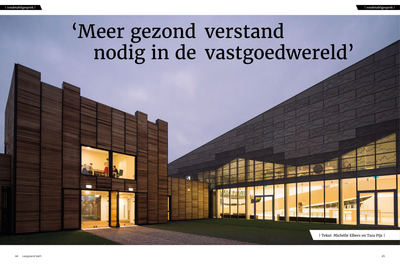
De voorbije jaren is er een aanzet gedaan tot het bestrijden van leegstand. Wat was het effect van deze inspanningen en wat heeft de eerste generatie maatregelen ons geleerd dat we kunnen gebruiken voor het komende decennium dat in het teken lijkt te staan van economische voorspoed? Wij zetten de hoofdrolspelers bij elkaar aan tafel en vroegen hen: ‘What’s next?’ Duidelijk werd dat we pas aan het begin staan van de noodzakelijke verduurzamings- en cultuuromslag waarin we beter met vastgoed moeten omgaan. Publieke en private partijen zijn nog zoekende naar hun rol in deze omslag. Tijdens het rondetafelgesprek zijn alle betrokkenen het er mee eens: er is een gebrek aan visie, regie én aan gezond verstand.
DOCUMENT