Preliminary empirical research conducted by the leading author has shown that design students using biological analogies, or models across different contexts, often misinterpreted these, intentionally or unintentionally, during design. By copying shape or form without integrating the main function of the mimicked biological model, students failed to consider the process or system directing that function when attempting to solve the design need. This article considers the first step in the development of an applicable educational model using distant analogies from nature, by means of biomimicry thinking methodology. The analysis examines results from a base-line exercise taken by students in the Minor Design with Nature during the Spring semester of Industrial Design Engineering at The Hague University of Applied Sciences in 2019, verifying that students without biomimicry training use this hollow approach automatically. This research confirms the gap between where students are at the beginning of the semester and where they need to be as expert sustainable designers when they graduate. These findings provide a starting point for future interventions in biomimicry workshops to improve systematic design thinking through structural and scientifically based iterations of analogical reasoning. https://doi.org/10.1007/s10798-020-09574-1 LinkedIn: https://www.linkedin.com/in/helenkopnina/
MULTIFILE

“Teaching is both an art and a science” (Harrison & Coll, 2008 p.1). Good teaching excites students and cultivates their curiosity to learn more than they are asked. But what if students’ blank faces tell you that the teaching did not land, what can you do? Using an analogy or metaphor to explain the principle helps students visualize and comprehend the knowledge of difficult, abstract concepts by making it familiar. The National Academy of Engineers issued a report in 2008 emphasizing the need for design engineers to develop 21st century skills, such as ingenuity and creativity, and to create innovative products and markets. However, designers have a hard time ignoring evident constraints on their concepts during their design process. This is especially difficult for novice designers when attempting to use analogical reasoning (Osborn, 1963; Hey et al. 2008). Hey et al. explains how the multitude of design considerations is even more difficult for novice as compared to expert designers who are more able to focus on the important features of a problem. Kolodner (1997) iterates how novice designers have difficulty sifting through the mass of information they encounter. They need help with the transfer of knowledge that analogical reasoning requires. When students can clearly extract and articulate what they have learned, this helps them to internalize this. Biomimicry education teaches the clear extraction and articulation while learning to decipher and transfer function analogies from biology to design. This transfer can also improve reasoning when solving problems (Wu and Weng, 2013), reacting to the challenge in a more ‘out-of-the-box’ manner (Yang et al. 2015). However, not being able to fully understand this “conceptual leap between biology and design” in an accurate manner, is sited as a key obstacle of this field (Rowland, 2017; Rovalo and McCardle 2019, p. 1). Therefore, didactics on how to teach this analogical leap to overcome the hurdles is essential. There is insufficient research on the effectivity of biomimicry education in design to help establish ‘best practices’. This thesis offers advice to fill this pedagogical gap to find out how to overcome the obstacle of analogical reasoning for novice designers, while practicing biomimicry. The contribution to science is a not earlier tested methodology that leads to a clearer understanding of the translation of biological strategies and mechanisms found in scientific research. This translation from biology to design in visual and textual manner, is called the Abstracted Design Principle (ADP) and is introduced and explained in detail in chapters 4, 5 and 6 of this thesis. Together with the proposed instructions, we sketch the net-gain of positive mind-set for novice designers on their path to design for a sustainable future.
DOCUMENT

Biomimicry education is grounded in a set of natural design principles common to every known lifeform on Earth. These Life’s Principles (LPs) (cc Biomimicry 3.8), provide guidelines for emulating sustainable strategies that are field-tested over nearly four billion years of evolution. This study evaluates an exercise for teaching LPs to interdisciplinary students at three universities, Arizona State University (ASU) in Phoenix, Arizona (USA), College of Charleston (CofC) in Charleston, South Carolina (USA) and The Hague University of Applied Sciences (THUAS) in The Hague (The Netherlands) during the spring 2021 semester. Students researched examples of both biological organisms and human designs exhibiting the LPs. We gauged the effectiveness of the exercise through a common rubric and a survey to discover ways to improve instruction and student understanding. Increased student success was found to be directly linked to introducing the LPs with illustrative examples, assigning an active search for examples as part of the exercise, and utilizing direct assessment feedback loops. Requiring students to highlight the specific terms of the LP sub-principles in each example is a suggested improvement to the instructions and rubric. An iterative, face-to-face, discussion-based teaching and learning approach helps overcome minor misunderstandings. Reiterating the LPs throughout the semester with opportunities for application will highlight the potential for incorporating LPs into students’ future sustainable design process. Stevens LL, Fehler M, Bidwell D, Singhal A, Baumeister D. Building from the Bottom Up: A Closer Look into the Teaching and Learning of Life’s Principles in Biomimicry Design Thinking Courses. Biomimetics. 2022; 7(1):25. https://doi.org/10.3390/biomimetics7010025
DOCUMENT

The methodology of biomimicry design thinking is based on and builds upon the overarching patterns that all life abides by. “Cultivating cooperative relationships” within an ecosystem is one such pattern we as humans can learn from to nurture our own mutualistic and symbiotic relationships. While form and process translations from biology to design have proven accessible by students learning biomimicry, the realm of translating biological functions in a systematic approach has proven to be more difficult. This study examines how higher education students can approach the gap that many companies in transition are struggling with today; that of thinking within the closed loops of their own ecosystem, to do good without damaging the system itself. Design students should be able to assess and advise on product design choices within such systems after graduation. We know when tackling a design challenge, teams have difficulties sifting through the mass of information they encounter, and many obstacles are encountered by students and their professional clients when trying to implement systems thinking into their design process. While biomimicry offers guidelines and methodology, there is insufficient research on complex, systems-level problem solving that systems thinking biomimicry requires. This study looks at factors found in course exercises, through student surveys and interviews that helped (novice) professionals initiate systems thinking methods as part of their strategy. The steps found in this research show characteristics from student responses and matching educational steps which enabled them to develop their own approach to challenges in a systems thinking manner. Experiences from the 2022 cohort of the semester “Design with Nature” within the Industrial Design Engineering program at The Hague University of Applied Sciences in the Netherlands have shown that the mixing and matching of connected biological design strategies to understand integrating functions and relationships within a human system is a promising first step. Stevens LL, Whitehead C, Singhal A. Cultivating Cooperative Relationships: Identifying Learning Gaps When Teaching Students Systems Thinking Biomimicry. Biomimetics. 2022; 7(4):184. https://doi.org/10.3390/biomimetics7040184
DOCUMENT

This full paper works towards merging ‘frugality’ and ‘design thinking’ into a simplified framework for a workshop routine as a stepping stone for SMEs in developed countries to create and capture value of frugal innovations. Innovations which are born out of the notion that we can do more with less, or for less. This framework is aimed at reaching a specific group of SMEs, in this paper called the peloton of SMEs, a large group of SMEs which generally have lower growth ambitions and growth potential in comparison to the frontrunners. This group is often overlooked by (regional) governmental innovation programmes due to a primary focus on the same industry’s frontrunners. The framework was first tested with students, discussed with experts and eventually tested with SMEs from the Agribusiness sector in the Netherlands. Frugal Elements added to the design thinking process are; (a.) a Frugal Lens (b.) Frugal Business Model Patternsfor BMI (c.) Frugal leadership development (d.) Frugal Validation of the solution (e.) Frugal Intervention (limited time, limited theory, vertical learning community, practical tools). Although the first Pilot has been a succes in terms of helping participating SMEs to create innovations, more research is necessary for the design of a final framework which is expected to contribute to the frameworks that are currently available to SMEs in frugal and sustainable business modelling.
DOCUMENT

Toekomstige professionals moeten complexe problemen kunnen oplossen. Hoeleren we dit hbo-studenten? Design thinking en ontwerpgericht onderzoek bieden beiden dezelfde logica voor het ontwerpen van onderbouwde oplossingenvoor complexe problemen. Ze verschillen in accent, met name in inhoudelijke uitgangspunten en de organisatie van het ontwerpproces. Zowel design thinkingals ontwerpgericht onderzoek zijn geschikt voor het oplossen van complexeproblemen, zeker als hun sterke punten in opeenvolgende ontwerpcycli wordengecombineerd.
DOCUMENT

Few people I know act likea magnet in the way Laura does. If you hear her speak, see her move, enjoy her smile - you can't help but want to be a part of what makes her heart beat faster. She radiates passion for her dream topic biomimicry and before you know it you're caught in that dream. From the day I met her, I was captivated by her enthusiasm and knowledge about this topic. In fact, meeting Laura made me decide to join the university as I thought: if people like Laura work at THUAS, I want to be a part of this organization'. Over the years I have seen her finish the Msc in biomimicry at Arizona State University followed by a PhD at TUDelft. And all that next to her full time job as a teacher. It's only a miracle that she still found the time to go outdoors and be in Nature. But luckily, she did as this is what nourishes her - and that nourishment is brought into the classroom affecting generations of students. I am very proud of how she builds her tribe just like Nature does; grassroots from the bottom up, not supported but also not inhibited by formal structures. In that way she truly acts as a bridge helping others to tap into Nature's wisdom. This morning I harvested the remaining vegetables from my garden and turned them into lunch. It's the second year I grow vegetables and it feels like I am only at the beginning of learning to collaborate with Nature. In Spring and Summer, Ihave witnessed in awe how seeds become seedlings which then grow into mature plants carrying fruit. The sheer wonder of Nature never ceases to amaze me, and my garden is only an attempt to be more aware of seasonal rhythms. It's Autumn right now, a time of year that invites us to go inside, reflect and let go of old baggage that no longer serves us. We'll be approaching the stage of wintering soon in which our inner journey will benefit from the darkness of wintertime introspection, along with the space to process the old, integrate learnings, and then germinate the new. Over the course of her career, Laura has gone through these seasonal cycles - reinventing herself in the past decade as a teacher, researcher and regenerative leader. One of Laura's many qualities is that she embodies three leadership characteristics derived from Nature. First, she acknowledges the importance of interconnection. Many times, we think of Nature as being separate from us, but in reality we humans are Nature. Connection with Nature enables us to think within systems and understand that we can't direct the system, but instead we're all part of multiple systems. Second, sensing the system and our part in it builds resilience. Even if things don't go as we expected or imagined, rather than reacting, we can step back and engage with more insight. Laura's adaptability to a system's needs while spotting opportunities to crack it open, is admirable. As the system is always in evolution, so is she - remarkably receptive to change even in the final stages of her career. Third, Laura creates space for people to develop and thrive, acting as multipliers of her vision and love for the natural world. In her leadership she embodies the ideal elder while being able to perceive the world through the eyes of a child - with continuous wonder for how life unfolds. This book is a bricolage of Laura's post-doc research conducted the past two years. In it you will find an array of fascinating reads and tools that help you deepen your practice as a biomimicry professional. The book is a community effort integrating tools Laura has co-created with her ecosystem as well as more in-depth readings written by some of the talents she has nourished over time. I wish for you to enjoy this careful curation of both practical as well as more conceptual contributions. May it inspire your own thriving in bringing Nature based wisdom to the core of our daily lives.
DOCUMENT

Er is behoefte aan mensen die bijdragen leveren aan de ontwikkeling van technische producten en processen. Onderwijs heeft de opdracht de technische geletterdheid van leerlingen te ontwikkelen en te zorgen dat ze zich prettig voelen bij het hanteren van techniek. Deze studie focust op de bijdrage die Mindtools hieraan leveren. Mindtools zijn op ICT gebaseerde leermiddelen die samenwerkend constructivistisch leren en hoger-orde (kritisch en creatief) denken stimuleren. Het begrip Direct Manipulation Environments (DME's), een subklasse van Mindtools, kenmerkt concrete leermiddelen zoals de microwerelden "Lego Mindstorms" en "Techno Logica". Deze microwerelden functioneren op basis van een materieel technisch model dat direct via een computer¬programma bestuurd wordt en taken kan uitvoeren (robots). De leertaak voor de leerling kan zich bewegen op het continuüm van het zelf programmeren van een kant-en-klaar materieel model dat bepaalde taken moet uitvoeren tot en met het zelf bedenken, bouwen en programmeren van een dergelijk model dat een of meer taken kan uitvoeren. Op grond van eerder literatuuronderzoek en een casestudie veronderstellen we dat het educatief toepassen van DME's bijdraagt aan de ontwikkeling van de technische geletterdheid van leerlingen. Hoewel definiëring van technische geletterdheid meer aandacht vraagt, zijn de volgende drie dimensies voor onze analyses bruikbaar gebleken: inhoud (zoals feiten, concepten, voorschriften), praktijk (het handelen, het materiële, doen en realiseren) en de cognitieve dimensie (denkvaardigheden en denkhoudingen). Het is aannemelijk dat door het toepassen van DME's domeinspecifieke concepten en kennis ontwikkeld wordt. Het denken van leerlingen is gekoppeld aan contexten en taken en moet niet geïsoleerd worden bestudeerd. We concentreren ons in deze studie vooral op onderzoek naar de dimensie van de denkvaardigheden en denkhoudingen (het denken van leerlingenduo's bij het oplossen van een probleemtaak) door het analyseren van de verbale interactie op kenmerken van kritisch - en creatief denken. Er is gebruik gemaakt van een Techno Logica leeromgeving bestaande uit een computer met software, een interface, bestuurbare materialen zoals lampjes en motors, en een zelfinstructie handleiding. Twee in complexiteit toenemende probleemtaken, ieder gebaseerd op een kant-en-klaar materieel model (Verkeerslicht en Reuzenrad), zijn gebruikt om de leerlingen besturingen te laten ontwerpen en testen. Dit proces werd op video opgenomen. We veronderstellen dat Techno Logica een bruikbare Mindtool is wanneer werken ermee bijdraagt aan technologische geletterdheid, in de zin dat er sprake is van probleemoplossen en hoger orde denken. Om dit te operationaliseren ontwierpen we een gestructureerd observatie-instrument op basis van het IOWA Integrated Thinking Model en de theorie over denkhoudingen (Costa, 2000). Hiermee werd het voorkomen en de diversiteit van denkvaardigheden en denkhoudingen in de verbale acties en interactie gescoord. Op basis van onze waarnemingen concluderen we dat veel interactie en handelen eerder geduid kan worden als uitingen van denken dan trial and error. Er zijn indicaties dat de leeromgeving en probleemtaken leiden tot ontwikkeling van expertise waardoor een nieuwe (moeilijkere) probleemtaak efficiënter en effectiever opgelost wordt. We vragen we aandacht voor de rol van de docent. We ervaren immers dat nieuwe leermiddelen niet gemakkelijk geadopteerd worden door leerkrachten.
DOCUMENT

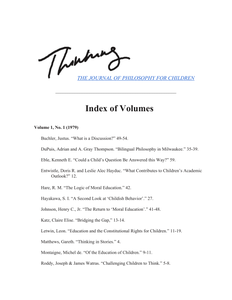
The journal was a forum for the work of both theorists and practitioners of philosophical practice with children, and published such work in all forms, including philosophical argument and reflection, classroom transcripts, curricula, empirical research, and reports from the field. The journal also maintained a tradition in publishing articles in the hermeneutics of childhood, a field of intersecting disciplines including cultural studies, social history, philosophy, art, literature and psychoanalysis.
DOCUMENT
Innovatie staat hoog op de Nederlandse agenda van prioriteiten. Innovatie genereert immers economische groei en daarmee mogelijkheden voor nieuwe banen. Maar hoe wordt er geïnnoveerd binnen organisaties? Waar innovatie gericht zou moeten zijn op het stimuleren van creativiteit en "out of the box thinking", leert de praktijk dat innovatie beschouwd wordt als een beheersingsvraagstuk. Innoveren verwordt daarmee tot controleren terwijl het gericht moet zijn op verandering en vernieuwing. Het móet anders en het kán ook anders zal ik betogen.
DOCUMENT



