We investigate entrepreneurial ecosystems that support circular start-ups and innovation. We argue that entrepreneurial ecosystems for circularity are constellations of existing entrepreneurial and innovation ecosystems that extend across geographies and sectors. Our research question centres on understanding ecosystem intermediation that facilitates the embedding of circular start-ups in different ecosystems and addresses a pertinent gap in the literature about ecosystem intermediation for circular transitions and circular start-ups Focusing on the emerging circular transition in the textiles and apparel industry, we gathered data from in-depth interviews, field observations, and archival documentation over a seven-year period. Our findings show that entrepreneurial ecosystems for circular start-ups are purposefully intermediated at a meta level, combining elements of extant ecosystems to focus on circularity. Drawing on these insights, we conceptualize ecosystem intermediation as connecting diverse ecosystems across geographic and sectoral boundaries. Our study contributes to the literatures on circular entrepreneurship, circular ecosystems, and ecologies of system intermediation as well as provides practical implications for practitioners and policy makers.
DOCUMENT
We investigate circular entrepreneurial ecosystems that support circular startups and innovation. We argue that circular entrepreneurial ecosystems are constellations of existing entrepreneurial ecosystems that extend across geographies and sectors, requiring ecosystem intermediaries to bridge institutional environments and provide access to actors and resources. Focusing on the emerging circular transition in the textiles and apparel industry, we gathered data from in-depth interviews, field observations, and archival documentation over a seven--year period. Our findings show that circular entrepreneurial ecosystems are purposefully intermediated at a meta level, generating nested and distributed ecosystems. To elucidate circular ecosystem intermediation, we devised a model of system level 5 intermediation that extends the conceptualization of ecologies of system intermediation across geographic and sector boundaries. Our study contributes to the literatures on circular entrepreneurship, circular ecosystems, and ecosystem intermediation as well as provides practical implications for practitioners and policy makers.
DOCUMENT
Lawmakers as representatives of the people should resist the anti-competitive proposals of the banking sector and embrace a vision of the digital euro that serves the collective interests of Europeans, Dr Martijn van der Linden and Vicky Van Eyck write. The influence of the banking lobby on policymakers risks undermining the digital euro's potential. Lawmakers as representatives of the people should resist the anticompetitive proposals of the banking sector and embrace a vision of the digital euro that serves the collective interests of Europeans. This means that the digital euro must be attractive, accessible and beneficial to all. The deliberation process must be free from the disproportionate influence of an industry that has much to lose from a level playing field for payment services and financial intermediation.
MULTIFILE
This contribution will describe how the Hanzehogeschool in Groningen, the Netherlands has implemented its entrepreneurship education throughoutthe entire institution resulting in entrepreneurial awareness among manystudents and great impact in the regional innovation ecosystem
DOCUMENT

Our planet’s ecology and society are on a collision course, which manifests due to a contradiction in the assumptions of unlimited material growth fueling the linear economic paradigm. Our closed planetary ecosystem imposes confined amounts of space and a finite extent of resources upon its inhabitants. However, practically all the economic perspectives have been defiantly neglecting these realities, as resources are extracted, used and disposed of reluctantly (Ellen MacArthur Foundation 2015). The circular economy attempts to reconcile the extraction, production and usage of goods and resources with the limited availability of those resources and nature’s regenerative capabilities This perspective entails a shift throughout the supply chain, from material science (e g non-toxic, regenerative biomaterials) to novel logistical systems (e g low-carbon reverse logistics). Because of this, the circular economy is often celebrated for its potential environmental benefits and its usefulness as a blueprint for sustainable development (Ellen MacArthur Foundation 2017). Unfortunately, the promise of the circular economy aiming at enhanced sustainability through restorative intent and design (McDonough & Braungart 2010), is often inhibited by institutional barriers posed by the current linear economy of take, make, use and waste (Ghisellini et al. 2016). Underlying those barriers our cultural paradigm celebrates consumerism, exponential growth and financial benefit instead of human values such as diversity, care and trust. Based on a mapping exercise of the circular economy discourse in the Netherlands and an overview of international (academic) literature (Van den Berg 2020) supplemented with collaborative co-creation sessions, visiting events, conferences, giving talks and classes, we have defined a gap leading to the focus of the Professorship. First, we highlight the importance of a process approach in studying the transition from a linear to a circular economy, which is why we use the verb ‘entrepreneuring’ as it indicates the movement we collectively need to make. The majority of work in the field is based on start-ups and only captures snapshots while longitudinal and transition perspectives - especially of larger companies - are missing (Merli et al. 2019; Geissdoerfer et al. 2018; Bocken et al. 2014). We specifically adopt an entrepreneurship-as-practice lens (Thompson, Verduijn & Gartner 2020), which allows us to trace the doings – as opposed to only the sayings - of organizations involved in circular innovation. Such an approach also enables us to study cross-sector and interfirm collaboration, which is crucial to achieve ecosystem circularity (Raworth 2019). As materials flow between actors in a system, traditional views of ‘a value chain’ slowly make way for an ecosystem or value web perspective on ‘organizing business’. We summarize this first theme as ‘entrepreneurship as social change’ broadening dominant views of what economic activity is and who the main actors are supposed to be (Barinaga 2013; Calás, Smircich & Bourne 2009; Steyaert & Hjorth 2008; Nicholls 2008). Second, within the Circular Business Professorship value is a big word in two ways. First of all, we believe that a transition to a circular economy is not just a transition of materials, nor technologies - it is most of all a transition of values We are interested in how people can explore their own agency in transitioning to a circular economy thereby aligning their personal values with the values of the organization and the larger system they are a part of Second, while circularity is a broad concept that can be approached through different lenses, the way in which things are valued and how value is created and extracted lies at the heart of the transition (Mazzucato 2018). If we don’t understand value as collectively crafted it will be very hard to change things, which is why we specifically focus on multiplicity and co-creation in the process of reclaiming value, originating from an ethics of care Third, sustainability efforts are often concerned with optimization of the current – linear – system by means of ecoefficient practices that are a bit ‘less bad’; using ’less resources’, causing ‘less pollution’ and ‘having less negative impact’. In contrast, eco-effective practices are inherently good, departing from the notion of abundance: circular thinking celebrates the abundance of nature’s regenerative capacities as well as the abundance of our imagination to envision new realities (Ellen MacArthur Foundation 2015). Instead of exploiting natural resources, we should look closely in order to learn how we can build resilient self-sustaining ecosystems like the ones we find in nature. We are in need of rediscovering our profound connection with and appreciation of nature, which requires us to move beyond the cognitive and employ an aesthetic perspective of sustainability This perspective informs our approach to innovating education: aesthetics can support deep sustainability learning (Ivanaj, Poldner & Shrivastava 2014) and contribute to facilitating the circular change makers of the future. The current linear economy has driven our planet’s ecology and society towards a collision course and it is really now or never: if we don’t alter the course towards a circular economy today, then when? When will it become urgent enough for us to take action? Which disaster is needed for us to wake up? We desperately need substitutes for the current neo-liberal paradigm, which underlies our linear society and prevents us from becoming an economy of well-being In Entrepreneuring a regenerative society I propose three research themes – ‘entrepreneurship as social change’, ‘reclaiming value’ and ‘the aesthetics of sustainability’ – as alternative ways of embracing, studying and co-creating such a novel reality. LinkedIn: https://www.linkedin.com/in/kim-poldner-a003473/
MULTIFILE

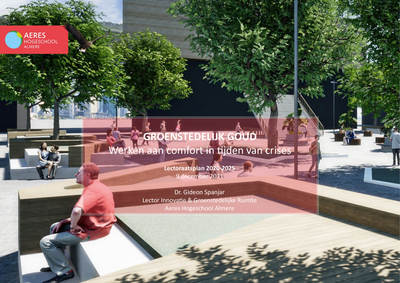
We wonen in een land met het hoogste welvaartsniveau ter wereld en toch staat onze manier van leven onder druk. Hoe realiseren we uitnodigende en comfortabele steden in tijden van crisis? Het is voor mij eervol om als lector aan het roer te mogen staan van een lectoraat dat met de stad en regio samenwerkt om de meest urgente opgaven van de 21ste eeuw op te pakken. De gevolgen van klimaatverandering en grootschalig biodiversiteitsverlies zijn immers inmiddels voelbaar in ons leven.
DOCUMENT
Elk jaar bezoeken tussen de een en twee miljoen mensen het waddengebied. Het toerisme is daar uitgegroeid tot een van de belangrijkste economische activiteiten. In Nederland zijn vooral de eilanden een populaire vakantiebestemming. Fietsen, wandelen en strandbezoek zijn populaire activiteiten. De authentieke atmosfeer, het strand en het duinlandschapworden het meest gewaardeerd. De natuurwaarden van de Waddenzee spelen een minder grote rol, hoewel uit onderzoek blijkt dat er een zekere relatie bestaat tussen natuurervaringen en de plaatsgebondenheid van de toerist. In tegenstelling tot Duitsland komt het toerisme op de vastelandskust van Noord-Holland, Friesland en Groningen nauwelijks op gang en kan niet profiteren van de stroom bezoekers naar de Waddeneilanden. De recente aanwijzing van de Waddenzee tot werelderfgoed wordt over het algemeen gezien als een belangrijke stimulans voor de ontwikkeling van het toerisme. InNederland blijkt de werelderfgoedstatus echter nog relatief onbekend te zijn. In tegenstelling tot het Duitse kustgebied wordt door ondernemers deze status niet of nauwelijks benut. Met de werelderfgoedstatus van de Waddenzee en de voorgenomen uitbreiding van het vliegveld Eelde als nieuwe uitdagingen zijn met behulp van scenarioplanning een aantal richtingen voor de ontwikkeling van het toerisme in Noord-Nederland geïdentificeerd en uitgewerkt in 23 product-markt-partner-combinaties. Deze hebben het karakter van shortbreaks waarineen bezoek aan het waddengebied gekoppeld wordt aan andere highlights in Noord-Nederland
DOCUMENT

Few people I know act likea magnet in the way Laura does. If you hear her speak, see her move, enjoy her smile - you can't help but want to be a part of what makes her heart beat faster. She radiates passion for her dream topic biomimicry and before you know it you're caught in that dream. From the day I met her, I was captivated by her enthusiasm and knowledge about this topic. In fact, meeting Laura made me decide to join the university as I thought: if people like Laura work at THUAS, I want to be a part of this organization'. Over the years I have seen her finish the Msc in biomimicry at Arizona State University followed by a PhD at TUDelft. And all that next to her full time job as a teacher. It's only a miracle that she still found the time to go outdoors and be in Nature. But luckily, she did as this is what nourishes her - and that nourishment is brought into the classroom affecting generations of students. I am very proud of how she builds her tribe just like Nature does; grassroots from the bottom up, not supported but also not inhibited by formal structures. In that way she truly acts as a bridge helping others to tap into Nature's wisdom. This morning I harvested the remaining vegetables from my garden and turned them into lunch. It's the second year I grow vegetables and it feels like I am only at the beginning of learning to collaborate with Nature. In Spring and Summer, Ihave witnessed in awe how seeds become seedlings which then grow into mature plants carrying fruit. The sheer wonder of Nature never ceases to amaze me, and my garden is only an attempt to be more aware of seasonal rhythms. It's Autumn right now, a time of year that invites us to go inside, reflect and let go of old baggage that no longer serves us. We'll be approaching the stage of wintering soon in which our inner journey will benefit from the darkness of wintertime introspection, along with the space to process the old, integrate learnings, and then germinate the new. Over the course of her career, Laura has gone through these seasonal cycles - reinventing herself in the past decade as a teacher, researcher and regenerative leader. One of Laura's many qualities is that she embodies three leadership characteristics derived from Nature. First, she acknowledges the importance of interconnection. Many times, we think of Nature as being separate from us, but in reality we humans are Nature. Connection with Nature enables us to think within systems and understand that we can't direct the system, but instead we're all part of multiple systems. Second, sensing the system and our part in it builds resilience. Even if things don't go as we expected or imagined, rather than reacting, we can step back and engage with more insight. Laura's adaptability to a system's needs while spotting opportunities to crack it open, is admirable. As the system is always in evolution, so is she - remarkably receptive to change even in the final stages of her career. Third, Laura creates space for people to develop and thrive, acting as multipliers of her vision and love for the natural world. In her leadership she embodies the ideal elder while being able to perceive the world through the eyes of a child - with continuous wonder for how life unfolds. This book is a bricolage of Laura's post-doc research conducted the past two years. In it you will find an array of fascinating reads and tools that help you deepen your practice as a biomimicry professional. The book is a community effort integrating tools Laura has co-created with her ecosystem as well as more in-depth readings written by some of the talents she has nourished over time. I wish for you to enjoy this careful curation of both practical as well as more conceptual contributions. May it inspire your own thriving in bringing Nature based wisdom to the core of our daily lives.
DOCUMENT





