Objectives: Promoting unstructured outside play is a promising vehicle to increase children’s physical activity (PA). This study investigates if factors of the social environment moderate the relationship between the perceived physical environment and outside play. Study design: 1875 parents from the KOALA Birth Cohort Study reported on their child’s outside play around age five years, and 1516 parents around age seven years. Linear mixed model analyses were performed to evaluate (moderating) relationships among factors of the social environment (parenting influences and social capital), the perceived physical environment, and outside play at age five and seven. Season was entered as a random factor in these analyses. Results: Accessibility of PA facilities, positive parental attitude towards PA and social capital were associated with more outside play, while parental concern and restriction of screen time were related with less outside play. We found two significant interactions; both involving parent perceived responsibility towards child PA participation. Conclusion: Although we found a limited number of interactions, this study demonstrated that the impact of the perceived physical environment may differ across levels of parent responsibility.
MULTIFILE

De Regiegroep van de topsector Life Sciences & Health wil een impuls geven aan initiatieven die praktijkgericht onderzoek op het gebied van Health betreffen. De redenen hiervoor zijn de relatief bescheiden positie van Health vergeleken bij de Life Sciences in de eerdere agendering onder de topsector en de verwachting dat praktijkgericht onderzoek door hogescholen een substantiële bijdrage kan leveren aan de doelstellingen onder het topsectorenbeleid. Daarom is opdracht gegeven tot het opstellen van een agenda voor praktijkgericht onderzoek “Health”. Deze agenda moet leiden tot samenwerking met een solide economische component tussen hogescholen, eventuele andere kennisinstellingen en publieke en private partijen uit de beroepspraktijk. De Agenda Praktijkgericht Onderzoek Health is ingedeeld in vier overkoepelende thema’s (A - D) waarop het onderzoek van hogescholen zich zou moeten richten. Binnen elk thema zijn onderwerpen benoemd die op basis van deze verkenning prioriteit verdienen.
DOCUMENT

More than 25!years after Moore’s first introduction of the public value concept in 995, the concept is now widely used, but its operationalization is still considered difficult. This paper presents the empirical results of a study analyzing the application of the public value concept in Higher Education Institutions, thereby focusing on how to account for public value. The paper shows how Dutch universities of applied sciences operationalize the concept ‘public value’, and how they report on the outcome achievements. The official strategy plans and annual reports for FY2016 through FY2018 of the ten largest institutions were used. While we find that all the institutions selected aim to deliver public value, they still use performance indicators that have a more narrow orientation, and are primarily focused on processes, outputs, and service delivery quality. However, we also observe that they use narratives to show the public value they created. In this way this paper contributes to the literature on public value accounting.
DOCUMENT

The concept of Smart Healthy Age-Friendly Environments (SHAFE) emphasises the comprehensive person-centred experience as essential to promoting living environments. SHAFE takes an interdisciplinary approach, conceptualising complete and multidisciplinary solutions for an inclusive society. From this approach, we promote participation, health, and well-being experiences by finding the best possible combinations of social, physical, and digital solutions in the community. This initiative emerged bottom-up in Europe from the dream and conviction that innovation can improve health equity, foster caring communities, and sustainable development. Smart, adaptable, and inclusive solutions can promote and support independence and autonomy throughout the lifespan, regardless of age, gender, disabilities, cultural differences, and personal choices, as well as promote happier and fairer living places.
DOCUMENT

Blog Aletta Jacobs School of Public Health
LINK
The evolution of emerging technologies that use Radio Frequency Electromagnetic Field (RF-EMF) has increased the interest of the scientific community and society regarding the possible adverse effects on human health and the environment. This article provides NextGEM’s vision to assure safety for EU citizens when employing existing and future EMF-based telecommunication technologies. This is accomplished by generating relevant knowledge that ascertains appropriate prevention and control/actuation actions regarding RF-EMF exposure in residential, public, and occupational settings. Fulfilling this vision, NextGEM commits to the need for a healthy living and working environment under safe RF-EMF exposure conditions that can be trusted by people and be in line with the regulations and laws developed by public authorities. NextGEM provides a framework for generating health-relevant scientific knowledge and data on new scenarios of exposure to RF-EMF in multiple frequency bands and developing and validating tools for evidence-based risk assessment. Finally, NextGEM’s Innovation and Knowledge Hub (NIKH) will offer a standardized way for European regulatory authorities and the scientific community to store and assess project outcomes and provide access to findable, accessible, interoperable, and reusable (FAIR) data.
DOCUMENT

Internationalizing curricula. Needs and wishes of alumni and employers with regard to international competencies. Internationalization has become of great importance for universities acrossthe globe. The labour market is becoming international, with internationalopportunities and international competition. Emerging markets such as India, China and Russia are gaining economic power. Global challenges demand world-wide solutions. Production and marketing networks span the globe and various forms of migration have resulted in a large cultural diversity within nations. As a result, societies and labour markets are changing as well. In order to deal with these societal changes adequately and to succeed in today’s labour market, graduates need to be equipped with international competencies. In a survey among 500 chief executives, ICM Research (on behalf of Think Global and The British Council, 2011) showed that employers strongly value staff members who are able to work in an international and multicultural environment. Similar results were found in Diamond et al. (2011), in which ‘multicultural teamwork’ was considered most important. The Hague University of Applied Sciences seeks to prepare its students adequately for the world of tomorrow. The University’s development plans (e.g. HogeschoolOntwikkelingsPlan, HOP 7, 2009-2013 and HOP 8, 2014-2017) indicate that its vision is to train students to be globally-minded professionals with an international and multicultural perspective, who are world-citizens, interested in global issues and able to deal with diversity in a constructive manner. They are to be professionals, who possess the competencies to function well in an international and intercultural environment. Internationalization is therefore high on the agenda of The Hague University of Applied Sciences (THUAS) which is illustrated by the fact that, as of 2014, new students in all academies have to fill 12.5% (30 ECTS) of their four-year Bachelor program with international activities. These activities can range from an internship or semester abroad (student mobility) to participating in full programs of study or minors in which English is the medium of instruction, or an internationally themed minor (Internationalization at Home, IaH). And this is only the beginning. Internationalization is a means, not an end. All THUAS courses are looking into ways in which they can internationalize their curriculum. And in doing so, they need to be innovative (Leask, 2009) and keep in mind the specific needs and wishes of alumni and their employers with regard to international competences. The THUAS research group International Cooperation supports these internationalization policy objectives by investigating various aspects, such as: • The acquisition and development of international competencies among students. • The extent to which lecturers possess international competencies and what their needs and wishes are for further development. • The international competencies THUAS graduates have acquired as part of their degree and how THUAS has stimulated this development. • The international competencies that employers and alumni consider important. Although international competencies and employability have received growing attention in internationalization research, existing studies have mainly focused on: • The effects of study abroad on the development of international competence (cf. Hoven & Walenkamp, 2013). • The effects of an experience abroad (study, internship, voluntary work) on employability. • A more general analysis of the skills employers look for in prospective employees.
DOCUMENT

Quality of life serves a reference against which you can measure the various domains of your own life or that of other individuals, and that can change over time. This definition of the World Health Organization encompasses many elements of daily living, including features of the individual and the environment around us, which can either be the social environment, the built environment, or other environmental aspects. This is one of the rationales for the special issue on “Quality of Life: The Interplay between Human Behaviour, Technology and the Environment”. This special issue is a joint project by the Centre of Expertise Health Innovation of the Hague University of Applied Sciences in The Netherlands. The main focus of this Special Issue is how optimising the interplay between people, the environment, and technology can enhance people’s quality of life. The focus of the contributions in this special issue is on the person or end‐user and his or her environment, both the physical, social, and digital environment, and on the interaction between (1) people, (2) health, care, and systems, and (3) technology. Recent advances in technology offer a wide range of solutions that support a healthy lifestyle, good quality of life, and effective and efficient healthcare processes, for a large number of end‐users, both patients/clients from minus 9 months until 100+ years of age, as well as practitioners/physicians. The design of new services and products is at the roots of serving the quality of life of people. Original article at MDPI; DOI: https://doi.org/10.3390/ijerph16245106 (Editorial of Special Issue with the same title: "Quality of Life: The Interplay between Human Behaviour, Technology and the Environment")
MULTIFILE

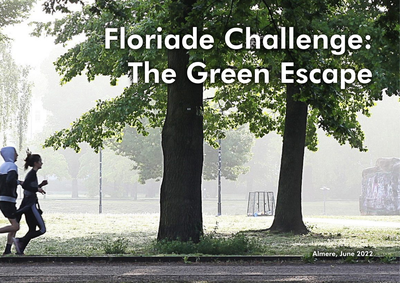
Almere is a green city where the greenery extends into the centre through a framework of nature, forests, parks and canals. With this green environment, Almere fulfils an important condition for a liveable city, where it is pleasant to live and work. An important goal for the municipality is to challenge its residents to develop a healthy lifestyle by using that green framework.But what really motivates Almeerders to go outside to exercise, enjoy the surroundings and meet each other? Are there sufficient green meeting or sports facilities nearby? Could the routes that connect the living and working environment with the larger parks or forests be better designed? And can those routes simultaneously contribute to climate adaptation?With the Green Escape Challenge, we invited students and young professionals to work on these assignments together.
DOCUMENT
Background: Running has become one of the most popular sports and has proven benefits for public health. Policy makers are increasingly aware that attractively designed public spaces may promote running. However, little is known about what makes a running environment attractive and restorative for runners and to what extent this depends on characteristics of the runner. This study aims to investigate 1) to what extent intrapersonal characteristics (i.e. motives and attitudes) and perceived environmental characteristics (e.g. quality of the running surface, greenness of the route, feelings of safety and hinderance by other road users) are associated with the perceived attractiveness and restorative capacity of the running environment and 2) to what extent the number of years of running experience modify these associations. Methods: Cross-sectional data were collected through the online Eindhoven Running Survey 2015 (ERS15) among half marathon runners (N = 2477; response rate 26.6%). Linear regression analyses were performed for two outcomes separately (i.e. perceived attractiveness and perceived restorative capacity of the running environment) to investigate their relations with motives and attitudes, perceived environmental characteristics and interactions between perceived environmental characteristics and number of years of running experience. Results: Perceived environmental characteristics, including green and lively routes and a comfortable running surface were more important for runners’ evaluation of the attractiveness and restorative capacity of the running environment than runners’ motives and attitudes. In contrast to experienced runners, perceived hinder from unleashed dogs and pedestrians positively impacted the attractiveness and restorative capacity for less experienced runners. Conclusions: Perceived environmental characteristics were important determinants of the attractiveness and restorative capacity of the running environment for both novice and experienced runners. However, green and lively elements in the running environment and hinderances by cars were more important for less experienced runners. In order to keep novice runners involved in running it is recommended to design comfortable running tracks and routes and provide good access to attractive, green and lively spaces.
DOCUMENT




