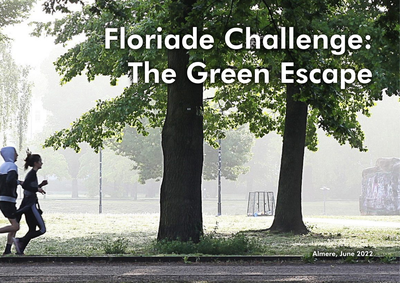
Almere is a green city where the greenery extends into the centre through a framework of nature, forests, parks and canals. With this green environment, Almere fulfils an important condition for a liveable city, where it is pleasant to live and work. An important goal for the municipality is to challenge its residents to develop a healthy lifestyle by using that green framework.But what really motivates Almeerders to go outside to exercise, enjoy the surroundings and meet each other? Are there sufficient green meeting or sports facilities nearby? Could the routes that connect the living and working environment with the larger parks or forests be better designed? And can those routes simultaneously contribute to climate adaptation?With the Green Escape Challenge, we invited students and young professionals to work on these assignments together.
DOCUMENT
In Europe, green hydrogen and biogas/green gas are considered important renewable energy carriers, besides renewable electricity and heat. Still, incentives proceed slowly, and the feasibility of local green gas is questioned. A supply chain of decentralised green hydrogen production from locally generated electricity (PV or wind) and decentralised green gas production from locally collected biomass and biological power-to-methane technology was analysed and compared to a green hydrogen scenario. We developed a novel method for assessing local options. Meeting the heating demand of households was constrained by the current EU law (RED II) to reduce greenhouse gas (GHG) emissions by 80% relative to fossil (natural) gas. Levelised cost of energy (LCOE) analyses at 80% GHG emission savings indicate that locally produced green gas (LCOE = 24.0 €ct kWh−1) is more attractive for individual citizens than locally produced green hydrogen (LCOE = 43.5 €ct kWh−1). In case higher GHG emission savings are desired, both LCOEs go up. Data indicate an apparent mismatch between heat demand in winter and PV electricity generation in summer. Besides, at the current state of technology, local onshore wind turbines have less GHG emissions than PV panels. Wind turbines may therefore have advantages over PV fields despite the various concerns in society. Our study confirms that biomass availability in a dedicated region is a challenge.
DOCUMENT

In order to gain a more mature share in the future energy supply, green gas supply chains face some interesting challenges. In this thesis green gas supply chains, based on codigestion of cow manure and maize, are considered. The produced biogas is upgraded to natural gas quality and injected into the existing distribution gas grid and thus replacing natural gas. Literature research showed that relatively much attention has been paid up to now to elements of such supply chains. Research into digestion technology, agricultural aspects of (energy) crops and logistics of biomass are examples of this. This knowledge is indispensable, but how this knowledge should be combined to help understand how future green gas systems may look like, remains a white spot in the current knowledge. This thesis is an effort to fill this gap. A practical but sound way of modeling green gassupply chains was developed, taking costs and sustainability criteria into account. The way such supply chains can deal with season dependent gas demand was also investigated. This research was further expanded into a geographical model to simulate several degrees of natural gas replacement by green gas. Finally, ways to optimize green gas supply chains in terms of energy efficiency and greenhouse gas reduction were explored.
DOCUMENT

Vegetables have low taste intensities, which might contribute to low acceptance. The aim of this study was to investigate the effect of taste (sweetness, sourness, bitterness, umami, and saltiness) and fattiness enhancement on consumer acceptance of cucumber and green capsicum purees. Three concentrations of sugar, citric acid, caffeine, mono-sodium glutamate, NaCl, and sunflower oil were added to pureed cucumber and green capsicum. Subjects (n = 66,35.6 ± 17.7 y) rated taste and fattiness intensity. Different subjects (n = 100, 33.2 ± 16.5 years) evaluated acceptance of all pureed vegetables. Taste intensities of vegetable purees were significantly different (P < 0.05) between the three tastant concentrations except for umami in both vegetable purees, sourness in green capsicum puree, and fattiness in cucumber puree. Only enhancement of sweetness significantly (P < 0.05) increased acceptance of both vegetable purees compared to unmodified purees. In cucumber purees, relatively small amounts of added sucrose (2%) increased acceptance already significantly, whereas in green capsicum acceptance increased significantly only with addition of 5% sucrose. Enhancement of other taste modalities did not significantly increase acceptance of both vegetable purees. Enhancing saltiness and bitterness significantly decreased acceptance of both vegetable purees. We conclude that the effect of taste enhancement on acceptance of vegetable purees differs between tastants and depends on tastant concentration and vegetable type. With the exception of sweetness, taste enhancement of taste modalities such as sourness, bitterness, umami, and saltiness was insufficient to increase acceptance of vegetable purees. We suggest that more complex taste, flavor, or texture modifications are required to enhance acceptance of vegetables.
DOCUMENT

Overcoming Challenges in local green H2 economies Organizer: Dr Beata Kviatek, Jean Monnet Chair in Sustainable EU Economy, Centre of Expertise Energy / International Business School / Hanze University of Applied Sciences Groningen, the Netherlands One of the main pathways of the current energy transition includes development of regional green hydrogen economy, usually based in the so-called hydrogen valleys. The development of regional green hydrogen economies enables to green up regional industry and mobility, brings new business opportunities for local and regional businesses, redirects regional investments and financial streams, and proposes new avenues for regional education, knowledge, and research institutions. However, the complexity of regional transformation towards green hydrogen economy, poses challenges that require a close cooperation between different local and regional stakeholders at multiple levels, including national and European. What are these challenges in developing regional green hydrogen economies here, in the northern part of the Netherlands, and in other regions of Europe and what are the new pathways to overcome challenges in regional green hydrogen economies? – is the main question of the proposed panel discussion that will involve academics, policy makers, and practitioners from the northern part of the Netherlands as well as some European regions.
DOCUMENT

Cities worldwide are growing at unprecedented rates, compromising their surrounding landscapes, and consuming many scarce resources. As a consequence, this will increase the compactness of cities and will also decrease the availability of urban green space. In recent years, many Dutch municipalities have cut back on municipal green space and itsmaintenance. To offer a liveable environment in 30 to 50 years, cities must face challenges head-on and strive to create green urban areas that build on liveable and coherent sustainable circular subsystems.
DOCUMENT

Green data centres are the talk of the day. But who in fact is involved in developing green data centres? What is their contribution? And what does this contribution constitute in practical terms? This article states which stakeholders are involved in green data centres in the Netherlands, what their involvement is and what effect their involvement has. The article starts by giving the definitions for sustainability and by determining the stakeholders and their possibilities in this field. Next, we examine the actual impact of each stakeholder for arriving at greener data centres. This leads to a number of conclusions for achieving a larger degree of sustainability.
DOCUMENT
This paper describes a project to explore the possibilities of virtual worlds in educating Green IT. In the project a virtual world has been created with various assignments which are meant to create awareness on sustainability aspects of IT. The world (and the assignments) will be incorporated in a course for first-year IT students. In order to measure the effects of the course, a questionnaire has been developed which can be used before and after the course to measure the attitude towards green IT.
DOCUMENT

Author supplied: Within the Netherlands the interest for sustainability is slowly growing. However, most organizations are still lagging behind in implementing sustainability as part of their strategy and in developing performance indicators to track their progress; not only in profit organizations but in higher education as well, even though sustainability has been on the agenda of the higher educational sector since the 1992 Earth Summit in Rio, progress is slow. Currently most initiatives in higher education in the Netherlands have been made in the greening of IT (e.g. more energy efficient hardware) and in implementing sustainability as a competence in curricula. However if we look at the operations (the day to day processes and activities) of Dutch institutions for higher education we just see minor advances. In order to determine what the best practices are in implementing sustainable processes, We have done research in the Netherlands and based on the results we have developed a framework for the smart campus of tomorrow. The research approach consisted of a literature study, interviews with experts on sustainability (both in higher education and in other sectors), and in an expert workshop. Based on our research we propose the concept of a Smart Green Campus that integrates new models of learning, smart sharing of resources and the use of buildings and transport (in relation to different forms of education and energy efficiency). Flipping‐the‐classroom, blended learning, e‐learning and web lectures are part of the new models of learning that should enable a more time and place independent form of education. With regard to smart sharing of resources we have found best practices on sharing IT‐storage capacity among universities, making educational resources freely available, sharing of information on classroom availability and possibilities of traveling together. A Smart Green Campus is (or at least is trying to be) energy neutral and therefore has an energy building management system that continuously monitors the energy performance of buildings on the campus. And the design of the interior of the buildings is better suited to the new forms of education and learning described above. The integrated concept of Smart Green Campus enables less travel to and from the campus. This is important as in the Netherlands about 60% of the CO2 footprint of a higher educational institute is related to mobility. Furthermore we advise that the campus is in itself an object for study by students and researchers and sustainability should be made an integral part of the attitude of all stakeholders related to the Smart Green Campus. The Smart Green Campus concept provides a blueprint that Dutch institutions in higher education can use in developing their own sustainability strategy. Best practices are shared and can be implemented across different institutions thereby realizing not only a more sustainable environment but also changing the attitude that students (the professionals of tomorrow) and staff have towards sustainability.
DOCUMENT

This booklet reports on experiments carried out by Van Hall Larenstein University of Applied Sciences in the context of the VALUE project. It consists of three parts. The first two chapters describe some experiments carried out in the Dutch town of Amersfoort and the students’ input and approach. This is followed by an intermezzo on sources of inspiration outside the Netherlands and examples of the way urban green spaces and elements can provide an impulse for towns and cities. The final two chapters concern the way such a green strategy can be designed in Dutch urban settings. Chapter 5 discusses how local governments can use the added value provided by urban green spaces for new investments:value capturing. Chapter 6 focuses on a new type of planning: Planning by Surprise, which combines dreams and pragmatism. The photo essay at the centre of the book tells the story of the many sides of green spaces in towns and cities. Unintentional, intentional, planned, dreamed of, drawn,remembered, pictured, developed: Planning by Surprise.
DOCUMENT




