High level circular use of post-consumer insulating glass units will contribute to lower the environmental and social impact of insulation glass industry. The application of various circular strategies for insulating glass units (IGU’s) is rising. The product age will give an indication of the remaining life-time of an IGU, but a method which includes screening a technical quality is needed to check if an IGU is indeed suitable for re-use on a high level of circularity. In this study the argon concentration is suggested as discriminative quality. Energy efficient double glazing applied in windows of buildings situated in The Netherlands were studied. Product codes were noted and unraveled. Measurements were performed using the Sparklike Laser Portable, a non-invasive argon measuring device, which generates argon concentration, glass thickness and cavity width values. In addition, measurements were performed with a Glass Check thickness meter. The resulting data were analyzed. Measuring errors were explored and used to setup a testing procedure. Threshold values of the product age and argon concentration were selected for different circular strategies. In conclusion, a screening method using the product age and argon concentration to determine the circular use potential of insulating glass units is proposed.
MULTIFILE

Verouderd isolatieglas eindigt vaak in relatief laagwaardige toepassingen als glaswol of verpakkingsmateriaal. Zonde, als je bedenkt hoeveel energie het kost om glas te maken. De Faculteit Techniek van de Hogeschool van Amsterdam (HvA) onderzoekt samen met bedrijven strategieën voor hergebruik. Onderzoekers Elke van Nieuwenhuijzen en Ed Melet: “We willen prototypes laten zien en bewijzen dat ze toepasbaar en te produceren zijn voor de bouw.”
MULTIFILE
In this article we investigate the change in wetting behavior of inkjet printed materials on either hydrophilic or hydrophobic plasma treated patterns, to determine the minimum obtainable track width using selective patterned μPlasma printing. For Hexamethyl-Disiloxane (HMDSO)/N2 plasma, a decrease in surface energy of approx. 44 mN/m was measured. This resulted in a change in contact angle for water from <10 up to 105 degrees, and from 32 up to 46 degrees for Diethyleneglycol-Dimethaclylate (DEGDMA). For both the nitrogen, air and HMDSO/N2 plasma single pixel wide track widths of approx. 320 μm were measured at a plasma print height of 50 μm. Combining hydrophilic pretreatment of the glass substrate, by UV/Ozone or air μPlasma printing, with hydrophobic HMDSO/N2 plasma, the smallest hydrophilic area found was in the order of 300 μm as well.
DOCUMENT
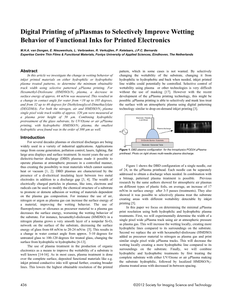
Inkjet printing is a rapidly growing technology for depositing functional materials in the production of organic electronics. Challenges lie among others in the printing of high resolution patterns with high aspect ratio of functional materials to obtain the needed functionality like e.g. conductivity. μPlasma printing is a technology which combines atmospheric plasma treatment with the versatility of digital on demand printing technology to selectively change the wetting behaviour of materials. In earlier research it was shown that with μPlasma printing it is possible to selectively improve the wetting behaviour of functional inks on polymer substrates using atmospheric air plasma. In this investigation we show it is possible to selectively change the substrate wetting behaviour using combinations of different plasmas and patterned printing. For air and nitrogen plasmas, increased wetting of printed materials could be achieved on both polycarbonate and glass substrates. A minimal track width of 320 μm for a 200 μm wide plasma needle was achieved. A combination of N2 with HMDSO plasma increases the contact angle for water up from <100 to 1050 and from 320 to 460 for DEGDMA making the substrate more hydrophobic. Furthermore using N2-plasma in combination with a N2/HMDSO plasma, hydrophobic tracks could be printed with similar minimal track width. Combining both N2 -plasma and N2/HMDSO plasma treatments show promising results to further decrease the track width to even smaller values.
DOCUMENT

With a market demand for low cost, easy to produce, flexible and portable applications in healthcare, energy, biomedical or electronics markets, large research programs are initiated to develop new technologies to provide this demand with new innovative ideas. One of these fast developing technologies is organic printed electronics. As the term printed electronics implies, functional materials are printed via, e.g. inkjet, flexo or gravure printing techniques, on to a substrate material. Applications are, among others, organic light emitting diodes (OLED), sensors and Lab-on-a-chip devices. For all these applications, in some way, the interaction of fluids with the substrate is of great importance. The most used substrate materials for these low-cost devices are (coated) paper or plastic. Plastic substrates have a relatively low surface energy which frequently leads to poor wetting and/or poor adhesion of the fluids on the substrates during printing and/ or post-processing. Plasma technology has had a long history in treating materials in order to improve wetting or promote adhesion. The µPlasma patterning tool described in this thesis combines a digital inkjet printing platform with an atmospheric dielectric barrier discharge plasma tool. Thus enabling selective and local plasma treatment, at atmospheric pressure, of substrates without the use of any masking materials. In this thesis, we show that dependent on the gas composition the substrate surface can either be functionalized, thus increasing its surface energy, or material can be deposited on the surface, lowering its surface energy. Through XPS and ATR-FTIR analysis of the treated (polymer) substrate surfaces, chemical modification of the surface structure was confirmed. The chemical modification and wetting properties of the treated substrates remained present for at least one month after storage. Localized changes in wettability through µPlasma patterning were obtained with a resolution of 300µm. Next to the control of wettability of an ink on a substrate in printed electronics is the interaction of ink droplets with themselves of importance. In printing applications, coalescence of droplets is standard practice as consecutive droplets are printed onto, or close to each other. Understanding the behaviour of these droplets upon coalescence is therefore important, especially when the ink droplets are of different composition and/or volume. For droplets of equal volume, it was found that dye transport across the coalescence bridge could be fully described by diffusion only. This is as expected, as due to the droplet symmetry on either side of the bridge, the convective flows towards the bridge are of equal size but opposite in direction. For droplets of unequal volume, the symmetry across the bridge is no longer present. Experimental analysis of these merging droplets show that in the early stages of coalescence a convective flow from the small to large droplet is present. Also, a smaller convective flow of shorter duration from the large into the small droplet was identified. The origin of this flow might be due to the presence of vortices along the interface of the bridge, due to the strong transverse flow to open the bridge. To conclude, three potential applications were showcased. In the first application we used µPlasma patterning to create hydrophilic patterns on hydrophobic dodecyl-trichlorosilane (DTS) covered glass. Capillaries for a Lab-on-a-chip device were successfully created by placing two µPlasma patterned glass slides on top of each other separated by scotch tape. In the second application we showcased the production of a RFID tag via inkjet printing. Functional RFID-tags on paper were created via inkjet printing of silver nanoparticle ink connected to an integrated circuit. The optimal operating frequency of the produced tags is in the range of 860-865 MHz, making them usable for the European market, although the small working range of 1 m needs further improvement. Lastly, we showed the production of a chemresistor based gas sensor. In house synthesised polyemeraldine salt (PANi) was coated by hand on top of inkjet printed silver electrodes. The sensor proved to be equally sensitive to ethanol and water vapour, reducing its selectivity in detecting changes in gas composition.
DOCUMENT

Paper which introduces an method developed by the research group Duurzame Projectontwikkeling of the SIA-RAAK project Energieke Restauratie. Besides an discription of the method, it also describes the application of the method for three (fictional) case study projects: Dairy Factory Dongeradelen (Lioessens), Strawboard Factory Free (Oude Pekela) and Der Aa church (Groningen).
DOCUMENT

Sporen uit het verleden zijn het waard bewaard te wordenvoor volgende generaties!In het onderzoeksproject Energieke Restauratie (2011-2013)van het kenniscentrum NoorderRuimte istwee jaar onderzoek gedaan naar restauratie, energieconceptenen herontwikkeling van historische gebouwen. Dit project,gefinancierd door SIA-RAAK, werd uitgevoerd in samenwerkingmet vele bedrijven en instellingen in Noord-Nederland.Energieke Restauratie verwijst naar een integrale aanpak vanbehoud en vernieuwing in historische gebouwen, met eenhoge ambitie voor energiebesparing.Een ‘Energieke Restauratie’ begint met het herkennen vanwensen en randvoorwaarden in het vooronderzoek. Zo wordtbij het ontwerp rekening gehouden met historische waarden,energie, en gebruikerswensen. Uiteraard wordt er bij derestauratie van een historisch gebouw veel aandacht besteedaan effecten op de lange termijn, bijvoorbeeld voor hetvoorkomen van schade aan historische materialen, flexibiliteitvoor (toekomstig) gebruik, energielasten en gebruikscomfort.Op 19 september 2013 vond de afsluitende internationaleconferentie ERIC2013 plaats in Groningen. Met trots bieden wiju nu het magazine Energieke Restauratie aan, waarin u korteweergaves vindt van de presentaties op ERIC2013, voornamelijkin het Engels. Bovendien zijn de volledige artikelen van veledeelnemers aan de conferentie opgenomen.Verder vindt u een beknopt overzicht van alle uitgevoerde casestudies van Energieke Restauratie.Tot slot bedanken wij iedereen die heeft bijgedragen aan detotstandkoming van dit magazine: de schrijvers van de artikelen,de vormgever en uiteraard de sponsors die het drukken van ditmagazine mogelijk hebben gemaakt.
DOCUMENT

Light therapy is increasingly administered and studied as a non-pharmacologic treatment for a variety of healthrelated problems, including treatment of people with dementia. Light therapy comes in a variety of ways, ranging from being exposed to daylight, to being exposed to light emitted by light boxes and ambient bright light. Light therapy is an area in medicine where medical sciences meet the realms of physics, engineering and technology. Therefore, it is paramount that attention is paid in the methodology of studies to the technical aspects in their full breadth. This paper provides an extensive introduction for non-technical researchers on how to describe and adjust their methodology when involved in lighting therapy research. A specific focus in this manuscript is on ambient bright light, as it is an emerging field within the domain of light therapy. The paper deals with how to (i) describe the lighting equipment, (ii) describe the light measurements, (iii) describe the building and interaction with daylight. Moreover, attention is paid to the uncertainty in standards and guidelines regarding light and lighting for older adults.
DOCUMENT

In this paper we investigate laypersons’ valuation of historic buildings, their experiences of thermal comfort in those buildings and contrast this with their views on the appropriateness of energy efficiency measures. This paper presents four case studies of medieval churches in Groningen, Netherlands. Valuation studies is used to investigate the values that are attached to historic buildings by various stakeholders. We apply the ‘heritage as a spatial vector’ approach, to position heritage in relation to developments in society and the landscape. Our theoretical contribution lies in the combination of heritage approaches and valuation studies. We conclude that for a more balanced assessment of historic buildings, laypersons’ valuations should be further integrated in heritage studies.
DOCUMENT

Electrohydrodynamic atomization (EHDA) is a technique which uses the influence of strong electric fields to manipulate the break-up of a liquid, pumped through a capillary nozzle, into droplets. In this work, an extended description of a specific high flow EHDA mode, known as the simple-jet mode, is presented. In it, a review of different works published about the mode is presented as well as results about the droplet population generated with varicose and whipping break-up using water as the atomized liquid. Additionally, experiments were conducted to investigate whether such atomization method could be used to improve the efficiency of droplet inair evaporation, using a single effect evaporation chamber coupled with a EHDA multinozzle system functioning as a shower head. The liquid used in these experiments was a solution of water and NaCl (35 g L−1) to simulate sea water average concentrations. The results have shown that, the manipulation of the droplet diameter, droplet size distribution and spray angle, provided by EHDA, could improve the droplet evaporation efficiency by up to 40% when combinedwith, e.g. forced convection and higher inlet temperatures.
DOCUMENT




