This study explored associations between perceived neighborhood walkability and neighborhood-based physical activity (NB-PA) and assessed possible moderation effects of the amount of time spent in the home neighborhood and individual characteristics (i.e., educational level and health-related problems). In 2016 to 2017, 509 Dutch adults, living in the South Limburg area, were included. Context-specific PA levels were measured using the Actigraph GT3X+ accelerometer and the Qstarz BTQ1000XT GPS-logger. Perceived neighborhood walkability, level of education, work status, and health-related quality of life were measured with validated self-report instruments. Results showed that individuals with a lower level of education or health-related problems spent more time in the home neighborhood. The perceived neighborhood walkability only affected NB-PA for individuals spending a relatively large amount of time in their home neighborhood. PA-facilitating features in the home neighborhood, for example, aesthetics, were only associated with more NB-PA for individuals without health-related problems or with a higher level of education.
DOCUMENT
Like many countries, the COVID-19 pandemic has forced Statistics Netherlands to make changes in its fieldwork strategy. Since mid-March 2020, there have been limited opportunities to conduct face-to-face interviews. Therefore, from September 2020, CAPI sampled people are offered the opportunity to respond by telephone. For this purpose, face-to-face interviewers are instructed to persuade the potential respondent at the doorway. When people refuse a face-to-face interview, interviewers ask for a telephone number and try to make an appointment to conduct the interview by telephone. The aim of our study was to investigate the effects of conducting the interview by telephone instead of face-to-face on important survey outcome variables. We were particularly interested in whether differences are due to selection effects or caused by mode-specific measurement errors. Because we did not have the time or capacity to set up a controlled experiment, we performed regression analyses to decompensate the differences between selection effects and mode-specific measurement errors. We used data of the Labour Force Survey (LFS) and the Housing Survey (WoON). Our analysis showed that there were differences in important target variables, for both LFS and WoON. These differences were, however, mainly caused by selection effects – which can be taken into account for during weighting – and were less likely to be caused by mode specific measurement errors. Although there are important limitations and caveats, these findings are supportive to further implement this field strategy.
DOCUMENT

If parents perceive the neighborhood as child friendly, they will allow their children more independent travel and play. Parental perception of child friendliness is therefore an important prerequisite for designing neighborhoods that promote children's health and wellbeing. However, there is currently no comprehensive and practical instrument to measure it. This study develops and empirically validates a measurement instrument for parental perception of child friendliness in neighborhoods. Survey data was collected from 309 parents in the Netherlands. The data was randomly divided into a calibration (n = 155) and a validation sample (n = 154). The factorial validity of parental perception of child friendliness in neighborhoods was examined using exploratory and confirmatory factor analysis. The construct validity was tested by using structural equation modelling (SEM) of assumed relationships between parental perception of child friendliness in neighborhoods and variables influencing this perception (antecedents) and children's physical activity (consequence). Overall, the results provided good reliability and validity for the instrument. This instrument does not only offer a practical tool; it also provides practical guidelines for designing child-friendly neighborhoods as perceived by parents. It suggests that measures, such as providing green spaces, care facilities and recreation facilities, can enhance child friendliness of neighborhoods as perceived by parents.
LINK
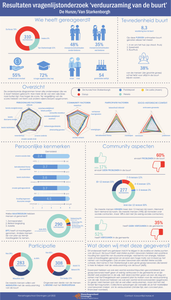
Grafische samenvatting van de onderzoeksresultaten.
DOCUMENT
Objective reduction of physical activity (PA) during pregnancy is common but undesirable, as it is associated with negative outcomes, including excessive gestational weight gain. Our objective was to explore changes in five types of activity that occurred during pregnancy and the behavioural determinants of the reported changes in PA. Design we performed a secondary analysis of a cross sectional survey that was constructed using the ASE-Model – an approach to identifying the factors that drive behaviour change that focuses on Attitude, Social influence, and self-Efficacy. Participants 455 healthy pregnant women of all gestational ages, receiving prenatal care from midwifery practices in the Netherlands. Findings more than half of our respondents reported a reduction in their PA during pregnancy. The largest reduction occurred in sports and brief rigorous activities, but other types of PA were reduced as well. Reduction of PA was more likely in women who considered themselves as active before pregnancy, women who experienced pregnancy-related barriers, women who were advised to reduce their PA, and multiparous women. Fewer than 5% increased their PA. Motivation to engage in PA was positively associated with enjoying PA. Key conclusions and implications for practice all pregnant women should be informed about the positive effects of staying active and should be encouraged to engage in, or to continue, moderately intensive activities like walking, biking or swimming. Our findings concerning the predictors of PA reduction can be used to develop an evidence-based intervention aimed at encouraging healthy PA during pregnancy.
MULTIFILE

An activity-friendly environment may increase physical activity (PA) levels and decrease sedentary behavior (SB). This study investigated associations between socio-demographic characteristics, health-related quality of life (HRQoL), perceived environment and objectively measured PA outcomes. Socio-demographic characteristics were assessed using a questionnaire and HRQoL was measured using the EQ-5D. The Neighborhood Environment Walkability Scale (NEWS-A) was used to assess the perceived environment. SB, light PA (LPA) and moderate-to-vigorous PA (MVPA) were measured using the Actigraph GT3X+. Data from 622 Dutch adults were used in multivariate linear regression analyses to investigate associations between NEWS-A and PA outcomes. Analyses were controlled for socio-demographic characteristics and HRQoL. The presence of attractive buildings was associated with less SB ( = ?0.086, p < 0.01) and more MVPA ( = 0.118, p < 0.01). Presence of destinations within walking distance was also positively associated with MVPA ( = 0.106, p < 0.01). Less crime was associated with less MVPA ( = 0.092, p < 0.05). Interactions between personal and environmental characteristics showed that the absence of PA-hindering characteristics (e.g., heavy traffic) was associated with less SB and more MVPA, but only for residents with problems regarding pain and usual activities. The presence of PA-facilitating characteristics (e.g., aesthetics and destinations) was associated with less SB, more LPA and more MVPA but only for the more advantaged people in society. Results suggest that to reduce health inequalities, it would be more helpful to remove barriers rather than introduce PA facilitating characteristics.
DOCUMENT

Although the prevalence of cybercrime has increased rapidly, most victims do not report these offenses to the police. This is the first study that compares associations between victim characteristics and crime reporting behavior for traditional crimes versus cybercrimes. Data from four waves of a Dutch cross-sectional population survey are used (N = 97,186 victims). Results show that cybercrimes are among the least reported types of crime. Moreover, the determinants of crime reporting differ between traditional crimes and cybercrimes, between different types of cybercrime (that is, identity theft, consumer fraud, hacking), and between reporting cybercrimes to the police and to other organizations. Implications for future research and practice are discussed. doi: https://doi.org/10.1177/1477370818773610 This article is honored with the European Society of Criminology (ESC) Award for the “Best Article of the Year 2019”. Dit artikel is bekroond met de European Society of Criminology (ESC) Award for the “Best Article of the Year 2019”.
MULTIFILE

If you, as a municipality or waste collector, you want to learn more abouthow residents view to the separation of organic waste and at the same timeencourage them to separate their organic waste (better), then the infosurveymay be an interesting solution. This is a survey and behavioural interventionin one. The infosurvey can be used in a neighborhood where organic wastecan be separated.
DOCUMENT

The goal of a local energy community (LEC) is to create a more sustainable, resilient, and efficient energy system by reducing dependence on centralized power sources and enabling greater participation and control by local communities and individuals. LEC requires transformations in local energy systems, and strongly depends on the preferences and actions of the local actors involved. The necessity for extensive stakeholder involvement adds complexity to the energy transition, posing a significant challenge for all involved parties. The municipality of Leidschendam-Voorburg has committed to the national decision for energy transition. It has taken a strategic approach by proceeding De Heuvel/Amstelwijk as the pioneer in this initiative, leading the way for other neighborhoods to follow. It is crucial to devise strategies that effectively facilitate stakeholder engagement. To this end, a thorough stakeholder analysis is needed. Such an analysis can focus on the identification of key stakeholders, their interests, their influence, and their behavioral characteristics in relation to the energy transition. Additionally, it's crucial to uncover the challenges encountered by these stakeholders and finally develop appropriate strategies to address them hence enhance their engagement. This thesis begins with an introduction to the research background, including a presentation of the case study and a statement of the problem identified in the field, followed by the research questions underpinning the study. A thorough literature review ensues, providing a robust synthesis of existing research relating to stakeholder engagement in LECs, with a view to expediting energy transitions. The literature review not only forms the foundation for the research methods adopted in this study but also promotes in the construction of the conceptual model. Subsequent to the literature review, the research method is detailed. The filed research is conducted in five steps: Step 1 - identification of stakeholders, Step 2 - prioritization of stakeholders, Step 3 - interviewing, Step 4 - data analysis, including stakeholder profiling with mapping and addressing challenges, and finally, Step 5 - proposal of strategies for stakeholder engagement enhancement based on the expected and current levels of stakeholders engagement. This research collects necessary information to understand the profiles of stakeholders in De Heuvel/Amstelwijk, tackle challenges faced by different stakeholders, propose strategies to increase stakeholders engagement. It not only aims to enrich the depth of theoretical knowledge on the subject matter but also strives to aid in the development of a localized energy strategy that is optimally suited for the De Heuvel/Amstelwijk neighborhood as good example for other neighborhoods.
DOCUMENT

Background: While the interest of health promotion researchers in change methods directed at the target population has a long tradition, interest in change methods directed at the environment is still developing. In this survey, the focus is on methods for environmental change; especially about how these are composed of methods for individual change ('Bundling') and how within one environmental level, organizations, methods differ when directed at the management ('At') or applied by the management ('From'). Methods: The first part of this online survey dealt with examining the 'bundling' of individual level methods to methods at the environmental level. The question asked was to what extent the use of an environmental level method would involve the use of certain individual level methods. In the second part of the survey the question was whether there are differences between applying methods directed 'at' an organization (for instance, by a health promoter) versus 'from' within an organization itself. All of the 20 respondents are experts in the field of health promotion. Results: Methods at the individual level are frequently bundled together as part of a method at a higher ecological level. A number of individual level methods are popular as part of most of the environmental level methods, while others are not chosen very often. Interventions directed at environmental agents often have a strong focus on the motivational part of behavior change. There are different approaches targeting a level or being targeted from a level. The health promoter will use combinations of motivation and facilitation. The manager will use individual level change methods focusing on self-efficacy and skills. Respondents think that any method may be used under the right circumstances, although few endorsed coercive methods. Conclusions: Taxonomies of theoretical change methods for environmental change should include combinations of individual level methods that may be bundled and separate suggestions for methods targeting a level or being targeted from a level. Future research needs to cover more methods to rate and to be rated. Qualitative data may explain some of the surprising outcomes, such as the lack of large differences and the avoidance of coercion. Taxonomies should include the theoretical parameters that limit the effectiveness of the method.
DOCUMENT




