Adaptive survey design has attracted great interest in recent years, but the number of case studies describing actual implementation is still thin. Reasons for this may be the gap between survey methodology and data collection, practical complications in differentiating effort across sample units and lack of flexibility of survey case management systems. Currently, adaptive survey design is a standard option in redesigns of person and household surveys at Statistics Netherlands and it has been implemented for the Dutch Health survey in 2018. In this article, the implementation of static adaptive survey designs is described and motivated with a focus on practical feasibility.
DOCUMENT

It is essential to consider the social context when designing sustainable energy systems that lead to successful implementation in neighbourhoods. Current methods often only consider techno-economic aspects and are insufficiently capable of including social factors, because they are unclear about which social factors are relevant and how they can be quantified. This paper explores how neighbourhoods can be characterized socially by studying pre-existing neighbourhood characteristics, focussed on socio-economic status and social cohesion. The paper is built around four case-studies in the Netherlands, which are analysed both quantitatively and qualitatively. The paper shows how the social context can be defined by 1) proposing a theoretical framework of social factors, 2) quantifying these social factors by survey research, 3) interpretating this data using qualitative casestudy data and 4) quantifying success in the cases and relating this to the scores of the survey data. The results of this explorative study will 1) show how a social profile can be used to find leads for a participative approach towards sustainable neighbourhoods where techno-economic solutions are well embedded in the social context and 2) help to understand and predict success of participation in communities.
DOCUMENT
As an active member of the Global Network for Age-Friendly Cities and Communities, The Hague has been monitoring the progress over the years. In 2022, a second cross-sectional survey based on the Age Friendly Cities and Communities Questionnaire (AFCCQ) was conducted among 396 community-dwelling older citizens in the municipality. During times of the pandemic, scores for Social Participation went notably down, and scores for Respect and Social Inclusion increased. For the first time, based on survey data, four personas were found through cluster analysis. These personas ranged from the precariat and people with personal health issues with lower scores, to the silent majority without the limitations of health problems, and the upper echelon who score positively in all domains. Age-friendly policies in The Hague should focus particularly on the first two clusters through dedicated action plans, which would help steer efforts towards those most in need for support. This would help The Hague to become an age-friendly city for all, and not only for those living in good health and with sufficient financial means.
MULTIFILE

The municipality of The Hague has been a member of the WHO's Global Network for Age-Friendly Cities and Communities since 2015. The municipality commissioned a survey to investigate how older citizens view the age-friendliness of their city. A cross-sectional survey was conducted among a diverse sample of 393 community-dwelling older citizens. The survey made use of the Age Friendly Cities and Communities Questionnaire (AFCCQ), and multilevel regression techniques to investigate how social groups differ on the domains of the AFCCQ. The Hague scored a satisfied as an overall score (16.9 ± 8.87), and a satisfied on social participation (2.6 ± 2.46), civic participation and employment (1.4 ± 1.34), communication and information (1.4 ± 1.32), respect and social inclusion (1.6 ± 1.59), community support and health services (2.7 ± 2.79), transportation (1.7 ± 1.26) and financial situation (1.9 ± 1.26). The Hague has an above-average score in the field of housing (2.4 ± 1.06). For Outdoor spaces and buildings, the municipality scores a moderate positive score (0.9 ± 1.41). Significant differences were found for sex, age, socio-economic position, receiving care support, and use of mobility aids. The findings show that older people have different perceptions regarding their city's age-friendliness. Policy makers must acknowledge this heterogeneity among their older citizens and adapt city policies accordingly. CC-BY Original article: https://doi.org/10.1016/j.cities.2022.103568 https://www.dehaagsehogeschool.nl/onderzoek/lectoraten/details/urban-ageing#over-het-lectoraat
MULTIFILE

Lower levels of news use are generally understood to be associated with less political engagement among citizens. But while some people simply have a low preference for news, others avoid the news intentionally. So far little is known about the relationship between active news avoidance and civic engagement in society, a void this study has set out to fill. Based on a four-wave general population panel survey in the Netherlands, conducted between April and July 2020 (N = 1,084) during a crisis situation, this research-in-brief investigates the development of news avoidance and pro-social civic engagement over time. Results suggest that higher news topic avoidance results in higher levels of civic engagement. The study discusses different explanations for why less news can mean more engagement.
DOCUMENT

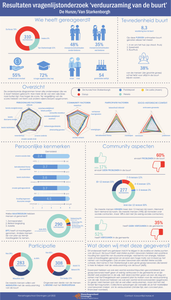
Grafische samenvatting van de onderzoeksresultaten.
DOCUMENT
Post-war urban neighbourhoods in industrialised countries have been shown to negatively affect the lifestyles of their residents due to their design. This study aims at developing an empirical procedure to select locations to be redesigned and the determinants of health at stake in these locations, with involvement of residents’ perspectives as core issue. We addressed a post-war neighbourhood in the city of Groningen, the Netherlands. We collected data from three perspectives: spatial analyses by urban designers, interviews with experts in local health and social care (n = 11) and online questionnaires filled in by residents (n = 99). These data provided input for the selection of locations to be redesigned by a multidisciplinary team (n = 16). The procedure yielded the following types of locations (and determinants): An area adjacent to a central shopping mall (social interaction, traffic safety, physical activity), a park (experiencing green, physical activity, social safety, social interaction) and a block of low-rise row houses around a public square (social safety, social interaction, traffic safety). We developed an empirical procedure for the selection of locations and determinants to be addressed, with addressing residents’ perspectives. This procedure is potentially applicable to similar neighbourhoods internationally.
DOCUMENT

In Amsterdam, the phenomenon of overcrowding is increasing, and tourism is one of the causes. Both the public debate and the municipal authorities are pointing to an increasing need for more expertise and knowledge regarding ways of achieving a healthy balance for various stakeholders. This article focuses on the stakeholder role of city residents and discusses their attitudes to tourists and tourism-related developments in their own neighbourhood and in the rest of the city. The term “attitude” can be divided into three components: feeling, behaviour and thinking. The results of this study are based on both quantitative and qualitative fieldwork (surveys and semi-structured interviews) and on desk research. It can be concluded that, for the most part, residents have a positive attitude to tourists and tourism. Differences in attitude are mostly determined by the city district where respondents live and by personal feelings and thinking. Follow-up research in the coming years will examine the complexity of the issue of overcrowding in more depth.
DOCUMENT

The World Health Organization engages cities and communities all over the world in becoming age-friendly. There is a need for assessing the age-friendliness of cities and communities by means of a transparently constructed and validated tool which measures the construct as a whole. The aim of this study was to develop a questionnaire measuring age-friendliness, providing full transparency and reproducibility. The development and validation of the Age Friendly Cities and Communities Questionnaire (AFCCQ) followed the criteria of the COnsensus-based Standards for selection of health Measurement INstruments (COSMIN). Four phases were followed: (1) development of the conceptual model, themes and items; (2) initial (qualitative) validation; (3) psychometric validation, and (4) translating the instrument using the forward-backward translation method. This rigorous process of development and validation resulted in a valid, psychometrically sound, comprehensive 23-item questionnaire. This questionnaire can be used to measure older people’s experiences regarding the eight domains of the WHO Age-Friendly Cities model, and an additional financial domain. The AFCCQ allows practitioners and researchers to capture the age-friendliness of a city or community in a numerical fashion, which helps monitor the age-friendliness and the potential impact of policies or social programmes. The AFCCQ was created in Dutch and translated into British-English. CC-BY Original article: https://doi.org/10.3390/ijerph17186867 (This article belongs to the Special Issue Feature Papers "Age-Friendly Cities & Communities: State of the Art and Future Perspectives") https://www.dehaagsehogeschool.nl/onderzoek/lectoraten/details/urban-ageing#over-het-lectoraat Extra: Vragenlijst bijlage / Questionnaire attachement
MULTIFILE

Ecological Pedagogy is the “Pedagogy of the whole”. It assumes a continuous interaction between the individual and his or her environment (e.g. Bronfenbrenner (1977)). Traditionally, Pedagogy has been aimed at separate aspects, such as the school, the family, the neighbourhood or government policies. By contrast, Ecological Pedagogy is characterised by an integral approach. The perspectives of children, parents, educators and other stakeholders are in the middle and are approached by taking into account all their important interrelations. In this essay, a plea ismade for a broad research perspective in Ecological Pedagogy in which qualitative and quantitative methods are treated by addressing their similarities rather than their differences.
DOCUMENT




