The combination of self-tracking and persuasive eCoaching in healthy lifestyle interventions is a promising approach. The objective of this study is to map the key components of existing healthy lifestyle interventions combining self-tracking and persuasive eCoaching using the scoping review methodology in accordance with the York methodological framework by Arksey and O’Malley. Seven studies were included in this preliminary scoping review. Components related to persuasive eCoaching applied only in effective interventions were reduction of complex behavior into small steps, providing positive motivational feedback by praise and providing reliable information to show expertise. Concerning self-tracking, it did not seem to matter if more action was required by the participant to obtain personal data. The first results of this study indicate the necessity to identify the needs and problems of the specific target group of the interventions, due to differences found between various groups of users. In addition to objective data on lifestyle and health behavior, other factors need to be taken into account, such as the context of use, daily experiences, and feelings of the users.
DOCUMENT

Background: The combination of self-tracking and persuasive eCoaching in automated interventions is a new and promising approach for healthy lifestyle management. Objective: The aim of this study was to identify key components of self-tracking and persuasive eCoaching in automated healthy lifestyle interventions that contribute to their effectiveness on health outcomes, usability, and adherence. A secondary aim was to identify the way in which these key components should be designed to contribute to improved health outcomes, usability, and adherence. Methods: The scoping review methodology proposed by Arskey and O'Malley was applied. Scopus, EMBASE, PsycINFO, and PubMed were searched for publications dated from January 1, 2013 to January 31, 2016 that included (1) self-tracking, (2) persuasive eCoaching, and (3) healthy lifestyle intervention. Results: The search resulted in 32 publications, 17 of which provided results regarding the effect on health outcomes, 27 of which provided results regarding usability, and 13 of which provided results regarding adherence. Among the 32 publications, 27 described an intervention. The most commonly applied persuasive eCoaching components in the described interventions were personalization (n=24), suggestion (n=19), goal-setting (n=17), simulation (n=17), and reminders (n=15). As for self-tracking components, most interventions utilized an accelerometer to measure steps (n=11). Furthermore, the medium through which the user could access the intervention was usually a mobile phone (n=10). The following key components and their specific design seem to influence both health outcomes and usability in a positive way: reduction by setting short-term goals to eventually reach long-term goals, personalization of goals, praise messages, reminders to input self-tracking data into the technology, use of validity-tested devices, integration of self-tracking and persuasive eCoaching, and provision of face-to-face instructions during implementation. In addition, health outcomes or usability were not negatively affected when more effort was requested from participants to input data into the technology. The data extracted from the included publications provided limited ability to identify key components for adherence. However, one key component was identified for both usability and adherence, namely the provision of personalized content. Conclusions: This scoping review provides a first overview of the key components in automated healthy lifestyle interventions combining self-tracking and persuasive eCoaching that can be utilized during the development of such interventions. Future studies should focus on the identification of key components for effects on adherence, as adherence is a prerequisite for an intervention to be effective.
DOCUMENT

Self-tracking and automated persuasive eCoaching combined in a smartphone application may enhance stress management among employees at an early stage. For the application to be persuasive and create impact, we need to achieve a fit between the design and end-users’ and important stakeholders’ values. Semi-structured interviews were conducted among 8 employees and 8 human resource advisors to identify values of self-tracking, persuasive eCoaching, and preconditions (e.g., privacy and implementation) for a stress management application, using the value proposition design by Osterwalder et al. Results suggest essential features and functionalities that the application should possess. In general, respondents see potential in combining self-tracking and persuasive eCoaching for stress management via a smartphone application. Future design of the application should mainly focus on gaining awareness about the level of stress and causes of stress. In addition, the application should possess a positive approach besides solely the focus on negative aspects of stress.
DOCUMENT
There is a growing number of eHealth interventionsaiming at enhancing lifestyle to address obesity. However, theexisting interventions do not take the emotional aspects ofobesity into account. Forty percent of the overweight populationis an emotional eater. Emotional eaters gain weight because ofpoor emotion regulation, not just due to bad eating habits. Weaim at developing a personalised virtual coach ‘Denk je zèlf!’providing support for self-regulation of emotions for obeseemotional eaters. This paper presents a research study protocolon validating persuasive coaching strategies in emotionregulation, based on Dialectical Behaviour Therapy, ultimatelytargeting behaviour change. Our goal is to design a personalisedeCoaching framework, allowing us to optimally translatesuccessful behaviour change mechanisms and techniques, suchas dialectical strategies, into personalised persuasive coachingstrategies.
LINK
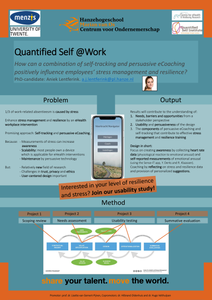
De poster is gepresenteerd tijdens het congres Healthy Work, Good for Business, Health Hub Roden op 29 april 2016. De poster presenteert het promotietraject waarbinnen wearable technology en persuasive eCoaching worden gecombineerd om duurzame inzetbaarheid onder werknemers te bevorderen. Wearable technology meet gezondheidsgedrag van de werknemer automatisch en objectief. De koppeling met persuasive eCoaching zorgt voor persoonlijk relevante feedback op het gemeten gezondheidsgedrag.
DOCUMENT

There is a growing number of eHealth interventionsaiming at enhancing lifestyle to address obesity. However, theexisting interventions do not take the emotional aspects ofobesity into account. Forty percent of the overweightpopulation is an emotional eater. Emotional eaters gain weightbecause of poor emotion regulation, not just due to bad eatinghabits. We aim at developing a personalized virtual coach‘Denk je zèlf!’ providing support for self-regulation ofemotions for young obese emotional eaters. This paperpresents an eCoaching model and a research study protocolaiming at the validation of persuasive coaching strategies basedon behavior change techniques. Ultimately, we aim atdesigning a personalized eCoaching framework, allowing us tooptimally translate successful behavior change mechanismsand techniques, such as dialectical strategies, into personalizedpersuasive coaching strategies.
DOCUMENT

The development of eHealth applications requires a new methodological approach, departing from the more conventional methods dedicated to designing health information systems. There is a gap between theories to design persuasive eHealth applications and practices. We consequently advocate an integrated, systematic and practical but scientifically based methodology to design effective persuasive eHealth applications. This approach is being successfully embedded in our educational health informatics program.
DOCUMENT

Obesity has become a major societal problem worldwide [1][2]. The main reason for severe overweight is excessive intake of energy, in relation to the individual needs of a human body. Obesity is associated with poor eating habits and/or a sedentary lifestyle. A significant part of the obese population (40%) belongs to a vulnerable target group of emotional eaters, who overeat due to negative emotions [3]. There is a need for self-management support and personalized coaching to enhance emotional eaters in recognising and self-regulating their emotions.Over the last years, coaching systems have been developed for behavior change support, healthy lifestyle, and physical activity support [4]-[9]. Existing virtual coach applications lack systematic evaluation of coaching strategies and usually function as (tele-)monitoring systems. They are limited to giving general feedback to the user on achieved goals and/or accomplished (online) assignments.Dialectical Behavior Therapy (DBT) focuses on getting more control over one’s ownemotions by reinforcing skills in mindfulness, emotion regulation, and stress tolerance [10]. Emotion regulation is about recognizing and acknowledging emotions and accepting the fact that they come and go. The behavior change strategies within DBT are based on validation and dialectics [11]. Dialectics changes the users’ attitude and behavior by creating incongruence between an attitude and behavior since stimuli or the given information contradict with each other.The ultimate goal of the virtual coach is to raise awareness of emotional eaters on their own emotions, and to enhance a positive change of attitude towards accepting the negative emotions they experience. This should result in a decrease of overeating and giving in to binges. We believe that the integration of the dialectical behavior change strategies and persuasive features from the Persuasive System Design Model by Kukkonen and Harjumaa [12] will enhance the personalization of the virtual coach for this vulnerable group. We aim at developing a personalized virtual coach ‘Denk je zèlf!’ (Dutch for ‘Develop a wise mind and counsel yourself’) providing support for self-regulation of emotions for young obese emotional eaters. This poster presents an eCoaching model and a research study protocol aiming at the validation of persuasive coaching strategies based on behavior change techniques using dialectical strategies. Based on the context (e.g., location), emotional state of the user, and natural language processing, the virtual coach application enables tailoring of the real-time feedback to the individual user. Virtual coach application communicates with the user over a chat timeline and provides personal feedback.The research protocol decribes the two weeks field study on validating persuasive coaching strategies for emotional eaters. Participants (N=30), recruited via a Dutch franchise organization of dietitian nutritionists, specialized in treating emotional eating behaviors, will voluntarily participate in this research study. Participants will be presented with short dialogues (existing questions and answers) and will be asked to select the preferred coaching strategy (validating or a dialectical), according to their (current) emotions. To trigger a certain emotion (e.g., the affect that fits best with the chosen coaching strategy), a set of pictures will be shown to the user that evoke respectively sadness, anger, fear, and disgust [13].Participants will be asked to fill out the demographics data ((nick) name, age, gender, weight, length, place of residence) and three questionnaires: • Dutch Eating Behavior Questionnaire (DEBQ) [14],• Five Factor Personality Inventory (FFPI) [15], • Quality of Life Index Questionnaire [16].This research study aims at answering the following research questions: “Which coaching strategies do users with a specific type of emotional eating behavior benefit most from while consulting their personalized virtual coach?; “Which coaching strategies are optimal for which emotions?” and “Which coaching approach do users prefer in which context, e.g. time of the day, before/after a craving?”
LINK
Aniek Lentferink is currently conducting a PhD research project called Quantified Self @Work, a collaboration between Quantified Self Institute, Hanze UAS, the University of Twente, and Menzis. The goal of this research is to develop an intervention in which sensor technology and persuasive eCoaching are combined to increase sustainable employability of employees by improving their stress management. Aniek has written a blog about her experiences in this project so far.
DOCUMENT