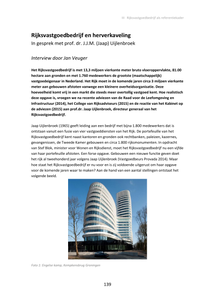
Het Rijksvastgoedbedrijf is met 13,3 miljoen vierkante meter bruto vloeroppervlakte, 81.00 hectare aan gronden en met 1.760 medewerkers de grootste (maatschappelijk) vastgoedeigenaar in Nederland. Het Rijk moet in de komende jaren circa 3 miljoen vierkante meter aan gebouwen afstoten vanwege een kleinere overheidsorganisatie. Deze hoeveelheid komt vrij in een markt die steeds meer overtollig vastgoed kent. Hoe realistisch deze opgave is, vroegen we na recente adviezen van de Raad voor de Leefomgeving en Infrastructuur (2014), het College van Rijksadviseurs (2015) en de reactie van het Kabinet op de adviezen (2015) aan prof.dr. Jaap Uijlenbroek, directeur generaal van het Rijksvastgoedbedrijf.
DOCUMENT
In dit artikel zal getoetst worden of de WOZ-waarde valide en betrouwbaar is als marktwaarde-indicator van de vastgoedportefeuilles van het Rijksvastgoedbedrijf (RVB). De belangrijkste bijdrage van onderhavig onderzoek is dat uit de uitkomsten van het empirische onderzoek blijkt dat er in het kader van de Wet WOZ sprake is van een significante overwaardering ten opzichte van de marktwaarde (transactieprijs). Gemeenten hebben moeite om de WOZ-waarden van de objecten zoals die in de vastgoedportefeuilles van het Rijk voorkomen, correct vast te stellen. Zeker gezien de bredere toepassing van de WOZ-waarde kan dit onderzoek aanleiding zijn tot een hernieuwde afweging van het gebruik, met name waar het minder courant vastgoed betreft.
DOCUMENT

Na de diverse thematieken van de afgelopen jaren Trends en ontwikkelingen in maatschappelijk vastgoed (2011), Onderzoeken en visie (2012), Onderzoeken en perspectieven op maatschappelijk en financieel rendement (2013) en Maatschappelijk Verantwoord Ondernemen (2014) kunnen we de scope van de 8e Barometer Maatschappelijk vastgoed verbreden. Dit hebben we gedaan door (inter)nationaal te kijken naar onderzoek over en ontwikkelingen van maatschappelijk vastgoed en in het bijzonder gemeentelijk vastgoed en zorgvastgoed. Deze internationale ontwikkeling van de Barometer Maatschappelijk Vastgoed wordt door actoren in en rondom maatschappelijk vastgoed gezien als interessant, actueel en belangrijk. Met deze stap van de Barometer beoog ik om vanuit andere contexten en culturen - door bijdragen over andere landen en met buitenlandse auteurs - te kijken naar ons eigen maatschappelijk vastgoed in Nederland en inzicht te geven in de problematiek en oplossingsrichtingen van gemeentelijk vastgoed en zorgvastgoed. Daarbij is een herverkaveling van vastgoedbelangen een gedachtegang voor de toekomst. De internationalisering wordt ook onderschreven door de RICS die wereldwijd actief is vanuit New York, Sao Paulo, London, Brussel, Dubai, New Delhi, Singapore, Hong Kong, Tokyo, Beijing en Sydney. Afgelopen jaar zijn er nog een aantal andere (internationale) ontwikkelingen geweest. Zo verscheen eind 2014 mijn proefschrift Materieel Immaterieel: besturing van woningcorporaties in samenhang met maatschappelijk vastgoed vanuit de RSM Erasmus Universiteit Rotterdam (RSM/EUR), één van Europa’s top business scholen voor het onderwijs en in de top 3 voor toponderzoek. Vanuit het lectoraat zijn we ook een structurele samenwerking met Odisee Hogeschool en Universiteit Brussel aangegaan. Het internationale karakter van het lectoraat in 2015 wordt naast het verschijnen van dit boek ook onderstreept door een drietal presentaties, twee abstracts en een geaccepteerde paper over maatschappelijk vastgoed voor het internationale congres van de European Real Estate Society (ERES) 2015 in Istanbul. De Barometer Maatschappelijk Vastgoed bestaat dit jaar uit vijf delen (I) gemeentelijk maatschappelijk vastgoed, (II) koplopers gemeentelijke vastgoedbedrijven, (III) het Rijksvastgoedbedrijf als referentiekader, (IV) ontwikkelingen in maatschappelijk vastgoed en (V) internationaal onderzoek maatschappelijk vastgoed.
DOCUMENT

Rural communities in the Netherlands experiencing (selective) population decline in recent years focused on concentrating services / facilities within te boundaries of their own communities. In order to prepare for a future in which the consequences of (selective) population decline are felt even stronger communities have to enter the discussion on concentrating basic services / facilities in their region.
LINK
Dit artikel behandelt het concept Maincontracting als referentiekader voor contracten in de vastgoedsector.
DOCUMENT

Wie is er verantwoordelijk voor het klimaatprobleem? En wie dient het op te lossen? De overheid dat zijn wij zelf, wat betekent dat we niet (alleen) naar de overheid moeten kijken om met een oplossing te komen. We dienen zelf verschillende maatregelen te treffen.
LINK
The built environment requires energy-flexible buildings to reduce energy peak loads and to maximize the use of (decentralized) renewable energy sources. The challenge is to arrive at smart control strategies that respond to the increasing variations in both the energy demand as well as the variable energy supply. This enables grid integration in existing energy networks with limited capacity and maximises use of decentralized sustainable generation. Buildings can play a key role in the optimization of the grid capacity by applying demand-side management control. To adjust the grid energy demand profile of a building without compromising the user requirements, the building should acquire some energy flexibility capacity. The main ambition of the Brains for Buildings Work Package 2 is to develop smart control strategies that use the operational flexibility of non-residential buildings to minimize energy costs, reduce emissions and avoid spikes in power network load, without compromising comfort levels. To realise this ambition the following key components will be developed within the B4B WP2: (A) Development of open-source HVAC and electric services models, (B) development of energy demand prediction models and (C) development of flexibility management control models. This report describes the developed first two key components, (A) and (B). This report presents different prediction models covering various building components. The models are from three different types: white box models, grey-box models, and black-box models. Each model developed is presented in a different chapter. The chapters start with the goal of the prediction model, followed by the description of the model and the results obtained when applied to a case study. The models developed are two approaches based on white box models (1) White box models based on Modelica libraries for energy prediction of a building and its components and (2) Hybrid predictive digital twin based on white box building models to predict the dynamic energy response of the building and its components. (3) Using CO₂ monitoring data to derive either ventilation flow rate or occupancy. (4) Prediction of the heating demand of a building. (5) Feedforward neural network model to predict the building energy usage and its uncertainty. (6) Prediction of PV solar production. The first model aims to predict the energy use and energy production pattern of different building configurations with open-source software, OpenModelica, and open-source libraries, IBPSA libraries. The white-box model simulation results are used to produce design and control advice for increasing the building energy flexibility. The use of the libraries for making a model has first been tested in a simple residential unit, and now is being tested in a non-residential unit, the Haagse Hogeschool building. The lessons learned show that it is possible to model a building by making use of a combination of libraries, however the development of the model is very time consuming. The test also highlighted the need for defining standard scenarios to test the energy flexibility and the need for a practical visualization if the simulation results are to be used to give advice about potential increase of the energy flexibility. The goal of the hybrid model, which is based on a white based model for the building and systems and a data driven model for user behaviour, is to predict the energy demand and energy supply of a building. The model's application focuses on the use case of the TNO building at Stieltjesweg in Delft during a summer period, with a specific emphasis on cooling demand. Preliminary analysis shows that the monitoring results of the building behaviour is in line with the simulation results. Currently, development is in progress to improve the model predictions by including the solar shading from surrounding buildings, models of automatic shading devices, and model calibration including the energy use of the chiller. The goal of the third model is to derive recent and current ventilation flow rate over time based on monitoring data on CO₂ concentration and occupancy, as well as deriving recent and current occupancy over time, based on monitoring data on CO₂ concentration and ventilation flow rate. The grey-box model used is based on the GEKKO python tool. The model was tested with the data of 6 Windesheim University of Applied Sciences office rooms. The model had low precision deriving the ventilation flow rate, especially at low CO2 concentration rates. The model had a good precision deriving occupancy from CO₂ concentration and ventilation flow rate. Further research is needed to determine if these findings apply in different situations, such as meeting spaces and classrooms. The goal of the fourth chapter is to compare the working of a simplified white box model and black-box model to predict the heating energy use of a building. The aim is to integrate these prediction models in the energy management system of SME buildings. The two models have been tested with data from a residential unit since at the time of the analysis the data of a SME building was not available. The prediction models developed have a low accuracy and in their current form cannot be integrated in an energy management system. In general, black-box model prediction obtained a higher accuracy than the white box model. The goal of the fifth model is to predict the energy use in a building using a black-box model and measure the uncertainty in the prediction. The black-box model is based on a feed-forward neural network. The model has been tested with the data of two buildings: educational and commercial buildings. The strength of the model is in the ensemble prediction and the realization that uncertainty is intrinsically present in the data as an absolute deviation. Using a rolling window technique, the model can predict energy use and uncertainty, incorporating possible building-use changes. The testing in two different cases demonstrates the applicability of the model for different types of buildings. The goal of the sixth and last model developed is to predict the energy production of PV panels in a building with the use of a black-box model. The choice for developing the model of the PV panels is based on the analysis of the main contributors of the peak energy demand and peak energy delivery in the case of the DWA office building. On a fault free test set, the model meets the requirements for a calibrated model according to the FEMP and ASHRAE criteria for the error metrics. According to the IPMVP criteria the model should be improved further. The results of the performance metrics agree in range with values as found in literature. For accurate peak prediction a year of training data is recommended in the given approach without lagged variables. This report presents the results and lessons learned from implementing white-box, grey-box and black-box models to predict energy use and energy production of buildings or of variables directly related to them. Each of the models has its advantages and disadvantages. Further research in this line is needed to develop the potential of this approach.
DOCUMENT

Almere en Zeewolde zijn beide gelegen in de provincie Flevoland, een provincie gecreëerd door landaanwinning uit de zee en bestemd voor landbouwproductie. De geografische verbondenheid binnen de Zuidelijke Flevopolder is aanleiding om deze twee gemeentes in deze studie tezamen op te pakken. De nadruk in dit rapport ligt op de urbane gemeente Almere, waarbij de aanpalende meer rurale gemeente Zeewolde als peri-urbaan voedsel- en grondstofproducerend gebied wordt meegenomen.
DOCUMENT
Dit jaar presenteert het lectoraat Maatschappelijk Vastgoed voor het eerst de Barometer Zorgvastgoed met als thema (inter)nationale context. Deze internationale context is van belang omdat de trackrecord voor het investeren in zorgvastgoed in Nederland nog erg beperkt is. Door te reflecteren aan de hand van de internationale context kunnen we wellicht in Nederland leren van ervaringen van anderen. In de Barometer Maatschappelijk Vastgoed 2014 was al te zien dat er veel aandacht is voor zorgvastgoed (Veuger et al., 2014: 129-235). De Barometer Zorgvastgoed is hier dan ook een gevolg van en heeft een drietal relevante en actuele invalshoeken: ontwikkelingen in zorgvastgoed, waardering en financiering van zorgvastgoed en assetmanagement zorgvastgoed. Het belang van de internationalisering van de zorgvastgoed wordt onderschreven door de bijdragen in internationale context en bijdrage van internationale auteurs. Hoewel de ervaringen voor het investeren in zorgvastgoed in Nederland nu nog erg beperkt zijn, gebeurd er in de internationale context veel. Sinds 2012 zijn Nederlandse zorgorganisaties zelf verantwoordelijk voor hun eigen vastgoed. Daarom staat het investeren in zorglocaties in Nederland nog in de kinderschoenen. Maar in de ons omringende landen als het Verenigd Koninkrijk (UK), België en Duitsland is zorgvastgoed anders georganiseerd. Buitenlandse investeerders zien veel pluspunten als ze naar de Nederlandse zorgvastgoedmarkt kijken. Pluspunten zijn dat de Nederlandse instellingen tegen de economische trend in de solvabiliteit en het eigen vermogen groeien. Voor financiering van zorgvastgoed heeft de zorgsector maar een beperkte keuze van een aantal Nederlandse banken die ook met enige regelmaat consortia vormen bij forse investeringen. Private investeerders en institutionele beleggers hebben wel meer belangstelling voor zorgvastgoed maar zijn relatief nog onbekend met investeringen in zorgvastgoed in Nederland. Zorginstellingen nemen steeds vaker het initiatief om een creditrating aan te vragen, op zoek naar vreemd vermogen.
DOCUMENT

De provincie Groningen heeft HanzePro gevraagd om een verkenning te doen naar de stand van zaken binnen de restauratiebranche in Groningen, met aandacht voor onderwijs, arbeidsmarkt en innovaties. Het doel van de verkenning is om te komen tot een realistisch en gezamenlijk beeld van de huidige situatie en wat vervolgens nodig is om de restauratiebranche in de provincie Groningen toekomstbestendig te maken. In het voorliggende rapport is de verkenning en haar uitkomsten beschreven.
DOCUMENT




