Specific approaches are needed to reach and support people with a lower socioeconomic position (SEP) to achieve healthier eating behaviours. There is a growing body of evidence suggesting that digital health tools exhibit potential to address these needs because of its specific features that enable application of various behaviour change techniques (BCTs). The aim of this scoping review is to identify the BCTs that are used in diet-related digital interventions targeted at people with a low SEP, and which of these BCTs coincide with improved eating behaviour. The systematic search was performed in 3 databases, using terms related to e/m-health, diet quality and socioeconomic position. A total of 17 full text papers were included. The average number of BCTs per intervention was 6.9 (ranged 3–15). BCTs from the cluster ‘Goals and planning’ were applied most often (25x), followed by the clusters ‘Shaping knowledge’ (18x) and ‘Natural consequences’ (18x). Other frequently applied BCT clusters were ‘Feedback and monitoring’ (15x) and ‘Comparison of behaviour’ (13x). Whereas some BCTs were frequently applied, such as goal setting, others were rarely used, such as social support. Most studies (n = 13) observed a positive effect of the intervention on eating behaviour (e.g. having breakfast) in the low SEP group, but this was not clearly associated with the number or type of applied BCTs. In conclusion, more intervention studies focused on people with a low SEP are needed to draw firm conclusions as to which BCTs are effective in improving their diet quality. Also, further research should investigate combinations of BCTs, the intervention design and context, and the use of multicomponent approaches. We encourage intervention developers and researchers to describe interventions more thoroughly, following the systematics of a behaviour change taxonomy, and to select BCTs knowingly.
DOCUMENT

Background and ObjectivesThis qualitative study applied a resilience perspective to socioeconomic inequalities in the functioning of older adults. We aimed to gain insight into how some older adults managed to age successfully despite having a low socioeconomic position (SEP) throughout their lives.Research Design and MethodsSemistructured interviews were conducted with 11 resilient adults over the age of 79 years participating in the Longitudinal Aging Study Amsterdam, the Netherlands. Participants were defined as resilient on the basis of having a low lifetime SEP and favorable trajectories of physical, mental, and social functioning. Grounded Theory coding techniques were applied to identify themes reflecting distinct ways in which participants dealt with what they indicated were the most significant adversities in their lives. The analysis focused on experiences linked to socioeconomic conditions.ResultsSix themes reflecting psychological, behavioral, and social factors were derived from the data: drawing support from social contacts; investing in younger generations; taking actions to manage or improve socioeconomic conditions; putting the impact of a low SEP into perspective; persevering; and resigning oneself to adversity.Discussion and ImplicationsFindings suggest that successful aging despite a low SEP throughout one’s lifetime requires considerable psychological and social resources. In addition, resignation and specific manifestations of generativity are identified as new elements of resilience. These findings may help to reduce the stereotyping of older adults with a low SEP, and nuance the heroic image of resilience as something that is primarily attributable to extraordinary individual abilities or efforts.
DOCUMENT
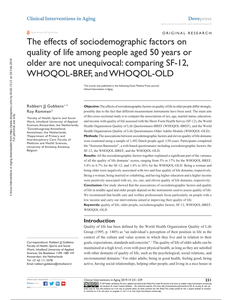
Objective: The effects of sociodemographic factors on quality of life in older people differ strongly, possibly due to the fact that different measurement instruments have been used. The main aim of this cross-sectional study is to compare the associations of sex, age, marital status, education, and income with quality of life assessed with the Short-Form Health Survey (SF-12), the World Health Organization Quality of Life Questionnaire-BREF (WHOQOL-BREF), and the World Health Organization Quality of Life Questionnaire-Older Adults Module (WHOQOL-OLD). Methods: The associations between sociodemographic factors and eleven quality of life domains were examined using a sample of 1,492 Dutch people aged $50 years. Participants completed the “Senioren Barometer”, a web-based questionnaire including sociodemographic factors, the SF-12, the WHOQOL-BREF, and the WHOQOL-OLD. Results: All the sociodemographic factors together explained a significant part of the variance of all the quality of life domains’ scores, ranging from 5% to 17% for the WHOQOL-BREF, 5.8% to 6.7% for the SF-12, and 1.4% to 26% for the WHOQOL-OLD. Being a woman and being older were negatively associated with two and four quality of life domains, respectively. Being a woman, being married or cohabiting, and having higher education and a higher income were positively associated with six, six, one, and eleven quality of life domains, respectively. Conclusion: Our study showed that the associations of sociodemographic factors and quality of life in middle-aged and older people depend on the instruments used to assess quality of life. We recommend that health care and welfare professionals focus particularly on people with a low income and carry out interventions aimed at improving their quality of life.
DOCUMENT
Alongside the growing number of older persons, the prevalence of chronic diseases is increasing, leading to higher pressure on health care services. eHealth is considered a solution for better and more efficient health care. However, not every patient is able to use eHealth, for several reasons. This study aims to provide an overview of: (1) sociodemographic factors that influence the use of eHealth; and (2) suggest directions for interventions that will improve the use of eHealth in patients with chronic disease. A structured literature review of PubMed, ScienceDirect, Association for Computing Machinery Digital Library (ACMDL), and Cumulative Index to Nursing and Allied Health Literature (CINAHL) was conducted using four sets of keywords: “chronic disease”, “eHealth”, “factors”, and “suggested interventions”. Qualitative, quantitative, and mixed-method studies were included. Four researchers each assessed quality and extracted data. Twenty-two out of 1639 articles were included. Higher age and lower income, lower education, living alone, and living in rural areas were found to be associated with lower eHealth use. Ethnicity revealed mixed outcomes. Suggested solutions were personalized support, social support, use of different types of Internet devices to deliver eHealth, and involvement of patients in the development of eHealth interventions. It is concluded that eHealth is least used by persons who need it most. Tailored delivery of eHealth is recommended
DOCUMENT

Empirical studies in the creative arts therapies (CATs; i.e., art therapy, dance/movement therapy, drama therapy, music therapy, psychodrama, and poetry/bibliotherapy) have grown rapidly in the last 10 years, documenting their positive impact on a wide range of psychological and physiological outcomes (e.g., stress, trauma, depression, anxiety, and pain). However, it remains unclear how and why the CATs have positive effects, and which therapeutic factors account for these changes. Research that specifically focuses on the therapeutic factors and/or mechanisms of change in CATs is only beginning to emerge. To gain more insight into how and why the CATs influence outcomes, we conducted a scoping review (Nstudies = 67) to pinpoint therapeutic factors specific to each CATs discipline, joint factors of CATs, and more generic common factors across all psychotherapy approaches. This review therefore provides an overview of empirical CATs studies dealing with therapeutic factors and/or mechanisms of change, and a detailed analysis of these therapeutic factors which are grouped into domains. A framework of 19 domains of CATs therapeutic factors is proposed, of which the three domains are composed solely of factors unique to the CATs: “embodiment,” “concretization,” and “symbolism and metaphors.” The terminology used in change process research is clarified, and the implications for future research, clinical practice, and CATs education are discussed.
DOCUMENT

Abstract Background: Multidimensional frailty, including physical, psychological, and social components, is associated to disability, lower quality of life, increased healthcare utilization, and mortality. In order to prevent or delay frailty, more knowledge of its determinants is necessary; one of these determinants is lifestyle. The aim of this study is to determine the association between lifestyle factors smoking, alcohol use, nutrition, physical activity, and multidimensional frailty. Methods: This cross-sectional study was conducted in two samples comprising in total 45,336 Dutch communitydwelling individuals aged 65 years or older. These samples completed a questionnaire including questions about smoking, alcohol use, physical activity, sociodemographic factors (both samples), and nutrition (one sample). Multidimensional frailty was assessed with the Tilburg Frailty Indicator (TFI). Results: Higher alcohol consumption, physical activity, healthy nutrition, and less smoking were associated with less total, physical, psychological and social frailty after controlling for effects of other lifestyle factors and sociodemographic characteristics of the participants (age, gender, marital status, education, income). Effects of physical activity on total and physical frailty were up to considerable, whereas the effects of other lifestyle factors on frailty were small. Conclusions: The four lifestyle factors were not only associated with physical frailty but also with psychological and social frailty. The different associations of frailty domains with lifestyle factors emphasize the importance of assessing frailty broadly and thus to pay attention to the multidimensional nature of this concept. The findings offer healthcare professionals starting points for interventions with the purpose to prevent or delay the onset of frailty, so communitydwelling older people have the possibility to aging in place accompanied by a good quality of life.
DOCUMENT

Background: More knowledge about characteristics of children and adolescents who need intensive levels of psychiatric treatment is important to improve treatment approaches. These characteristics were investigated in those who need youth Assertive Community Treatment (youth-ACT). Method: A cross-sectional study among children/adolescents and their parents treated in either a regular outpatient clinic or a youth-ACT setting in a specialized mental health treatment center in the Netherlands. Results: Child, parent and family/social context factors were associated with treatment intensification from regular outpatient care to youth-ACT. The combination of the child, parent, and family/social context factors adds substantially to the predictive power of the model (Nagelkerke R2 increasing from 36 to 45% for the three domains separately, to 61% when all domains are combined). The strongest predictors are the severity of psychiatric disorders of the child, parental stress, and domestic violence. Conclusions: Using a wide variety of variables that are potentially associated with treatment intensification from regular outpatient clinic to youth-ACT, we constructed a regression model illustrating a relatively strong relation between the predictor variables and the outcome (Nagelkerke R2 = 0.61), with three strong predictors, i.e. severity of psychiatric disorders of the child, parental stress, and domestic violence. This emphasizes the importance of a system-oriented approach with primary attention for problem solving and stress reduction within the system, in addition to the psychiatric treatment of the child, and possibly also the parents. Auteurs: Vijverberg, R., Ferdinand, R., Beekman, A., & van Meijel B.
LINK
The relationship between socioeconomic factors and crime is a classic theme in criminological literature. However, the relationship between debt and crime is still unclear, and little is known about the causality of this relationship and the factors that influence it. In addition, effective interventions and guidelines to adequately support offenders with debt are limited. Therefore, this thesis aims to systematically gain more insight into the factors that influence the relationship between debt and crime among probation clients and to contribute to developing tools that probation officers and other forensic social professionals can use to support clients with debt adequately. The relationship between debt and crime was studied by (1) a systematic and scoping literature review (5 studies were included in the systematic review and 24 studies in the scoping review), (2) a client file study including risk assessment data of a sample of 250 Dutch probation clients, (3) a quantitative study including recidivism data of the same sample of 250 Dutch probation clients, (4) interviews with 33 Dutch probation officers and 16 clients, and (5) a multiple case study focusing on working elements in the supervision of individual offenders (5 cases). The results show that debt is prevalent among probation clients, hinders resocialization, and increases recidivism risk. Debt and crime are not only related directly but are also related by a complex interplay of problems in different life domains, such as problems regarding childhood, education and work, and mental and physical health. Notwithstanding the strong relationship between debt and crime, financial assistance for probation clients with debts is limited. As debt is strongly related to problems in other life domains, a systematic collaboration between professionals of different disciplines is necessary to support clients with debt adequately.
DOCUMENT

Mexican oregano is a non-timber forest product harvested in natural vegetation and represents an important source of income for rural families. Recent reports have highlighted decreases in natural populations caused by increased harvest intensity. Oregano leaf harvesting is a complex problem, involving different components and views, and has a clear spatial dimension. We proposed an analytical framework based on multi-criteria-multi-objective analyses. GIS tools were used as the platform for managing, displaying and analyzing ecological and socioeconomic information from different sources in order to evaluate land suitability of three different management strategies for two competing land objectives: oregano Harvest and oregano Regeneration. The incorporation of environmental evaluation criteria in the analysis allowed the identification of new potential oregano harvesting areas which were neither reported by harvesters, nor registered during harvesting trips. Socio-economic criteria, such as land tenure, highlighted the fact that a substantial proportion of current oregano harvesting areas are located outside ejido limits resulting in potential conflicts for resource access. The proposed Balanced oregano management strategy, in which the same proportion of suitable area (50%) was assigned to both objectives, represents the most favorable management strategy. This option allows harvesters to continue earning an income from oregano leaf harvest; and at the same time helps in the selection of the best areas for oregano regeneration. It also represents a management strategy with a smaller impact on oregano populations and on the harvesters ́ income, as well as lower monitoring costs. The proposed analytical frame-work may contribute to advance the application of systematic approaches for solving decision-making problems in areas where oregano leaves and other NTFP are harvested.
DOCUMENT

Very little is known about the personal goals of homeless people and how these relate to their quality of life (QoL). By using survey data on 407 homeless adults upon entry to the social relief system in 2011, we examined the personal goals of homeless adults and the association between their perceived goal-related self-efficacy and their QoL. A hierarchical regression analysis was used to analyse the association between QoL and goal-related self-efficacy, relative to factors contributing to QoL, such as demographic characteristics, socioeconomic resources, health and service use. Results indicate that the majority of homeless adults had at least one personal goal for the coming 6 months and that most goals concerned housing and daily life (94.3%) and finances (83.6%). The QoL of homeless adults appeared to be lower in comparison with general population samples. General goal-related self-efficacy was positively related to QoL (β = 0.09, P = 0.042), independent of socioeconomic resources (i.e. income and housing), health and service use. The strongest predictors of QoL were psychological distress (β = −0.45, P < 0.001), income (β = 0.14, P = 0.002) and being institutionalised (β = 0.12, P = 0.004). In conclusion, the majority of homeless adults entering the social relief system have personal goals regarding socioeconomic resources and their goal-related self-efficacy is positively related to QoL. It is therefore important to take the personal goals of homeless people as the starting point of integrated service programmes and to promote their goal-related self-efficacy by strength-based interventions.
DOCUMENT



