This paper compares different low-cost sensors that can measure (5G) RF-EMF exposure. The sensors are either commercially available (off-the-shelf Software Defined Radio (SDR) Adalm Pluto) or constructed by a research institution (i.e., imec-WAVES, Ghent University and Smart Sensor Systems research group (S3R), The Hague University of Applied Sciences). Both in-lab (GTEM cell) and in-situ measurements have been performed for this comparison. The in-lab measurements tested the linearity and sensitivity, which can then be used to calibrate the sensors. The in-situ testing confirmed that the low-cost hardware sensors and SDR can be used to assess the RF-EMF radiation. The variability between the sensors was 1.78 dB on average, with a maximum deviation of 5.26 dB. Values between 0.09 V/m and 2.44 V/m were obtained at a distance of about 50 m from the base station. These devices can be used to provide the general public and governments with temporal and spatial 5G electromagnetic field values.
DOCUMENT

As Vehicle-to-Everything (V2X) communication technologies gain prominence, ensuring human safety from radiofrequency (RF) electromagnetic fields (EMF) becomes paramount. This study critically examines human RF exposure in the context of ITS-5.9 GHz V2X connectivity, employing a combination of numerical dosimetry simulations and targeted experimental measurements. The focus extends across Road-Side Units (RSUs), On-Board Units (OBUs), and, notably, the advanced vehicular technologies within a Tesla Model S, which includes Bluetooth, Long Term Evolution (LTE) modules, and millimeter-wave (mmWave) radar systems. Key findings indicate that RF exposure levels for RSUs and OBUs, as well as from Tesla’s integrated technologies, consistently remain below the International Commission on Non-Ionizing Radiation Protection (ICNIRP) exposure guidelines by a significant margin. Specifically, the maximum exposure level around RSUs was observed to be 10 times lower than ICNIRP reference level, and Tesla’s mmWave radar exposure did not exceed 0.29 W/m2, well below the threshold of 10 W/m2 set for the general public. This comprehensive analysis not only corroborates the effectiveness of numerical dosimetry in accurately predicting RF exposure but also underscores the compliance of current V2X communication technologies with exposure guidelines, thereby facilitating the protective advancement of intelligent transportation systems against potential health risks.
MULTIFILE

This review offers a detailed examination of the current landscape of radio frequency (RF) electromagnetic field (EMF) assessment tools, ranging from spectrum analyzers and broadband field meters to area monitors and custom-built devices. The discussion encompasses both standardized and non-standardized measurement protocols, shedding light on the various methods employed in this domain. Furthermore, the review highlights the prevalent use of mobile apps for characterizing 5G NR radio network data. A growing need for low-cost measurement devices is observed, commonly referred to as “sensors” or “sensor nodes”, that are capable of enduring diverse environmental conditions. These sensors play a crucial role in both microenvironmental surveys and individual exposures, enabling stationary, mobile, and personal exposure assessments based on body-worn sensors, across wider geographical areas. This review revealed a notable need for cost-effective and long-lasting sensors, whether for individual exposure assessments, mobile (vehicle-integrated) measurements, or incorporation into distributed sensor networks. However, there is a lack of comprehensive information on existing custom-developed RF-EMF measurement tools, especially in terms of measuring uncertainty. Additionally, there is a need for real-time, fast-sampling solutions to understand the highly irregular temporal variations EMF distribution in next-generation networks. Given the diversity of tools and methods, a comprehensive comparison is crucial to determine the necessary statistical tools for aggregating the available measurement data.
MULTIFILE

Poster en begeleidende audio uit de guided tour van het Open Atelier van CoE Groen op 7 december 2023 over het project RhoC bulkdichtheidsmeter. De bulkdichtheid van de bodem wordt steeds belangrijker als bodemparameter. De bulkdichtheid kun je alleen meten door ongestoorde ringmonsters te nemen op verschillende dieptes in een profielkuil en deze in het lab te analyseren. Dit is specialistisch en tijdrovend werk. Een andere meting die wel snel is en vaak wordt gebruikt om verdichte grondlagen op te sporen, is met een penetrometer. Deze meet niet de bulkdichtheid maar de indringingsweerstand van de grond. Dit is niet om te rekenen naar bulkdichtheid en de indringingsweerstand is bovendien zeer gevoelig voor natte en droge omstandigheden, waardoor de metingen soms onbetrouwbaar zijn. Als mogelijke oplossing voor deze uitdaging om de bulkdichtheid te meten, wordt een sensor ontwikkeld die de bodembulkdichtheid van een volledig bodemprofiel meet.
MULTIFILE
A low-cost sensornode is introduced to monitor the 5G EMF exposure in the Netherlands for the four FR1 frequency bands. The sensornode is validated with in-lab measurements both with CW signals as for QAM signals and perform for both cases and for all frequency bands an error less than 1 dB for a dynamic range of 40 dB. This sensor is a follow up of the earlier version of our previously developed sensor and have substantial improvements in terms of linearity, error, and stability.
DOCUMENT

Purpose:The International Commission on Illumination (CIE) recommends researchers to investigate a widevariety of behavioural and health outcomes. However, researchers often investigate only a part of occupationalhealth (OH) in relation to light. A literature study (2002–2017) regarding the relationship between office lightingconditions and OH was performed to identify gaps and methodological issues.Method:The OH outcomes investigated in this paper were grouped according to the International Classificationof Diseases and analysed per category: physical and physiological health, mental health, eye health, sleep param-eters and visual comfort.Results:Findings from the literature study (20 eligible papers) showed that all OH aspects were mostly but notexclusively measured subjectively. Furthermore, most studies investigated only a fraction of office lighting par-ameters and OH aspects.Conclusions:It seems that Correlated Colour Temperature (CCT) and illuminance mainly correlate with OH.However, this may also be explained by gaps and methodological issues in studies described in eligible papers.Based on the literature study, an overview was composed elucidating gaps and methodological issues of officelighting and OH studies. It can be used to design and target the purpose of light and health research.
DOCUMENT

The inefficiency of maintaining static and long-lasting safety zones in environments where actual risks are limited is likely to increase in the coming decades, as autonomous systems become more common and human workers fewer in numbers. Nevertheless, an uncompromising approach to safety remains paramount, requiring the introduction of novel methods that are simultaneously more flexible and capable of delivering the same level of protection against potentially hazardous situations. We present such a method to create dynamic safety zones, the boundaries of which can be redrawn in real-time, taking into account explicit positioning data when available and using conservative extrapolation from last known location when information is missing or unreliable. Simulation and statistical methods were used to investigate performance gains compared to static safety zones. The use of a more advanced probabilistic framework to further improve flexibility is also discussed, although its implementation would not offer the same level of protection and is currently not recommended.
MULTIFILE

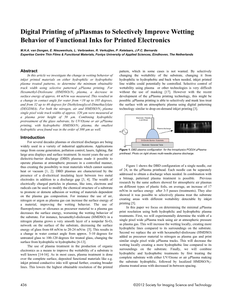
In this article we investigate the change in wetting behavior of inkjet printed materials on either hydrophilic or hydrophobic plasma treated patterns, to determine the minimum obtainable track width using selective patterned μPlasma printing. For Hexamethyl-Disiloxane (HMDSO)/N2 plasma, a decrease in surface energy of approx. 44 mN/m was measured. This resulted in a change in contact angle for water from <10 up to 105 degrees, and from 32 up to 46 degrees for Diethyleneglycol-Dimethaclylate (DEGDMA). For both the nitrogen, air and HMDSO/N2 plasma single pixel wide track widths of approx. 320 μm were measured at a plasma print height of 50 μm. Combining hydrophilic pretreatment of the glass substrate, by UV/Ozone or air μPlasma printing, with hydrophobic HMDSO/N2 plasma, the smallest hydrophilic area found was in the order of 300 μm as well.
DOCUMENT
Recent years have seen a global rise in the failure of tailings dams. Studies investigating the causes of slope failure often recognise high intensity rainfall events to significantly contribute to liquefaction, erosion and overtopping. This study aims to investigate the influence of alternative physical and geohydrological processes that, under tension saturation conditions, contribute to slope instability in tailings dams. It has been suggested that the generation of transient pressure wave mechanisms by high intensity rainfall events, surface ponding and wetting front advancement result in the formation of an induced pressure head that triggers the mobilization of pre-event water. In order to quantify these physical processes, this study included the analysis of rapid transmission conditions in a silica fines mix, with similar physical and hydraulic characteristics as platinum tailings. A tall leak-proof soil column, containing the soil sample compacted to in-situ dry bulk density, was fitted with seven observation ports. Each port consisted of a pore air pressure probe, a mini tensiometer and a time domain reflectometry probe. After set-up and initial stabilisation, three separate artificial high intensity rainfall events were applied to the surface. Monitoring of hydraulic state variables was recorded at thirty second intervals by automatic logging, thereby enabling the analysis of measured outcomes. Observations showed instant spikes in pore air pressure ahead of the wetting front, as well as a number of delayed responses. The interpretation of lab results led to the conclusion that pressure diffusion mechanisms throughout the porous medium, could result in the rapid release and mobilisation of previously stagnant antecedent moisture, thereby enabling phreatic levels to rising rapidly and in excess to the amount of surface infiltration. Also, since an increase in pore water pressure is likely to cause a reduction in shear strength, it is suggested that these physical and geohydrological processes could have an adverse impact on the stability of tailings dams.
MULTIFILE
Plasmid-mediated dissemination of antibiotic resistance among fecal Enterobacteriaceae in natural ecosystems may contribute to the persistence of antibiotic resistance genes in anthropogenically impacted environments. Plasmid transfer frequencies measured under laboratory conditions might lead to overestimation of plasmid transfer potential in natural ecosystems. This study assessed differences in the conjugative transfer of an IncP-1 (pKJK5) plasmid to three natural Escherichia coli strains carrying extended-spectrum beta-lactamases, by filter mating. Matings were performed under optimal laboratory conditions (rich LB medium and 37°C) and environmentally relevant temperatures (25, 15 and 9°C) or nutrient regimes mimicking environmental conditions and limitations (synthetic wastewater and soil extract). Under optimal nutrient conditions and temperature, two recipients yielded high transfer frequencies (5 × 10⁻¹) while the conjugation frequency of the third strain was 1000-fold lower. Decreasing mating temperatures to psychrophilic ranges led to lower transfer frequencies, albeit all three strains conjugated under all the tested temperatures. Low nutritive media caused significant decreases in transconjugants (−3 logs for synthetic wastewater; −6 logs for soil extract), where only one of the strains was able to produce detectable transconjugants. Collectively, this study highlights that despite less-than-optimal conditions, fecal organisms may transfer plasmids in the environment, but the transfer of pKJK5 between microorganisms is limited mainly by low nutrient conditions.
DOCUMENT




