The goal of this study was (1) to determine whether and how nursing home residents with dementia respond to the interactive art installation in general and (2) to identify whether responses change when the content type and, therefore, the nature of the interaction with the artwork changes. The interactive art installation ‘VENSTER’ evokes responses in nursing home residents with dementia, illustrating the potential of interactive artworks in the nursing home environment. Frequently observed responses were naming, recognizing or asking questions about depicted content and how the installation worked, physically gesturing towards or tapping on the screen and tapping or singing along to the music. It seemed content matters a lot. When VENSTER is to be used in routine care, the choice of a type of content is critical to the intended experience/usage in practice. In this study, recognition seemed to trigger memory and (in most cases) a verbal reaction, while indistinctness led to asking for more information. When (initially) coached by a care provider, residents actively engaged physically with the screen. Responses differed between content types, which makes it important to further explore different types of content and content as an interface to provide meaningful experiences for nursing home residents. •Implications for rehabilitation •VENSTER can facilitate different types of responses ranging from verbal reactions to active physical engagement. The choice of a type of content is critical to the intended experience/usage in practice. •Activating content seems suitable for use as a meaningful experience during the spare time in between existing activities or therapy. •Sessions with interactive content are short (avg. 30 mins) and intense and can therefore potentially be used as an activating therapy, activity or exercise. •In order to actively engage residents with dementia, the role of the care provider seems very important.
MULTIFILE

This paper reports the responses of nursing home residents who live in a psychogeriatric ward to the abstract interactive art installation ‘Morgendauw’, which was specifically designed for this study. All stakeholders were involved in designing and implementing Morgendauw. The artwork seems able to evoke responses in both the residents and their caregivers, but the amount and duration of the responses observed during the study were limited. 15 interactions over the course of 14 h were noted and almost all of them were initiated by the nursing home staff, physiotherapy students or visitors (n = 12). Interactions lasted for about 3 min on average. Although the nursing home residents initially did not seem to notice the artwork, the threshold of acknowledging and approaching the artwork was quickly overcome when staff nudged or directed the residents’ attention towards the artwork. Beyond this point, nursing home residents generally needed little explanation of the interface to interact with the artwork. The location in which Morgendauw was placed during the study or the characteristics of the installation seemed to create a threshold. Further research should focus on the importance and the effects of context when designing and implementing an interactive art installation in a nursing home environment.
DOCUMENT

The present study attempts to explore the field of creative music workshops with the elderly. A growing amount of research has been carried out into running (creative) workshops, and besides we know a lot about the elderly and ageing. The aim of this research is to gather knowledge on the merging of both subjects, creative music workshops with the elderly in the so-called ‘fourth age’. In particular, this research project has been carried out as a study of a potential professional field for musicians and music educators. For this reason the research objective is focused on the position of the workshop leader and what is needed to run creative music workshops with elderly in residential homes for the elderly successfully. We therefore aim to explore aspects connected to this practice such as entrepreneurship, musicianship and leadership.
DOCUMENT

Inaugural lecture, delivered upon public acceptance of the endowed professorship in Professionalisation of Nursing and Care in Elderly Care by Prof. Dr. Robbert J.J. Gobbens at Tilburg University on 29 September 2023.
DOCUMENT
A Dutch healthcare organisation modernizes its real estate portfolio to meet today’s requirements and acquired an office building for conversion into a nursing home for elderly with dementia. The purpose of the research has been to study the design principles for elderly with dementia, for innovative and smart application in work processes and the acquired building.Methods – Using multiple-method qualitative research design, bachelor thesis students of a university of applied sciences explored the reconstruction of the acquired building and related healthcare processes. Results – Application of design principles for the elderly with dementia were studied, among which were interior design, catering process, and connection with the neighbourhood. Feasible interior ideas were elaborated, intentions for change in the catering process were confirmed by stakeholders, and an action plan for neighbourhood connections was delivered. Elements are being used for a final design. Implementation has to be checked with close scrutiny.Originality – The application of design principles for elderly with dementia (design, favourable state, beautiful moments) together with changes in work processes of health care employees aiming at patient-centred care is a new combination. Practical or social implications – When a healthcare organisation chooses a new care concept, not only the surroundings change. Also, the processes around people and the way we take care of them change. In many ways a new concept can only succeed when the employees and the way they work change as well.
MULTIFILE

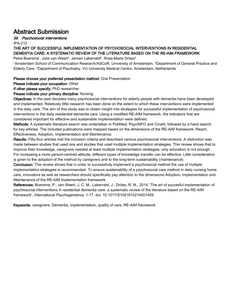
Presentatie gegeven over de review in Brussel Objectives: In the past decades many psychosocial interventions for elderly people with dementia have been developed and implemented. Relatively little research has been done on the extent to which these interventions were implemented in the daily care. The aim of this study was to obtain insight into strategies for successful implementation of psychosocial interventions in the daily residential dementia care. Using a modified RE-AIM framework, the indicators that are considered important for effective and sustainable implementation were defined.
MULTIFILE
In leaving the more traditional territories of the concert performance for broader societal contexts, professional musicians increasingly devise music in closer collaboration with their audience rather than present it on a stage. Although the interest for such forms of devising co-creative musicking within the (elderly) health care sector is growing, the work can be considered relatively new. In terms of research, multiple studies have sought to understand the impact of such work on musicians and participants, however little is known about what underpins the musicians’ actions in these settings. With this study, I sought to address this gap by investigating professional musicians’ emerging practices when devising co-creative musicking with elderly people. Three broad concepts were used as a theoretical background to the study: Theory of Practice, co-creative musicking, and Praxialism. Firstly, I used Theory of Practice to help understand the nature of emerging practices in a wider context of change in the field of music and habitus of musicians and participants. Theory of Practice enabled me to consider a practice as “a routinized type of behaviour which consists of several elements, interconnected to one another: forms of bodily activities, forms of mental activities, ‘things’ and their use, a background knowledge in the form of understanding, know-how, states of emotion, and motivational knowledge” (Reckwitz, 2002, p. 249). Secondly, I drew the knowledge from co-creative musicking, which is a concept I gathered from two existing concepts: co-creation and musicking. Musicking (Small, 1998), which considers music as something we do (including any mode of engagement with music), provided a holistic and inclusive way of looking at participation in music-making. The co-creation paradigm encompasses a view on enterprise that consists of bringing together parties to jointly create an outcome that is meaningful to all (Prahalad & Ramaswamy, 2004; Ramaswamy & Ozcan, 2014). The concept served as a lens to specify the jointness of the musicking and challenge issues of power in the engagement of participants in the creative-productive process. Thirdly, Praxialism considers musicking as an activity that encompasses “musical doers, musical doing, something done and contexts in which the former take place” (Elliott, 1995). Praxialism sets out a vision on music that goes beyond the musical work and includes the meanings and values of those involved (Silverman, Davis & Elliott, 2014). The concept allowed me to examine the work and emerging relationships as a result of devising co-creative musicking from an ethical perspective. Given the subject’s relative newness and rather unexplored status, I examined existing work empirically through an ethnographic approach (Hammersley & Atkinson, 2007). Four cases were selected where data was gathered through episodic interviewing (Flick, 2009) and participant observation. Elements of a constructivist Grounded Theory (Charmaz, 2014) were used for performing an abductive analysis. The analysis included initial coding, focused coding, the use of sensitizing concepts (Blumer 1969 in Hammersley, 2013) and memoing. I wrote a thick description (Geertz, 1973) for each case portraying the work from my personal experience. The descriptions are included in the dissertation as one separate chapter and foreshadow the exposition of the analysis in a next chapter. In-depth study of the creative-productive processes of the cases showed the involvement of multiple co-creative elements, such as a dialogical interaction between musicians and audience. However, participants’ contributions were often adopted implicitly, through the musicians interpreting behaviour and situations. This created a particular power dynamic and challenges as to what extent the negotiation can be considered co-creative. The implicitness of ‘making use’ of another person’s behaviour with the other not (always) being aware of this also triggered an ethical perspective, especially because some of the cases involved participants that were vulnerable. The imbalance in power made me examine the relationship that emerges between musicians and participants. As a result of a closer contact in the co-creative negotiation, I witnessed a contact of a highly personal, sometimes intimate, nature. I recognized elements of two types of connections. One type could be called ‘humanistic’, as a friendship in which there is reciprocal care and interest for the other. The other could be seen as ‘functional’, which means that the relationship is used as a resource for providing input for the creative musicking process. From this angle, I have compared the relationship with that of a relationship of an artist with a muse. After having examined the co-creative and relational sides of the interaction in the four cases, I tuned in to the musicians’ contribution to these processes and relationships. I discovered that their devising in practice consisted of a continuous double balancing act on two axes: one axis considers the other and oneself as its two ends. Another axis concerns the preparedness and unpredictability at its ends. Situated at the intersection of the two axes are the musicians’ intentionality, which is fed by their intentions, values and ethics. The implicitness of the co-creation, the two-sided relationship, the potential vulnerability of participants, and the musicians’ freedom in navigating and negotiation, together, make the devising of co-creative musicking with elderly people an activity that involves ethical challenges that are centred around a tension between prioritizing doing good for the other, associated with a eudaimonic intention, and prioritizing values of the musical art form, resembling a musicianist intention. The results therefore call for a musicianship that involves acting reflectively from an ethical perspective.
DOCUMENT

Abstract: This study sought to provide insight into how art activities influence the well-being of long-term care residents, and how artists and caregivers collaborate in offering these activities. In two long-term care facilities for people with dementia and one for older people with chronic psychiatric disorders, an uncontrolled pre- and post-test study was conducted using a mixed-method design. Forty-six residents participated in the study. Three art activities—(a) dance, (b) music and movement, and (c) visual arts—were studied and co-created with the residents and executed by artists and caregivers together in eight to ten weeks. The Face expression scale (FACE) was used to examine the extent to which participating in the art activity influenced resident mood. Qualitative data were collected via group discussions with artists, caregivers, residents, and an informal caregiver. The results indicated that participating in an art activity positively influenced resident mood (p < 0.000). p-values for the three art activities were: p < 0.000 for dance, p = 0.048 for music and movement, and p = 0.023 for visual arts. The qualitative data revealed that joining an art activity provided a positive effect, increased social relationships, and improved self-esteem for residents. The collaboration between artists and caregivers stimulated creativity, beauty, and learning from each other, as well as evoking emotions.
DOCUMENT

The “Age-Friendly Cities & Communities: States of the Art and Future Perspectives”publication presents contemporary, innovative, and insightful narratives, debates, and frameworks based on an international collection of papers from scholars spanning the fields of gerontology, social sciences, architecture, computer science, and gerontechnology. This extensive collection of papers aims to move the narrative and debates forward in this interdisciplinary field of age-friendly cities and communities. CC BY-NC-ND Book CC BY Chapters © 2021 by the authors Original book at: https://doi.org/10.3390/books978-3-0365-1226-6 (This book is a printed edition of the Special Issue Feature Papers "Age-Friendly Cities & Communities: State of the Art and Future Perspectives" that was published in IJERPH)
MULTIFILE

Onderzoek toont aan dat muziek en de kunsten het proces van gezond ouder worden in positieve zin beïnvloeden. Wat betekent werken in deze praktijk voor musici? Deze vraag wordt vanuit diverse invalshoeken onderzocht. en diversiteit aan onderzoeksprojecten maakt deel uit van deze onderzoekslijn:- Het leren bespelen van een instrument op oudere leeftijd - Het werken met ouderen in creatieve muziekworkshops - Workshops voor ouderen met dementie- Onderzoek naar de muzikale carrières van oudere beroepsmusici- Onderzoek naar de relatie tussen de ziekte van Parkinson en muziek
DOCUMENT




