The aim of this research is to assess the potential impact of the CO2 Performance Ladder on CO2 emission reduction. The CO2 Performance Ladder is a new green procurement scheme that has been adopted by several public authorities in the Netherlands; it is a staged certification scheme for energy and CO2 management. The achieved certification level gives companies a certain competitive advantage in contract awarding procedures. While the scheme has been widely adopted by companies in the construction industry, other types of companies in the supply chain of the commissioning parties also participate. Currently, more than 190 companies participate in the scheme. The aggregate CO2 emissions covered by the scheme are around 1.7 Mtonnes, which corresponds to almost 1 % of national greenhouse gas emissions in the Netherlands. Since the introduction of the scheme the total CO2 emissions have decreased substantially. Nevertheless, these emission reductions should be interpreted with caution since emission reductions are dominated by a few companies and are affected to a large extent by economic activity. Companies participating in the scheme have set different types of CO2 emission reduction targets with varying ambition levels. The projected impact of these targets on CO2 emissions is in the range of a 0.5 %-1.3 % absolute emission reduction per year, with a most likely value of 1.1 %. The CO2 Performance Ladder can therefore make a substantial contribution to achieving the CO2 emission reductions for non-ETS sectors in the Netherlands up to 2020.
DOCUMENT

The article evaluates the effectiveness of implementing a Dutch certifiable scheme for carbon reporting. This CO2 Performance Ladder is described as a energy management schemes and focuses on CO2 emission reduction in the construction industry sector. A literature study was combined with interviews.
DOCUMENT

Densely populated areas are major sources of air, soil and water pollution. Agriculture, manufacturing, consumer households and road traffic all have their share. This is particularly true for the country featured in this paper: the Netherlands. Continuous pollution of the air and soil manifests itself as acification, decalcification and eutrofication. Biodiversity becomes lower and lower in nature areas. Biological farms are also under threat. In case of mobility, local air pollution may have a huge health impact. Effective policy is called for, after high courts blocked construction projects, because of foreseen building- and transport-related NOx emissions. EU law makers are after Dutch governments, because these favoured economics and politics over environmental and liveability concerns. But, people in the Netherlands are strongly divided. The latest provincial elections were dominated by environmental concerns, next to many socio-economic issues. NOx and CO2 emissions by passenger cars are in focus. Technical means and increasing fuel economy norms strongly reduced NOx emissions to a still too high level. A larger number of cars neutralized a technological reduction of CO2 emissions. The question is: What would be the impact of a drastic mandatory reduction in CO2, NOx, and PM10 emissions on car ownership and use in the Netherlands? The authors used literature, scenario analysis and simulation modelling to answer this question. Electric mobility could remove these emissions. Its full impact will only be achieved if the grid-mix, which is still dominated by fossil fuels, becomes green(er), which is a gradual, long-term, process. EVs compete with other consumers of electricity, as many other activities, such as heating, are also electrifying. With the current grid-mix, it is inevitable that the number of km per vehicle per year is reduced to reach the scenario targets (−25% resp. −50% CO2 emissions by cars). This calls for an individual mobility budget per car user.
LINK
Energy management and carbon accounting schemes are increasingly being adopted as a corporate response to climate change. These schemes often demand the setting of ambitious targets for the reduction of corporate greenhouse gas emissions. There is however only limited empirical insight in the companies’ target setting process and the auditing practice of certifying agencies that evaluate ambition levels of greenhouse gas reduction targets. We studied the target setting process of firms participating in the CO2 Performance Ladder. The CO2 Performance Ladder is a new certifiable scheme for energy management and carbon accounting that is used as a tool for green public procurement in the Netherlands. This study aimed at answering the question ‘to what extent does the current target setting process in the CO2 Performance Ladder lead to ambitious CO2 emission reduction goals?’. The research methods were interviews with relevant stakeholders (auditors, companies and consultants), document reviews of the certification scheme, and an analysis of corporate target levels for the reduction of CO2 emissions. The research findings showed that several certification requirements for target setting for the reduction of CO2 emissions were interpreted differently by the various actors and that the conformity checks by the auditors did not include a full assessment of all certification requirements. The research results also indicated that corporate CO2 emission reduction targets were not very ambitious. The analysis of the target setting process revealed that there was a semi-structured bottom-up auditing practice for evaluating the corporate CO2 emission reduction targets, but the final assessment whether target levels were sufficiently ambitious were rather loose. The main conclusion is that the current target setting process in the CO2 Performance Ladder did not necessarily lead to establishing the most ambitious goals for CO2 emission reduction. This process and the tools to assess the ambition level of the CO2 emission reduction targets need further improvement in order to maintain the CO2 Performance Ladder as a valid tool for green public procurement.
DOCUMENT

Martien Visser concludeert dat er feitelijk bijzonder weinig reden is veel stampij te maken over de taxonomierichtlijn van de Europese Commissie, omdat die de weg baant naar zeer forse CO2-reducties.
LINK
Martien Visser roept de politiek en de rechterlijke macht op te stoppen met het nemen van deelbesluiten en strategisch en integraal te gaan denken en doen.
LINK
Snelle introductie van blauwe waterstof jaagt de innovatie aan. “Dat is belangrijk, want er moet nog veel ontwikkeld worden. De hele wereld kan daarvan profiteren. Blauwe waterstof biedt ons tevens de kans het elektriciteitssysteem in 2035 CO2-vrij te maken. Dat is thans een kansloze missie. Het belangrijkste argument is echter dat blauwe waterstof de mogelijkheid biedt meer maakindustrie in de EU te behouden zonder dat daarvoor de CO2-reductie ambitie te zeer hoeft te verwateren.”
LINK
The methodology should be a uniform approach that also is flexible enough to accommodate all combinations that make up the different solutions in 6 OPs. For KPIs A and B this required the use of sub-KPIs to differentiate the effects of each (individual and combination of) implemented solutions and prevent double counting of results. This approach also helped to ensure that all 6 OPs use a common way and scope to calculate the various results. Consequently, this allowed the project to capture the results per OP and the total project in one ‘measurement results’ template. The template is used in both the individual OP reports and the ‘KPI Results: Baseline & Final results’ report where all results are accumulated; each instance providing a clear overview of what is achieved. This report outlines the details of the methodology used and applied. It is not just meant to provide a clarification of the results of the project, but is also meant to allow others who are embarking on adopting similar solutions for the purpose of CO2 reduction, becoming more energy autonomous or avoid grid stress or investments to learn about and possibly use the same methodology.
DOCUMENT

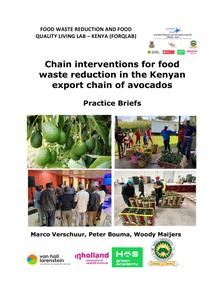
This booklet presents the practice briefs (popular papers) of master and bachelor theses and business assignments of students at three Dutch Universities of Applied Sciences: Van Hall Larenstein (VHL), InHolland and HAS Green Academy, and Meru University of Science and Technology in Kenya. All theses and business assignments were commissioned through the researchproject entitled “Food Waste Reduction and Food Quality Living Lab (FORQLAB)” in Kenya.
DOCUMENT
This study systematically evaluates greenhouse gas (GHG) emissions reporting practices of European airline groups, covering both mandatory and voluntary key performance indicators (KPIs) under evolving regulatory frameworks. By analysing annual and sustainability reports from 16 major airline groups, the research identifies significant progress in the reporting of core metrics, with Scope 1 CO2 totals reported by 94 % and emissions intensity by 88 %, reflecting growing regulatory alignment and stakeholder expectations. However, persistent gaps remain: Scope 2 and Scope 3 reporting appears in only 56 % and 50 % of cases, respectively, while non-CO2 emissions are disclosed by just 38 %, despite forthcoming European Union Emissions Trading System (EU ETS) monitoring requirements. Reporting on sustainable aviation fuels (SAF) life-cycle emissions is limited (19 %), and CO2 offsetting disclosures are rare (6 %), complicating verification of decarbonisation claims and readiness for ReFuelEU Aviation and Carbon Offsetting and Reduction Scheme for International Aviation (CORSIA). The proliferation of voluntary KPI disclosures further complicates comparability due to a lack of standardization and clear definitions. These challenges are compounded by risks of greenwashing, where airlines selectively report favourable data such as emissions intensity, and greenhushing, where substantive achievements are under-communicated. The study concludes that while regulatory frameworks such as the Corporate Sustainability Reporting Directive (CSRD), the EU ETS, CORSIA, and ReFuelEU are driving improvements, further harmonization and methodological clarity are required to ensure transparency, comparability, and genuine progress toward aviation's climate goals.
DOCUMENT